

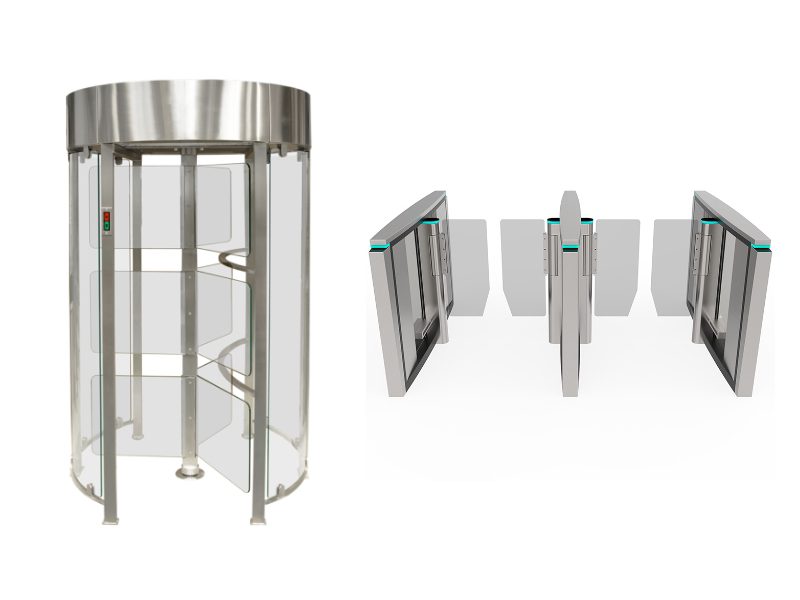
Waist-High vs. Full-Height Turnstiles: Stopping Tailgating
Every facility manager who has dealt with a tailgating incident knows how quickly a single unauthorized entry can spiral into a security breach, a compliance failure, or worse. The question is not whether you need turnstile access control — it is which type actually does the job. At Nexlar, we install and configure both waist high turnstiles and Full Height Turnstiles for commercial facilities across Houston, Dallas, San Antonio, Austin, Fort Worth, and San Marcos. After working with hundreds of clients on entry control projects, we have seen exactly where each system succeeds and where it falls short.
This guide breaks down the real differences between Waist-High vs. Full-Height Turnstiles so you can make a confident decision for your property.
Waist-High Aesthetics
When people picture a modern lobby, an open office park, or a corporate headquarters, they usually imagine a space that feels welcoming without looking like a checkpoint. That is where waist high turnstiles shine. These units typically stand between 36 and 40 inches tall, integrating smoothly into reception areas, gym entrances, transit terminals, and co-working spaces.
The appeal goes beyond appearance. A waist high turnstile processes people faster than its taller counterpart, making it a strong fit for venues with high throughput during peak hours. Think stadiums, convention centers, university libraries, or office buildings where hundreds of employees badge in during a short morning window. The lower height also keeps sightlines open, allowing security personnel at reception desks to observe the flow of traffic and respond to issues without craning over a six-foot barrier.
Modern waist high turnstile designs support a wide range of credential types — proximity cards, QR codes, biometrics, and mobile credentials — and can be integrated with your existing access control platform. When paired with optical sensors and alarm outputs, they deliver solid detection of unauthorized entries in supervised, low-risk environments.
The important caveat: a waist-high turnstile does not physically prevent a motivated person from stepping over or ducking under the arm. It deters opportunistic tailgating. It relies on the combination of social pressure, camera coverage, and nearby personnel to enforce access. For most corporate lobbies, fitness centers, and transit hubs, that combination is entirely sufficient.
Full-Height Security
Full Height Turnstiles are a different category of solution entirely. Standing six to seven feet tall and built with solid steel construction, these units create a complete physical barrier from floor to ceiling — or close enough to it that neither jumping over nor sliding under is a realistic option. That makes them the appropriate choice wherever the cost of unauthorized entry is high.
Data centers, server rooms, pharmaceutical manufacturing floors, correctional facilities, critical infrastructure sites, and military installations all rely on Full Height Turnstiles because the stakes demand it. But you also see them in commercial settings: parking garages that manage ticketing revenue, stadiums that enforce ticket validation, and industrial facilities where safety compliance requires knowing exactly who is on the floor at any given time.
The trade-off is throughput and experience. A full-height unit processes one person at a time, with a complete rotation of the turnstile arm required for each entry. In environments with several hundred employees arriving simultaneously, this creates a need for more lanes. The mechanical footprint is also larger, and the aesthetic is industrial by nature — appropriate for a warehouse or utility plant, less so for a luxury apartment building.
One area where Full Height Turnstiles consistently outperform waist high turnstiles is unsupervised access points. A remote entrance to a utility corridor at 2 a.m. with no guard and no camera nearby needs a physical barrier, not a social deterrent. The full-height unit provides exactly that.
Best for Employee Entrances
The employee entrance question comes up constantly in our consultations, and the honest answer is that it depends on the risk profile of the facility rather than the size of the company.
For a professional services office, a medical clinic, or a retail headquarters, a waist high turnstile at the main employee entrance is a proven solution. It maintains a professional appearance, processes staff quickly, logs every credential event, and deters casual tailgating without creating a friction-heavy experience that employees resent. Pair it with security cameras, a visitor management system, and proper badging protocols, and the result is an access control layer that is both effective and user-friendly.
For a manufacturing plant, a pharmaceutical facility, a data center, or any location where one unauthorized person on the floor creates regulatory exposure or safety liability, the full-height unit is the correct choice for the employee entrance. The extra seconds each entry takes are an acceptable trade-off for a verifiable physical barrier that produces reliable audit logs.
In multi-zone facilities, we often recommend a hybrid approach: waist high turnstiles at lobby-level employee entrances and Full Height Turnstiles at secondary access points leading into restricted areas. That layered architecture gives you smooth daily flow while enforcing strict access at the zones where it matters most.
Tailgating Prevention Side by Side
To make the comparison concrete, here is how each system performs against the most common tailgating scenarios.
When an employee holds the door open for a colleague who forgot their badge, a waist high turnstile with a dual-sensor anti-passback configuration will log the violation and trigger an alert. A full-height unit will not open a second rotation until a valid credential is presented, making the scenario physically impossible rather than just logged after the fact.
When a visitor follows closely behind a badged employee, a waist high turnstile with standard spacing will detect the second person and alarm. A full-height turnstile physically cannot be piggybacked because the rotating arm completes its cycle and locks before the next person can enter.
When an intruder attempts forced entry, a full-height unit with crash-rated construction resists direct physical pressure in a way that a waist-high unit cannot. The mechanical strength of a full-height turnstile is simply not a design goal of a waist-high model.
For most supervised commercial environments, a quality waist high turnstile with proper sensor configuration and integration addresses the vast majority of tailgating scenarios effectively. For unsupervised, high-security, or liability-sensitive environments, Full Height Turnstiles are not optional — they are the minimum standard.
Integration and Technology Considerations
Neither waist high turnstiles nor Full Height Turnstiles operate in isolation. The value of either unit depends almost entirely on how well it integrates with the rest of your security infrastructure.
At Nexlar, our turnstile installations are always tied into the broader access control platform — whether that is Kantech, Avigilon, OpenPath, Kisi, or another system you are already running. We configure anti-passback rules, alarm outputs to your monitoring station, real-time event logging, and video verification triggers so that every access event is captured and actionable.
We also account for emergency egress requirements in every installation. Both waist-high and full-height units must comply with fire code egress standards, and the configuration of fail-safe versus fail-secure modes needs to match the occupancy type and local code requirements. That is a detail that matters enormously and is frequently overlooked in turnstile installations that are not handled by an experienced integrator.
Why Choose Nexlar for Your Turnstile Installation
At Nexlar, we do not sell turnstiles as standalone hardware. We design and install complete access control solutions that account for your facility layout, your credential ecosystem, your monitoring infrastructure, and your compliance requirements. Our team holds Texas license B14634, and every technician goes through a rigorous background check before stepping onto a client site.
We have secured more than 1,000 commercial facilities across Texas, working with Fortune 500 companies, government agencies, healthcare operators, and industrial facilities. When we recommend a waist high turnstile versus a Full Height Turnstile, that recommendation is based on a thorough on-site assessment — not a product catalog.
Our consultants are available for free on-site consultations throughout Houston, Dallas, San Antonio, Austin, Fort Worth, and San Marcos. We design the solution, handle the installation, integrate it with your existing systems, and provide ongoing maintenance and health checks to make sure your entry control never goes dark.
If you are evaluating Waist-High vs. Full-Height Turnstiles for a new facility or an upgrade project, contact Nexlar today at (281) 407-0768 or visit Nexlar to schedule your free consultation.
Frequently Asked Questions
Q. What is the main difference between waist high turnstiles and Full Height Turnstiles?
Waist high turnstiles stand approximately 36 to 40 inches tall and act as a deterrent and detection layer for tailgating. Full Height Turnstiles stand six to seven feet tall and create a complete physical barrier that cannot be stepped over or ducked under. The right choice depends on your security requirements, throughput needs, and whether the access point is supervised.
Q. Can a waist high turnstile prevent all tailgating?
No turnstile eliminates tailgating by itself. A waist high turnstile with dual-occupancy sensors, anti-passback rules, and alarm integration will detect and log virtually every tailgating attempt. However, a physically determined person can step over or around a waist-high unit if there is no nearby personnel or camera response. For zero-tolerance environments, Full Height Turnstiles provide the physical enforcement that waist-high models cannot.
Q. Which turnstile type is better for high-traffic employee entrances?
For professional office environments and corporate campuses with supervised entrances, waist high turnstiles handle high-volume traffic more efficiently. For industrial facilities, data centers, or any location with strict headcount compliance, Full Height Turnstiles are the appropriate choice even if they require more lanes to match throughput.
Q. Do Full Height Turnstiles slow down entry?
Yes, compared to waist high turnstiles. Each person must complete a full rotation of the arm, and the unit locks between each entry. In high-traffic environments, this is addressed by installing multiple lanes. The trade-off is accepted in high-security applications where physical access certainty is more important than speed.
Q. Can turnstiles be integrated with biometric readers and mobile credentials?
Both waist high turnstiles and Full Height Turnstiles support integration with a wide range of credential technologies including proximity cards, PIN pads, fingerprint readers, facial recognition, QR codes, and mobile access apps. The integration is handled through the access control platform rather than the turnstile hardware itself, so compatibility depends on your chosen system.
Q. How does Nexlar handle turnstile installation?
Nexlar conducts a free on-site assessment to evaluate your facility layout, access control platform, and security requirements before recommending a turnstile configuration. We handle the full installation, system integration, access control programming, and ongoing maintenance. Our service area covers Houston, Dallas, San Antonio, Austin, Fort Worth, and San Marcos.
Q. Are turnstiles compliant with fire code egress requirements?
Both types must comply with local fire code egress standards. In a fire alarm or power failure event, turnstiles are typically configured to fail-safe (unlocked) or fail-secure depending on the occupancy type and applicable code. Nexlar configures each installation in accordance with Texas fire code and building regulations.
Q. What industries use Full Height Turnstiles most commonly?
Full Height Turnstiles are most common in data centers, pharmaceutical manufacturing, corrections, utility and energy infrastructure, stadiums with ticketing revenue control, and any industrial facility with strict headcount or compliance requirements. Waist-high turnstiles are more common in corporate offices, transit hubs, fitness centers, universities, and retail environments.
Follow Us