

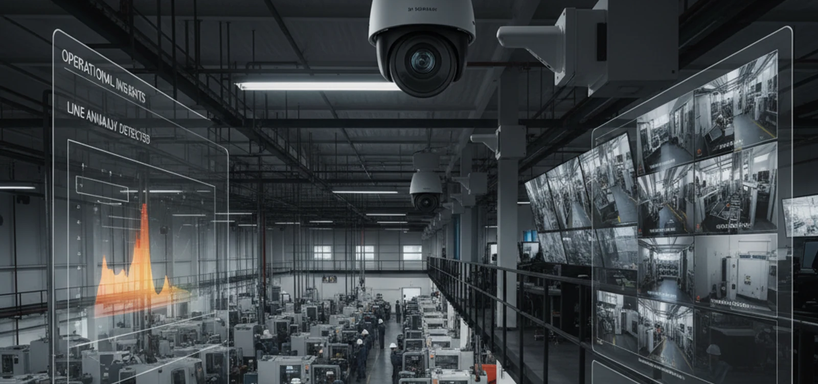
San Antonio’s manufacturing and heavy industry sector operates across the city’s South Side and Southeast industrial corridors, the Kelly Field / Port San Antonio campus, and the expanding industrial zones along IH-35 and IH-10. These operations include automotive components, food and beverage manufacturing, aerospace parts fabrication, distribution and logistics operations, and heavy equipment assembly.
For these facilities, the camera systems installed for security monitoring purposes are increasingly generating a second return on investment through video analytics capabilities that serve quality control and workplace safety functions alongside their original security role.
The shift is driven by AI-powered analytics software that can process the same camera feeds used for security recording and extract operational intelligence from them in real time. A camera that records the factory floor for security purposes can simultaneously analyze that recording for PPE compliance violations, assembly line anomalies, and process quality deviations using the same hardware and network infrastructure, adding analytics capability through software rather than separate sensor or hardware deployments.
For San Antonio manufacturing operators evaluating the business case for advanced camera systems, the combined security and analytics return makes the investment case significantly stronger than security value alone.
Get a Free Industrial Video Analytics Assessment for Your San Antonio Facility
Nexlar designs camera and analytics systems for San Antonio manufacturing, assembly, and heavy industry facilities. Contact Nexlar at nexlar.com/contact or call (281) 407-0768
AI Detection of Worker PPE Violations on San Antonio Factory Floors
Personal protective equipment compliance is one of the most persistent operational safety challenges in San Antonio manufacturing facilities. OSHA 29 CFR 1910.132 requires employers to provide and ensure the use of appropriate PPE in areas where hazards require it, and non-compliance with hard hat, safety vest, safety glasses, and other PPE requirements is both a regulatory violation and a direct contributor to workplace injury events. [1]
Traditional PPE compliance enforcement relies on supervisory observation, periodic safety walks, and self-reporting. Each of these mechanisms is intermittent and resource-intensive. A safety manager walking the floor once per shift cannot observe every worker in every area for the full duration of their shift, and the behavioral effect of infrequent observation is limited because workers know the observation is periodic.
AI video analytics applied to camera feeds on San Antonio factory floors provide continuous PPE compliance monitoring that does not depend on supervisory presence. The analytics system analyzes each camera feed in real time, using trained AI models to identify whether workers visible in the frame are wearing the required PPE for the specific area.
Hard hat detection identifies workers in designated hard hat zones who are not wearing head protection, generating a compliance alert that can be delivered to the area supervisor’s mobile device, displayed on a floor management screen, or logged for end-of-shift compliance reporting.
Safety vest detection identifies workers in visibility vest zones without the required high-visibility vest, using the distinctive color and retroreflective pattern of safety vests as the detection target.
Safety glasses detection is technically more demanding than hard hat or vest detection due to the smaller size and greater similarity to non-safety eyewear, but is available in systems from vendors including Intenseye, Protex.ai, and Axis Communications’ ACAP analytics partners. [2]
For San Antonio facilities under OSHA compliance programs with documented citation history, the ability to demonstrate continuous monitoring and documented compliance enforcement through video analytics records is a significant asset in OSHA inspection responses.
Monitoring Assembly Line Equipment for Jams and Performance Abnormalities
Beyond worker PPE compliance, AI video analytics for San Antonio manufacturing facilities addresses equipment performance monitoring applications that traditionally require dedicated sensor networks or manual operator observation.
Assembly line jams, conveyor belt stoppages, component feed anomalies, and equipment position deviations are the most common performance abnormalities on San Antonio manufacturing production lines. Traditional detection depends on sensors (which require installation at each monitoring point and maintenance over time), operator observation (which is limited by attention and shift coverage), or physical alarms triggered only when an abnormality reaches a critical threshold.
AI video analytics applied to cameras already covering the assembly line provides a continuous visual monitoring layer that identifies abnormalities earlier than sensor-triggered alarms or operator observation because it continuously evaluates the visual state of the line against the learned baseline of normal operation. [3]
Jam detection. When product accumulates at a point on the line beyond the normal flow pattern, the analytics system identifies the visual change in product distribution and generates an alert before the jam creates the full production stoppage that triggers physical alarms.
Equipment position monitoring. Robotic arms, die press positions, and fixture alignments have specific visual profiles during correct operation. AI systems trained on normal operation footage can identify when equipment position deviates from the learned baseline, alerting maintenance before the deviation causes a defective production run or equipment damage.
Throughput monitoring. Visual counting of product units passing through a specific point on the line provides real-time throughput data that can be compared against the production plan target, identifying rate deviations without requiring separate counting sensor installation.
For San Antonio food and beverage manufacturing facilities, visual inspection analytics that identify out-of-specification product characteristics on the production line before packaging provide a quality control layer that complements physical inspection stations.
Speeding Up Investigations: Searching Days of Footage in Minutes
The investigation value of AI video analytics is most dramatically demonstrated in situations where a San Antonio facility needs to review days of footage to find specific events, incidents, or patterns. Without analytics, this review requires human observers to watch footage in real time or at accelerated playback, spending hours or days to review what happened over a multi-day period.
AI-powered footage search transforms this process. Modern VMS platforms with AI analytics capability including Milestone XProtect with AI analytics plugins, Genetec Security Center with AI search, and Hanwha WiseNet WAVE with AI features allow operators to search recorded footage using natural language queries or visual criteria.
For a San Antonio manufacturing facility investigating a workplace injury that occurred somewhere on the factory floor at an unknown time during a 12-hour shift, an AI footage search for events matching “person on ground in Area B” returns the relevant clips from the full 12 hours within minutes, rather than requiring 12 hours of footage review. [3]
For an inventory discrepancy investigation covering a five-day period, an AI search for “person accessing loading dock area after 8 PM” returns all relevant clips from the five-day period sorted by time, allowing the investigator to review the actual access events without reviewing the full week of footage from every dock camera.
This investigation speed reduction has direct operational value for San Antonio manufacturing facilities: faster incident resolution, reduced staff time allocated to footage review, and better documentation of investigation methodology for OSHA or insurance purposes.
OSHA Documentation Benefits of Industrial Video Analytics
For San Antonio manufacturing facilities under active OSHA compliance programs, video analytics systems provide documentation benefits that extend beyond the real-time alert function to the OSHA inspection and compliance reporting context.
OSHA compliance programs for San Antonio facilities under Site Specific Targeting (SST) or National Emphasis Programs (NEP) require documented evidence of ongoing safety compliance efforts, not merely the absence of documented violations. Video analytics systems that generate continuous PPE compliance records, log detected violation events with timestamps and camera identification, and produce trend reports showing compliance rates over time provide exactly the type of documented continuous compliance monitoring that OSHA compliance programs recognize.
When OSHA citations are contested, documented video analytics records showing that the cited area was monitored continuously for PPE compliance and that compliance rates were above threshold during the inspection period are stronger evidence of reasonable compliance effort than supervisor attestations or periodic inspection records alone.
Nexlar’s commercial business security systems for San Antonio manufacturing facilities include analytics documentation configuration as part of every industrial camera project.
Camera Hardware for San Antonio Manufacturing Analytics Deployments
Industrial video analytics systems require camera hardware specifications that are more demanding than standard commercial security cameras, both because of the environmental conditions of manufacturing facilities and because of the image quality requirements of AI analytics processing.
Resolution. AI analytics accuracy for PPE detection and equipment monitoring improves with higher camera resolution. The analytics AI needs sufficient pixel density to reliably classify small objects such as safety glasses and hard hat brim profiles at the distances where workers are present in the camera’s field of view. 4MP to 8MP cameras provide the resolution needed for reliable analytics at typical factory camera mounting heights and working distances.
Frame rate. AI analytics for moving assembly line monitoring benefit from higher frame rates that provide more frequent image updates for equipment position and product flow analysis. Standard 15 fps recording is adequate for PPE compliance monitoring of relatively slow human movement, but 25 to 30 fps is preferred for assembly line equipment anomaly detection where rapid position changes are relevant.
Rugged industrial housings. San Antonio manufacturing environments expose cameras to dust, coolant mist, vibration from machinery, and temperature extremes that require IP66 or higher housings, IK08 or IK10 impact ratings, and operating temperature specifications appropriate for the specific factory environment.
Visit Nexlar’s San Antonio security systems page for industrial camera hardware options appropriate for San Antonio manufacturing environments.
Cost and Pricing for San Antonio Industrial Video Analytics Installations
| Installation Scope | Estimated Cost Range |
|---|---|
| PPE Analytics Camera (per camera with AI, installed) | $800 to $3,000 |
| Assembly Line Monitoring Camera (per position) | $1,000 to $4,000 |
| Small Factory (10 to 20 analytics cameras) | $12,000 to $40,000 |
| Mid-Size Facility (20 to 60 cameras, VMS with AI) | $30,000 to $90,000 |
| VMS Analytics License (per channel per year) | $100 to $400 |
| Edge Analytics Camera (ACAP-enabled, per unit) | $400 to $1,500 additional |
| Integration with Factory Management System | $5,000 to $15,000 |