

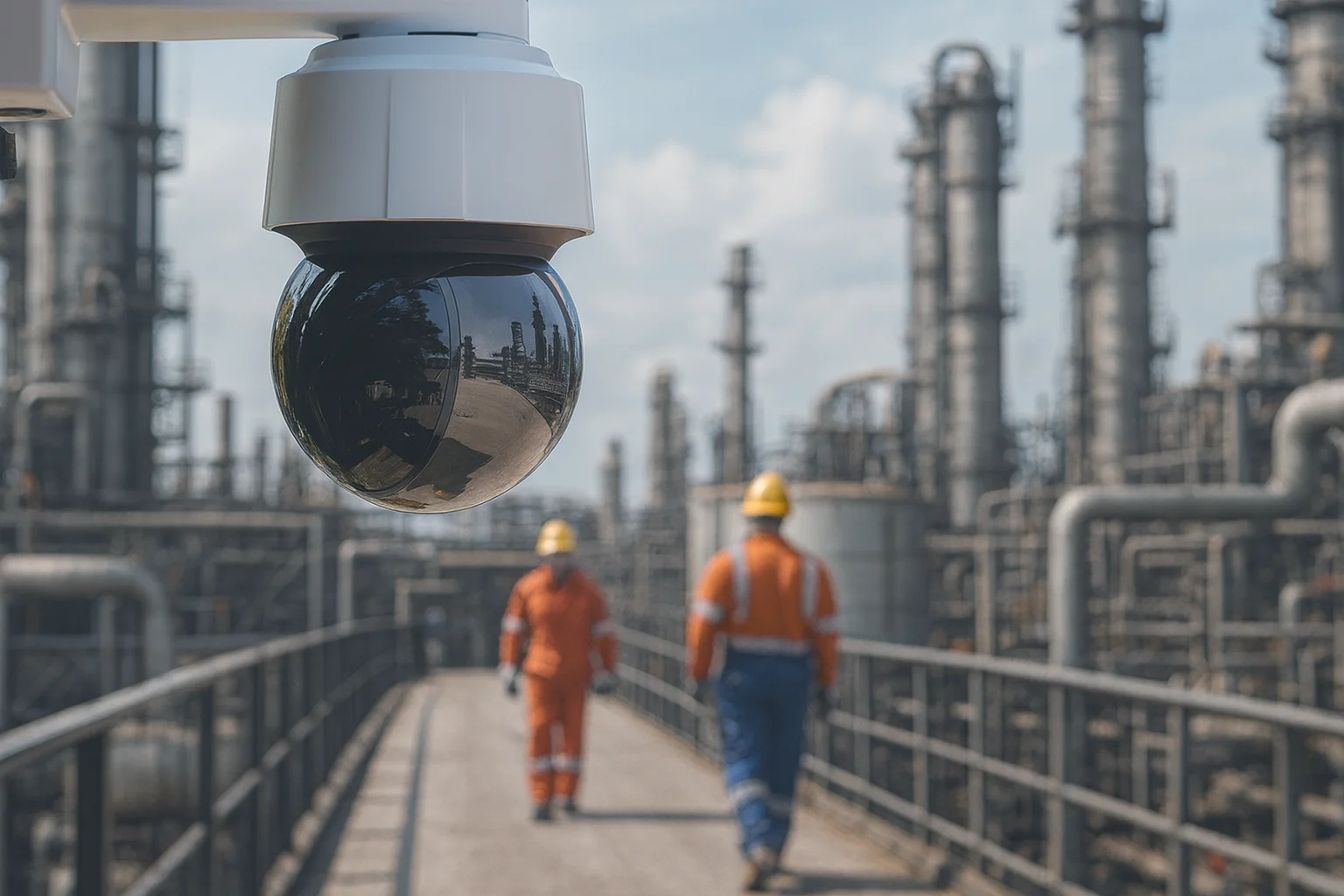
Standard commercial security cameras — even high-quality, outdoor-rated commercial cameras — cannot legally be installed in classified hazardous locations at Houston and Baytown refineries, petrochemical plants, and chemical processing facilities. This is not a specification preference. It is a code requirement with enforcement consequences.
The National Electrical Code (NEC), Article 500, establishes the classification system for hazardous locations — areas where flammable gases, vapors, liquids, combustible dust, or ignitable fibers are present in sufficient concentrations to create an ignition risk from electrical equipment. In these classified areas, all electrical equipment — including security cameras — must be specifically rated and listed for the hazardous location classification. Installing standard electrical equipment in a classified hazardous area is a code violation that creates immediate risk of explosive ignition and exposes the facility to OSHA enforcement action. [1]
Houston’s petrochemical corridor — spanning the Ship Channel refineries, the Baytown and Pasadena processing complexes, Texas City’s chemical facilities, and the La Porte industrial corridor — represents one of the highest concentrations of Class I hazardous locations in the United States. For every facility in this corridor that requires security camera coverage, explosion-proof or intrinsically safe camera hardware is not a specification upgrade — it is the only legally permissible hardware.
🔒 Free Hazardous Area Camera Assessment for Your Houston or Baytown Facility
Nexlar Security designs and installs explosion-proof and intrinsically safe security camera systems for Houston and Baytown petrochemical, refinery, and manufacturing facilities. NEC 500 compliant. 👉 Book Your Free Hazardous Area Assessment
NEC Article 500: Understanding Class I Division 1 and Division 2 Classifications
NEC Article 500 establishes two primary classification systems for hazardous locations in the United States: the Division system (Class I/II/III, Division 1 or 2) and the Zone system (Zone 0/1/2 for gas, Zone 20/21/22 for dust). Most legacy Houston petrochemical facilities use the Division classification system; some newer facilities and international-standard operations use the Zone system. [1]
Class I locations involve flammable gases, vapors, or liquids — the primary classification for Houston and Baytown refineries and petrochemical processing facilities.
Division 1 (Class I Div 1): Flammable concentrations exist or may exist under normal operating conditions, or exist frequently due to maintenance, repair, or leakage. Equipment in Class I Div 1 areas must be specifically designed and listed to prevent ignition of the surrounding atmosphere under normal operation. This is the highest-risk classification — the standard in process units, pump rooms, and areas with routine flammable gas presence. [1]
Division 2 (Class I Div 2): Flammable concentrations are not normally present but may occur in the event of an accident or equipment failure. Equipment in Class I Div 2 areas must be designed so that arcing or sparking contacts are enclosed to prevent ignition, or the equipment must use non-incendive circuit design. This classification applies to areas adjacent to Division 1 zones, outdoor process areas where vapors disperse quickly under normal conditions, and areas where flammable liquids are handled in closed systems. [1]
For security camera installations in Houston petrochemical facilities, the classification of each camera position must be determined by the facility’s certified electrical engineer or process safety team before camera hardware is specified — different areas within the same facility may carry different classifications that require different equipment ratings.
Deploying Class I Div 1 and Div 2 Rated Camera Housings
The defining feature of explosion-proof camera housing for Class I Div 1 applications is containment — the housing is designed to contain any internal explosion (from the camera’s own electrical components) within the housing, preventing the explosion from igniting the surrounding atmosphere. This containment is achieved through heavy-duty cast aluminum or stainless steel housing with close-tolerance machined flanges at all joints, specifically rated sealing surfaces, and no conduit openings that allow flammable atmosphere to contact the internal electrical components. [2]
Class I Div 1 camera housings:
The camera electronics (the camera module itself) are enclosed within the explosion-proof housing — a purpose-built enclosure that meets NEMA 7 (hazardous location) ratings and carries UL Listed or FM Approved certifications for the applicable NEC Division and Class. The housing is typically cast aluminum (for lighter-duty applications) or 316L stainless steel (for corrosive environments or applications requiring higher material resistance). All conduit connections use explosion-proof conduit fittings (EYS — conduit seal fittings — to prevent flammable vapors from traveling through conduit from the hazardous area to the non-hazardous area).
The camera module inside the housing is a standard IP camera — the explosion-proof function is provided by the housing, not the camera electronics themselves. This modular approach allows the camera inside to be updated as camera technology advances without requiring replacement of the entire explosion-proof housing.
Class I Div 2 camera housings:
Div 2 applications may use purged and pressurized enclosures (Type X, Y, or Z purging per NEC 500-8 and NFPA 496) as an alternative to the solid explosion-proof containment required for Div 1. A purged enclosure is continuously supplied with clean air or inert gas at positive pressure — preventing flammable atmosphere from entering the enclosure. Purged enclosure camera systems are common in control room video monitoring applications at Baytown and Pasadena refineries where continuous air supply is available.
Chemical-Resistant Stainless Steel Dome Structures for Houston Petrochemical Facilities
The Houston and Baytown petrochemical environment presents a secondary material challenge beyond the explosion containment requirement: chemical corrosion.
Process areas at Houston Ship Channel refineries, sulfur processing plants, and chemical manufacturing operations expose outdoor camera housings to airborne hydrogen sulfide, sulfur dioxide, chlorine, caustic mist, and other corrosive atmospheres. Standard aluminum explosion-proof housings — adequate for the electrical classification — may not provide adequate corrosion resistance for prolonged exposure to these chemical environments without surface coating maintenance.
316L stainless steel housings address this challenge directly. Grade 316L stainless offers substantially better corrosion resistance than standard 304 stainless and dramatically better than aluminum — particularly against chloride-containing environments and the sulfur compounds common in Houston’s refinery belt. [3]
Dome window materials:
The dome window through which the camera images must be optically clear must also be resistant to chemical exposure. Standard polycarbonate domes degrade from UV and chemical exposure within 12 to 24 months in Houston’s petrochemical environments. Borosilicate glass or sapphire glass windows provide the chemical and scratch resistance needed for long-term window integrity in Houston refinery camera installations.
316L stainless camera housing manufacturers for Houston petrochemical applications:
Pelco’s EP and EH series explosion-proof housings in stainless, Axis Communications’ XF series explosion-proof cameras with stainless housing options, and R. Stahl’s video camera housings in 316L stainless for process industry applications represent the primary hardware options Nexlar specifies for Houston and Baytown petrochemical camera installations with stainless requirements. [4]
Heat and Vibration-Resistant Sensors for Heavy Manufacturing Operations
Houston’s heavy manufacturing facilities — including the Baytown complex refinery operations and the structural steel, cement, and heavy equipment manufacturing operations on San Jacinto and around the Port — present a second set of environmental challenges: extreme heat at camera mounting positions near process equipment, and vibration from machinery, rotating equipment, and structural movement.
Heat resistance for Houston industrial camera positions:
Camera electronics — the image sensor, processing board, and power regulation components — have defined operating temperature ranges. Standard commercial cameras typically specify operating temperatures up to 60°C (140°F). Camera mounting positions near Houston refinery process equipment, furnaces, heat exchangers, and flare systems can expose camera housings to ambient temperatures well above this threshold.
Camera sensors and electronics specified for Houston high-heat industrial positions should carry operating temperature ratings to 70°C (158°F) or higher for extreme positions. Internal thermostatically controlled heaters are irrelevant for high-heat positions (they are used for cold environments) — for high-heat positions, the relevant specification is maximum operating temperature and the thermal management approach (ventilated housing with thermal separation from hot surfaces, or intrinsically low-power electronics that generate minimal self-heating). [5]
Vibration resistance:
Industrial machinery generates low-frequency, high-amplitude vibration that can, over time, cause fatigue failure of camera mounting hardware, PCB solder joint failure, and optical misalignment in fixed-focus cameras. For camera positions near rotating equipment, compressors, pumps, and structural members subject to equipment vibration, vibration-isolated mounting systems — shock-absorbing mounts between the camera housing and the structural attachment — are specified to decouple camera mounting from the vibration source.
Camera Housing Manufacturers for Houston and Baytown Hazardous Areas
Pelco (Schneider Electric) Pelco’s EP series explosion-proof housings are among the most widely installed in the North American petrochemical market, with UL and FM listings for Class I Div 1 and Div 2 applications. Pelco’s alliance program allows their explosion-proof housings to be equipped with a range of camera modules including high-definition IP cameras from current-generation platforms. [4]
Axis Communications XF Series Axis’s XF camera series includes purpose-built explosion-proof camera units with ATEX and UL certifications for Class I Div 1 and Zone 1 applications. The XF40-Q1765 and related models integrate Axis’s Lightfinder low-light sensor technology within an explosion-proof housing — providing the low-light performance Houston refinery operations require in 24/7 operation. [6]
R. Stahl German manufacturer with extensive international petrochemical installation history, R. Stahl’s camera housings and camera systems are specified at Houston Ship Channel facilities with international design-basis requirements or for facilities where the Zone classification system (Zone 1/Zone 2) rather than the Division system is applicable.
System Comparison Table
| Feature | Standard Commercial Camera | Outdoor Rated (IP67) | Explosion-Proof Class I Div 1 |
|---|---|---|---|
| NEC 500 Hazardous Area Compliance | No | No | Yes |
| UL/FM Listed for Hazardous Location | No | No | Yes |
| Chemical Corrosion Resistance | Basic (plastic housing) | Moderate (IP67 rated) | High (316L stainless option) |
| High-Temperature Rating | Standard (60°C max) | Standard (60°C max) | Extended (70°C+ rated options) |
| Vibration-Resistant Mounting | No | No | Yes (shock mounts available) |
| Conduit Seal Fittings Required | No | No | Yes (EYS seals required) |
| OSHA 29 CFR 1910.307 Compliant | No | No | Yes |
| Best For | Office / commercial | Outdoor non-hazardous | Refineries, petrochemical, classified areas |
Cost and Pricing for Houston and Baytown Hazardous Area Camera Installations
| Installation Scope | Estimated Cost Range |
|---|---|
| Single Explosion-Proof Camera (housing + camera + mount) | $2,500 – $7,000 |
| Class I Div 1 Camera with 316L Stainless Housing | $4,000 – $10,000 |
| Process Unit Camera Coverage (10–20 cameras) | $40,000 – $120,000 |
| Conduit and EYS Seal Installation (per camera) | $800 – $2,500 additional |
| Facility-Wide Hazardous Area Camera System | $100,000 – $500,000+ |
Note: Hazardous area camera costs are significantly higher than standard commercial camera installations due to classified hardware, specialized conduit requirements, and the engineering documentation required for classified location installations in Houston and Baytown industrial facilities.
💡 Explosion-Proof Camera Systems for Houston Refineries and Baytown Petrochemical Facilities
Nexlar installs NEC 500-compliant explosion-proof security cameras for Class I Div 1 and Div 2 locations in Houston and Baytown’s petrochemical corridor. 👉 Schedule Your Hazardous Area Camera Assessment