

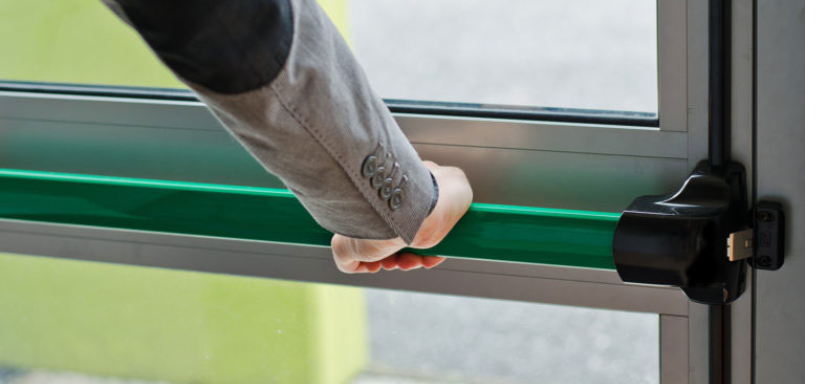
Panic hardware — the crash bars, exit devices, and emergency release mechanisms installed on commercial exit doors — sits at the intersection of two competing requirements that every Houston healthcare facility has to manage simultaneously.
On the life safety side, NFPA 101 and the International Building Code (IBC) require that occupants in a building emergency can always exit — that no locked door ever traps someone inside during a fire or evacuation, regardless of what the security requirements of that door are during normal operations. [1]
On the security side, healthcare facilities — hospitals, clinics, behavioral health units, memory care facilities, and pediatric wards — need to prevent certain patients from exiting without authorization. A memory care patient wandering through an unsecured exit door into a Houston parking lot at night is a safety emergency. A behavioral health patient exiting a secured unit without clinical clearance is a clinical and liability event.
Getting this balance right requires understanding which type of panic hardware is appropriate for each door, how that hardware integrates with the facility’s access control system, and what the AHJ (Authority Having Jurisdiction) — in Houston, typically the city fire marshal or local building department — requires for your specific occupancy classification.
Getting it wrong has two possible consequences: a facility that fails a fire inspection and faces code violations, or one that allows an at-risk patient to exit unsupervised. Neither is acceptable.
Nexlar Security installs NFPA 101-compliant panic hardware and exit devices for healthcare facilities across Houston, in coordination with fire marshal requirements and integrated with centralized access control systems.
🔒 Get a Free Panic Hardware Assessment for Your Houston Facility
Nexlar Security evaluates exit door compliance, delayed egress suitability, and access control integration for Houston healthcare facilities. Fully licensed and fire marshal compliant. 👉 Book Your Free Onsite Assessment
NFPA 101 Life Safety Code Requirements for Houston Healthcare Facilities
NFPA 101, the Life Safety Code, is the primary standard governing emergency egress in commercial buildings — including Houston healthcare facilities. It is adopted and enforced through Texas state and local building codes and Houston fire marshal requirements. [2]
The foundational principle of NFPA 101 egress requirements is that occupants must be able to exit a building during an emergency without specialized knowledge or keys. For healthcare facilities — classified as Health Care Occupancies under NFPA 101 Chapter 18 and 19 (new and existing, respectively) — this means exit doors must generally be operable from the inside with a single motion (the push of a crash bar) without requiring a key, tool, or special knowledge. [2]
However, NFPA 101 Chapter 18/19 also specifically addresses the unique needs of healthcare occupancies — particularly the need to control the movement of patients who cannot be left to self-evacuate or who may exit unsafely. The code provides for specific controlled egress provisions that allow healthcare facilities to delay egress from certain doors, under specific conditions that include patient safety justification, authority having jurisdiction approval, and staff response capability. [2]
Key NFPA 101 requirements that directly affect Houston healthcare facility door hardware selection:
Section 7.2.1.6 — Delayed Egress. Allows egress doors in healthcare occupancies to be equipped with delayed egress hardware that delays the release of the door by up to 15 seconds (or 30 seconds with AHJ approval), provided specific alarm and signage requirements are met, the system releases immediately on fire alarm activation, and the delay can be overridden by building staff. [3]
Section 18/19.2.2.2 — Locking in Health Care Occupancies. Specifically addresses clinical needs locking — the ability to lock doors to protect patients who are a danger to themselves or others — under conditions including 24-hour supervision of locked areas, clinical necessity documentation, and staff override capability. [2]
Section 7.2.1.9 — Access-Controlled Egress. Allows egress doors to be access-controlled provided the door releases immediately (within 3 seconds) when a request-to-exit device is activated, the fire alarm panel activates, or a power failure occurs. [3]
These provisions are the technical basis for how Houston healthcare facilities balance life safety egress with patient security — and they require correct hardware selection, correct wiring, and correct integration with the fire alarm system to function as the code intends.
Types of Commercial Panic Hardware
Standard Rim Exit Devices (Panic Bars) The most common panic hardware type for commercial exit doors. A push bar mounted horizontally across the door releases a rim latch when pushed from the inside, allowing egress without a key. Appropriate for general commercial exit doors where free egress is required and no delay is needed. Available in fire-rated versions for fire-rated door assemblies. Common Houston healthcare applications: stairwell access doors, non-sensitive exit corridors. [4]
Vertical Rod Exit Devices Similar to rim devices in function but use vertical rods extending to top and bottom latches in addition to the latch at door height. Used on wide or double doors, and on doors that require a higher level of physical security when latched. Common applications in Houston healthcare: emergency department exit pairs, main entry vestibule doors.
Concealed Vertical Rod Exit Devices Vertical rod devices with the rod hardware concealed within the door itself rather than surface-mounted on the door face. Used where door aesthetics matter and in higher-security applications. Common applications: administrative areas, pharmaceutical storage exits.
Delayed Egress Exit Devices Exit devices with integrated electronic delayed egress functionality — when the device is pushed, a 15-second (or AHJ-approved 30-second) timer begins, an alarm sounds, and the door releases after the delay period unless a staff override is used. Fire alarm activation or power failure causes immediate release. [3]
The most commonly specified brands for Houston healthcare applications include Von Duprin (an Allegion brand), Dormakaba, and Corbin Russwin — all of which manufacture devices with proven fire-rating, ANSI/BHMA certification, and UL listing for commercial healthcare use.
Delayed Egress Crash Bars: Memory Care, Pediatrics, and Behavioral Health
Delayed egress hardware is the category that most directly addresses the patient safety challenge unique to Houston healthcare facilities serving populations that may attempt to exit unsafely.
Memory Care and Dementia Units Memory care residents may not be capable of safely navigating an exit or understanding where they are going. A door that opens freely is a wandering risk. A delayed egress device provides a 15-second window during which the door alarm alerts staff — who can reach the door and redirect the patient before the door releases. Combined with wander management systems (RFID tags worn by residents that trigger door alarms when a resident approaches), delayed egress devices in memory care applications provide both the legal egress compliance NFPA 101 requires and the patient safety protection clinical operations need. [5]
Under NFPA 101 provisions for healthcare occupancies, delayed egress in memory care settings is permitted with AHJ approval, appropriate signage on the door indicating the delayed egress function, staff override capability, and immediate release on fire alarm activation. [2]
Pediatric Units Pediatric wards — particularly those serving young children who may not understand or follow egress restrictions — use delayed egress devices to prevent unsupervised patient exit from secured clinical areas. The same NFPA 101 provisions apply as in memory care applications.
Behavioral Health and Psychiatric Units Behavioral health units often require the most robust door security in a healthcare facility — controlling movement of patients who may be at risk to themselves or others. NFPA 101’s clinical needs locking provisions (Section 18/19.2.2.2) allow full locking of doors in behavioral health occupancies with 24-hour supervision, clinical necessity documentation, and immediate staff override capability. [2]
The door hardware in behavioral health units is frequently the most complex in a Houston healthcare facility — combining delayed egress or full clinical needs locking hardware with request-to-exit devices, door position sensors, electric strikes or magnetic locks, and integration with the centralized access control system and the nurse call platform.
Fire-Rated Door Compliance for Houston Medical Facilities
In healthcare facilities, fire-rated door assemblies are required at specific locations defined by NFPA 101 and the applicable building code — corridor doors, stairwell enclosures, hazardous material storage rooms, and connections between occupancies with different fire rating requirements. [6]
A fire-rated door assembly is a system — the door, the frame, the hardware, and the installation — that has been tested and listed as a complete assembly. Every component of the assembly must be listed for the specific fire-rating required. A fire-rated door with non-listed hardware loses its rating. [6]
This has direct implications for panic hardware selection in Houston healthcare facilities: exit devices on fire-rated doors must carry the appropriate UL fire rating listing for that specific door rating (20-minute, 45-minute, 60-minute, 90-minute, or 3-hour). Mixing a standard commercial exit device with a fire-rated door assembly — even if the device otherwise meets NFPA 101 egress requirements — is a fire code violation that will be cited in a fire marshal inspection.
Common Houston fire marshal inspection findings related to door hardware include: non-listed hardware on fire-rated door assemblies, aftermarket modifications to fire-rated doors (holes, non-listed closers) that void the assembly rating, improper use of hold-open devices that prevent fire doors from closing during a fire, and delayed egress hardware that does not release immediately on fire alarm activation.
Nexlar’s healthcare installation process includes complete verification of fire rating requirements for each door position in the project scope, hardware specification matched to the door assembly’s rating, and close coordination with Houston fire marshal requirements for the applicable occupancy classification.
Integrating Exit Door Alarms with Access Control Systems
The integration of exit door hardware with the centralized access control system is where panic hardware moves from a purely code compliance function to an active security and operations tool.
Door Position Sensors Door position sensors (magnetic contacts) on every monitored door report the door’s open or closed state to the access control system in real time. A door held open beyond a defined threshold generates an alarm event. An emergency exit door that opens outside of authorized hours generates an immediate alert. This creates active monitoring of every door in the facility without requiring physical observation of each door. [7]
Request-to-Exit (REX) Devices Access-controlled egress doors that carry an electric strike or magnetic lock require a request-to-exit device to release the lock for egress — because the access control credential reader is on the entry side, not the egress side. REX devices detect motion on the egress side (using passive infrared) and release the lock automatically when an occupant approaches, without requiring any action by the occupant. This allows free egress while maintaining controlled entry — and the egress event is logged by the access control system as a door release event. [3]
Emergency Override Integration In healthcare facilities with delayed egress or clinical needs locking hardware, emergency override capability — the ability for a staff member with an authorized credential to release a locked door immediately — is both an NFPA 101 requirement and an operational necessity. Staff override is typically implemented through a dedicated credential reader or keyswitch on the secured side of the door, or through a software command from the access control management platform. [2]
Fire Alarm Integration All electronically locked or delayed egress doors in Houston healthcare facilities must be wired to release immediately upon activation of the building’s fire alarm panel — no credential, no delay, immediate release. This integration is both a code requirement and a fundamental life safety obligation, and it must be verified during commissioning of every door with electronic locking hardware. [3]
Nexlar’s healthcare security solutions include complete panic hardware and access control integration for Houston medical facilities — from initial hardware specification and fire rating verification through installation, fire alarm integration, and commissioning.
Common Panic Hardware Mistakes in Houston Healthcare Facilities
Using non-fire-rated hardware on fire-rated door assemblies. The most commonly cited violation in Houston fire marshal inspections of healthcare facilities. Every component of a fire-rated door assembly must be listed for that rating.
Installing delayed egress without AHJ approval. Delayed egress in healthcare occupancies requires authority having jurisdiction approval before installation. Houston facilities that install delayed egress hardware without the required approvals and signage face code enforcement findings.
Failing to integrate with the fire alarm panel. Electronically locked or delayed egress doors that don’t release on fire alarm activation fail both the NFPA 101 requirement and the fundamental life safety purpose of emergency egress. This is the most safety-critical integration step in any healthcare facility exit hardware installation.
Improper request-to-exit (REX) placement. REX sensors must be positioned to detect occupants approaching the door from the egress side — covering the full width of the door approach path. Improperly positioned REX sensors result in occupants being unable to exit without activating a held-open alarm, creating operational problems and potential egress interference.
Failing to maintain door closers and hardware. Fire-rated doors require closers that fully return the door to the latched position after each opening. Failed closers on fire-rated doors are a life safety violation — and in a healthcare facility, one of the most common findings in annual life safety compliance surveys.
Hardware Comparison Table
| Hardware Type | Free Egress | Delay Available | Fire-Rated Option | Access Control Integration | Typical Application |
|---|---|---|---|---|---|
| Standard Rim Panic Bar | Yes | No | Yes (UL listed) | Door position sensor | General exit corridors |
| Vertical Rod Panic Device | Yes | No | Yes (UL listed) | Door position sensor + REX | Wide/double exit doors |
| Delayed Egress Device | Yes (after delay) | Yes (15–30 sec) | Yes | Full integration + override | Memory care, pediatric units |
| Clinical Needs Lock | Staff control | Full lock | Yes | Full integration + staff override | Behavioral health, psychiatric |
| Access-Controlled Egress | Yes (REX) | No | Yes | Full: reader + REX + fire release | Secured clinical areas |
Cost and Pricing for Houston Healthcare Installations
| Scope | Estimated Cost Range |
|---|---|
| Standard Panic Bar Replacement (per door) | $600 – $1,500 |
| Delayed Egress Device (per door, hardware only) | $1,500 – $3,500 |
| Full Delayed Egress Installation (hardware + wiring + integration) | $2,500 – $5,000 per door |
| Clinical Needs Lock with Access Control Integration | $3,000 – $6,000 per door |
| Complete Exit Hardware Compliance Audit (facility-wide) | $2,000 – $6,000 |
| Fire Alarm Integration Per Door | $500 – $1,500 additional |