

Paging System for Manufacturing Plants: OSHA, Noise & Zoning
Table of Contents
- Why Manufacturing Plants Need a Purpose-Built Paging System
- How a Manufacturing Paging System Works
- Types of Paging Systems Used in Manufacturing Facilities
- Key Operational and Safety Benefits
- Key Challenges: OSHA Compliance, Noise, and Zoning
- OSHA Requirements for Manufacturing Facility Alarms
- How to Choose the Right Paging System for Your Plant
- Manufacturing Paging System Comparison Table
- Cost and Pricing for Manufacturing Installations
- Frequently Asked Questions
- Conclusion
- References
Introduction
Walk onto an active manufacturing floor and you immediately understand why standard commercial paging systems don't belong there. Machinery running at 85 to 100 decibels. Forklifts moving through production aisles. Press lines, conveyor systems, and ventilation units creating a constant wall of industrial noise. Workers wearing hearing protection as required by OSHA — and still struggling to hear communication directed at them from standard speakers.
Manufacturing facilities are one of the most acoustically and operationally demanding environments for any paging system installation. The stakes are high: a message that isn't heard during a machinery malfunction, a chemical spill, or an emergency evacuation isn't just a communication failure — it's a safety failure.
This guide from Nexlar Security gives Texas manufacturing operators, plant managers, and safety directors a complete picture of what a properly designed manufacturing paging system looks like — from OSHA compliance requirements and industrial speaker selection to zone planning and integration with your plant's safety infrastructure.
📞 Get Expert Paging Design for Your Manufacturing Facility
Nexlar Security offers FREE on-site consultations for Texas manufacturing plants and industrial facilities. Our licensed team designs systems that meet OSHA requirements and your operational communication needs. 👉 Book Your Free Site Survey Today
Why Manufacturing Plants Need a Purpose-Built Paging System
Manufacturing facilities have communication requirements that overlap with warehouses in some ways but present additional complexity in others. Where warehouses deal primarily with size and noise, manufacturing plants add the dimensions of machinery-specific safety protocols, chemical or process hazard communication requirements, precise shift and production line coordination, and often more rigorous OSHA compliance obligations.
A standard commercial paging system — the kind appropriate for an office building or retail store — cannot handle these demands. Standard ceiling speakers are acoustically inadequate in high-noise industrial environments. Standard analog amplifiers don't support the zone granularity needed to address different production lines, departments, and safety zones independently. And standard paging controllers can't integrate with the emergency stop systems, fire suppression systems, and hazmat alert protocols that manufacturing safety plans require.
Nexlar's commercial security and communication installations serve manufacturing and industrial facilities throughout Texas, and the pattern is consistent: plants that invest in purpose-built industrial paging systems report faster emergency response times, better shift coordination, fewer production delays caused by communication gaps, and stronger OSHA compliance posture.
How a Manufacturing Paging System Works
A manufacturing plant paging system follows the core signal flow of any commercial installation — input trigger, controller processing, zone routing, and speaker output — but with industrial engineering adaptations at every stage.
Input triggers in a manufacturing environment include microphones at supervisor stations, software interfaces on plant management workstations, SIP phone extensions, automated production system integrations, emergency pull stations on the plant floor, and connections from fire alarm panels and safety relay systems.
The central IP paging controller or multi-zone amplifier system processes each trigger, identifies the target zone based on the initiating source and the configured routing logic, and routes the audio signal to the appropriate speakers in that zone.
Industrial-grade speakers — horn speakers, high-output ceiling speakers, or explosion-proof units in hazardous areas — receive the signal and project audio at output levels designed to achieve intelligibility above the measured ambient noise floor of each zone. In areas where workers are required to wear hearing protection, the system is calibrated to achieve audio levels audible even through standard hearing protection devices.
For IP-based manufacturing paging systems, all of this can be automated. A fire alarm activation triggers an immediate evacuation broadcast to all plant zones. An emergency stop event on a specific production line can trigger a targeted safety alert to that zone. A shift change schedule broadcasts automatically at the programmed time across the entire facility.
Types of Paging Systems Used in Manufacturing Facilities
IP Multi-Zone Paging with Industrial Speakers
The recommended system for most modern Texas manufacturing plants. IP paging manages multiple production zones from a centralized software platform, supports automated event triggers from safety systems, integrates with access control and security cameras, and uses industrial-rated speakers appropriate for the noise levels and environmental conditions of each zone.
Analog Multi-Amplifier Zone Systems
Traditional analog systems using multiple zone amplifiers hardwired to industrial horn speakers or high-output ceiling units. Still functional for plants with established analog infrastructure, but limited in scalability, remote management, and integration with modern safety platforms. Most plants should plan for IP migration as part of their capital improvement cycle.
Explosion-Proof Paging Systems
Required for manufacturing facilities that handle flammable gases, vapors, dusts, or other hazardous materials in areas classified under NEC Article 500 (Class I, II, or III hazardous locations). Explosion-proof speakers, amplifiers, and junction boxes are specifically rated and certified for use in these environments. Installing standard commercial equipment in classified hazardous locations is both non-compliant and unsafe.
Visual Alert Integrated Systems
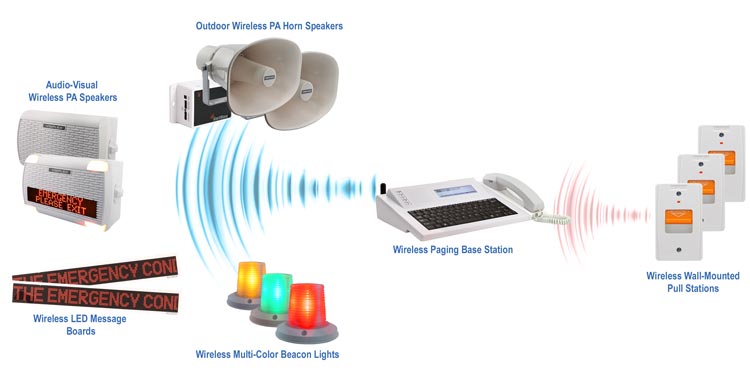
In zones where ambient noise levels are extreme enough that even high-output audio speakers cannot guarantee intelligibility — or where workers are wearing Class A hearing protection — visual alert devices such as strobe lights, LED warning beacons, or visual display panels must be integrated with the paging system to ensure emergency alerts are received. OSHA requires that employee alarm systems be perceptible above ambient sensory levels in the workplace.
Wireless Industrial Paging
For areas of the plant where running dedicated cabling is impractical — outdoor yard areas, remote outbuildings, or zones where cable routing would conflict with production equipment — wireless industrial paging speakers provide reliable coverage without cable infrastructure.
Key Operational and Safety Benefits
Immediate Plant-Wide Emergency Alerts A properly designed manufacturing paging system reaches every worker on every part of the plant floor simultaneously — ensuring that emergency evacuations, machinery stoppage orders, chemical spill responses, and safety alerts are communicated instantly to everyone who needs to act.
Precise Zone-Based Production Communication Zone control allows supervisors to address specific production lines, departments, or shift groups without broadcasting facility-wide. Shift change announcements to the assembly line don't interrupt the quality control team. Safety alerts for one production zone don't create unnecessary alarm in unaffected areas.
OSHA Compliance Support A properly designed and documented employee alarm system is a regulatory requirement under OSHA 1910.165 for most manufacturing operations. IP paging systems with event logging provide documentation of alarm system operation that supports OSHA compliance records and incident investigation.
Automated Safety and Emergency Triggers IP paging systems integrated with fire alarm panels, emergency stop relays, and process control systems can broadcast appropriate safety messages automatically when a triggering event occurs — eliminating the dependency on a supervisor manually initiating a page during an emergency scenario.
Integration with Plant Security Infrastructure When integrated with Nexlar's access control systems and security cameras, a manufacturing paging system becomes part of a comprehensive plant security platform — enabling coordinated responses to both safety and security incidents.
Improved Shift and Production Coordination Automated shift change schedules, production line announcements, and operational updates delivered through a reliable paging system reduce the time supervisors spend on manual communication tasks — freeing them to focus on production management.
Key Challenges: OSHA Compliance, Noise, and Zoning
OSHA Noise Exposure and the 85 dB Challenge
OSHA Standard 1910.95 requires a Hearing Conservation Program when workers are exposed to noise levels at or above 85 dB Time-Weighted Average (TWA). In manufacturing environments, ambient noise frequently reaches 85 to 100 dB or higher — meaning that standard ceiling speakers rated at 90–95 dB SPL provide little to no margin above the ambient noise floor. Speech intelligibility at these ambient levels requires industrial speakers rated at 105–115 dB SPL, positioned and angled to achieve measured sound pressure levels at worker ear height that exceed the ambient noise floor by at least 10–15 dB. This calculation must be based on measured ambient noise data, not assumptions.
Acoustic Diversity Within a Single Plant
A manufacturing facility contains a wide range of acoustic environments within the same building. Office areas and break rooms may have ambient noise levels of 55–65 dB. Production floors may reach 90–100 dB. Compressor rooms or hydraulic press areas may exceed 100 dB. Each zone requires different speaker specifications, output levels, and placement calculations. A single speaker type cannot serve all of these environments.
Hazardous Location Classification
Any manufacturing facility handling flammable materials, combustible dusts, or explosive vapors must identify and classify hazardous locations per NEC Article 500. Paging equipment installed in classified zones must be specifically rated and certified for that classification. This is not optional — it is a code requirement and a critical safety obligation.
Complex Zone Planning
Large manufacturing facilities with multiple production lines, departments, maintenance areas, quality control zones, shipping and receiving docks, and outdoor yard areas require careful zone planning. Zones must be mapped to both the physical geography of the plant and the operational communication logic — ensuring that the right message reaches the right team without creating unnecessary noise in unaffected areas.
OSHA Requirements for Manufacturing Facility Alarms
OSHA Standard 1910.165 establishes the following requirements for employee alarm systems in manufacturing facilities with more than ten employees:
The alarm system must be capable of alerting employees to the need for action in case of fire or other emergency. The alarm must be audible or visible above ambient noise or light levels in the work area. Alarm systems must be tested and maintained at regular intervals. Employers must establish procedures for sounding emergency alarms and must train employees in those procedures. Documentation of alarm system tests and maintenance must be retained.
For manufacturing plants where ambient noise levels make audio-only alarms insufficient, OSHA requires supplemental visual alarms — strobe lights or beacons — in affected work areas to ensure all employees receive emergency alerts regardless of noise exposure level or hearing protection use.
IP paging systems with automated event logging support OSHA documentation requirements by maintaining automatic records of every alarm activation, test event, and maintenance action with full timestamp detail.
How to Choose the Right Paging System for Your Plant
Conduct Measured Ambient Noise Surveys Do not select speakers or determine speaker count based on estimated noise levels. Conduct actual sound level measurements throughout the facility — during production operation, not during shutdown — to establish the real ambient noise floor in each zone. This data drives every speaker specification and placement decision.
Identify and Map All Hazardous Locations Before any equipment is specified, identify all NEC Article 500 classified hazardous locations in the facility and confirm that specified equipment carries the appropriate hazardous location rating for each area.
Define Zone Architecture Based on Operational Needs Map your plant zones to production lines, departments, safety zones, and support areas. Identify which zones always share messages (same zone) and which zones need independent communication (separate zones). Consider maintenance areas, outdoor loading yards, and office areas as separate zones from production floor areas.
Prioritize Integration with Safety Systems A manufacturing paging system should integrate with your fire alarm panel, emergency stop systems, and process safety infrastructure. Define the specific trigger events and the corresponding paging response for each before system design begins.
Choose IP for Scalability and Safety Integration IP paging systems are the recommended choice for manufacturing environments because they support advanced zone control, remote management, automated safety triggers, integration with security platforms, and compliance event logging that analog systems cannot provide.
Work with a Licensed Industrial Communication Specialist Manufacturing paging installations are complex technical projects. Texas Low Voltage License# B14634 is required for commercial low-voltage installation — and beyond licensing, experience with industrial acoustic environments and safety system integration is essential. Nexlar Security brings both.
Manufacturing Paging System Comparison Table
| Feature | Analog Multi-Zone | IP Industrial Paging | Explosion-Proof IP |
|---|---|---|---|
| High-Noise Coverage | Good (with horns) | Excellent | Excellent |
| Hazardous Location Rating | Limited | Limited | Yes |
| Zone Control | Limited | Advanced | Advanced |
| OSHA Alarm Documentation | No | Yes | Yes |
| Safety System Integration | No | Yes | Yes |
| Visual Alert Integration | No | Yes | Yes |
| Remote Management | No | Yes | Yes |
| Scalability | Low | High | High |
| Best For | Smaller non-hazardous plants | Most manufacturing environments | Classified hazardous zones |
Cost and Pricing for Manufacturing Installations
| Facility Size | Recommended System | Estimated Cost Range |
|---|---|---|
| Small Plant (under 20,000 sq. ft.) | Analog or Entry IP | $4,000 – $12,000 |
| Mid-Size Plant (20,000 – 75,000 sq. ft.) | Mid-Range IP | $12,000 – $35,000 |
| Large Plant (75,000 – 200,000 sq. ft.) | Enterprise IP Multi-Zone | $30,000 – $70,000 |
| Very Large or Multi-Building | Custom Multi-Zone IP | $60,000 – $150,000+ |
| Hazardous Location Zones (add-on) | Explosion-Proof Equipment | $5,000 – $25,000+ |
These estimates include industrial-grade speakers, IP controllers, cabling, zone configuration, safety system integration, and installation labor. Nexlar provides detailed, itemized project quotes after every free on-site assessment.
💡 Build a Manufacturing Paging System That Meets OSHA Standards
Nexlar's licensed team designs industrial paging systems calibrated to your plant's actual noise levels — not estimates — with full safety system integration and OSHA compliance documentation support. 👉 Schedule Your Free On-Site Survey Today
Frequently Asked Questions
Q: What type of paging system is best for a manufacturing plant?
A: An IP-based multi-zone paging system with industrial-grade, high-output horn speakers or high-directivity ceiling speakers is the recommended solution for most Texas manufacturing facilities. IP systems support advanced zone control, automated safety triggers from fire alarms and emergency stop systems, OSHA event logging, and integration with security cameras and access control. Speaker specifications must be determined by measured ambient noise surveys — not generic estimates — to ensure audio intelligibility above the plant's actual noise floor.
Q: Does OSHA require a paging system in a manufacturing plant?
A: OSHA Standard 1910.165 requires that manufacturing facilities with more than ten employees have an employee alarm system capable of alerting all workers to emergency situations. The alarm must be perceptible above the ambient noise and light levels of the workplace. In high-noise manufacturing environments, this typically requires industrial-grade audio speakers with sufficient output to exceed the ambient noise floor, supplemented by visual strobe alerts in areas where noise levels or hearing protection use make audio-only alarms insufficient.
Q: How do I make a paging system audible above manufacturing floor noise?
A: Achieving audible, intelligible paging in a manufacturing environment requires three elements: industrial speakers with SPL output ratings sufficient to exceed the measured ambient noise floor by at least 10 to 15 decibels, correct speaker placement and spacing based on acoustic coverage calculations for the specific noise levels and ceiling heights in each zone, and adequate amplifier power to drive the speaker system at the required output levels. A professional acoustic site survey with measured noise level data is essential before any speaker selection or placement decisions are made.
Q: What is an explosion-proof paging system?
A: An explosion-proof paging system uses speakers, amplifiers, junction boxes, and wiring methods specifically rated and certified for installation in areas classified under NEC Article 500 as hazardous locations — areas where flammable gases, vapors, combustible dusts, or fibers are present in concentrations that could cause an explosion. In these environments, standard commercial paging equipment cannot be used. Explosion-proof equipment is designed to contain any internal sparks or heat within an enclosure that prevents ignition of the surrounding hazardous atmosphere.
Q: How many zones does a manufacturing plant paging system need?
A: Zone requirements depend on the plant's operational structure and safety design. At minimum, separate zones are recommended for each distinct production area or line, office and break room areas, shipping and receiving docks, outdoor yard areas, and maintenance zones. Plants with hazardous locations may need additional zone separation between classified and non-classified areas. The goal is to enable targeted communication to specific areas and teams without broadcasting facility-wide when it's unnecessary.
Q: Can a manufacturing paging system be triggered automatically by a fire alarm?
A: Yes. IP-based manufacturing paging systems can be integrated with fire alarm panels so that a fire alarm activation automatically broadcasts a pre-programmed evacuation announcement to all designated zones — without requiring any manual operator action. This integration is critical in manufacturing environments where the speed of emergency response directly determines the safety of workers throughout the facility.
Q: What documentation does a manufacturing paging system need to support OSHA compliance?
A: OSHA 1910.165 requires that employee alarm systems be tested and maintained at regular intervals and that documentation of those tests be retained. IP paging systems with automatic event logging generate timestamped records of all alarm activations, scheduled test events, and system status — supporting both routine maintenance documentation and post-incident investigation records. Nexlar provides full system documentation including wiring diagrams, zone maps, test procedures, and maintenance schedules as part of every commercial installation.
Conclusion: Manufacturing Paging Systems Must Be Engineered, Not Installed
A manufacturing paging system is not a commercial installation with industrial speakers substituted in. It is an engineered safety communication system — designed around measured noise levels, OSHA compliance requirements, hazardous location classifications, and the specific operational communication needs of a production environment.
Getting it right requires acoustic engineering expertise, industrial equipment knowledge, safety system integration experience, and a thorough understanding of manufacturing operations. Cutting corners on any of these dimensions creates a system that looks installed but doesn't actually perform its safety function.
Nexlar Security designs and installs manufacturing paging systems for industrial facilities across Houston, Dallas, San Antonio, Austin, Fort Worth, and San Marcos. Our licensed team (License# B14634) brings the technical depth and industry experience that manufacturing safety communication demands.
Book your FREE on-site consultation today and let Nexlar design a manufacturing paging system that genuinely protects your workers and supports your OSHA compliance obligations.
References
- OSHA 1910.165 — Employee Alarm Systems Standard
- OSHA 1910.95 — Occupational Noise Exposure (Hearing Conservation)
- NFPA 72 — National Fire Alarm and Signaling Code (2022 Edition)
- NFPA 70 (NEC) — Article 500: Hazardous (Classified) Locations
- ANSI/ASA S12.60 — Acoustical Performance Criteria, Design Requirements and Guidelines for Schools
- Texas Department of Licensing and Regulation (TDLR) — Low Voltage Contractor Licensing
- Nexlar Security — Warehouse and Industrial Security: nexlar.com/warehouse-security-system
- Nexlar Security — Business Security Systems: nexlar.com/commercial-business-security-systems-installer
Follow Us