

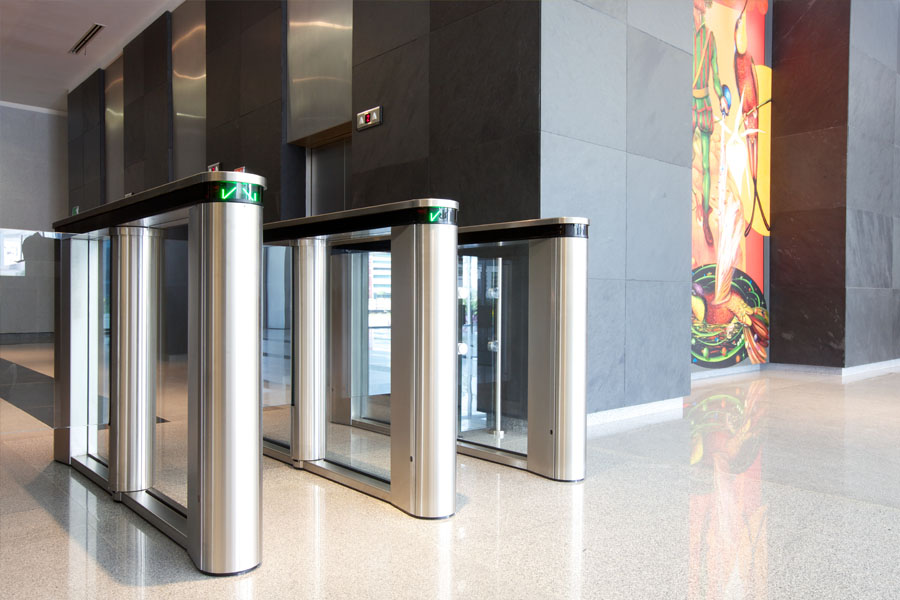
In Houston’s major commercial office districts — Downtown, the Galleria, Greenway Plaza, the Energy Corridor — the morning rush hour lobby experience at a large office building is one of the highest-volume, highest-risk security windows in the facility’s daily operation. Hundreds of employees, contractors, and visitors move through the lobby in a compressed time window. And in buildings relying only on a badge reader at the lobby entrance without a physical access control barrier, tailgating — one person following another through an access point without presenting their own credential — is essentially uncontrolled.
Optical turnstiles solve this problem with an elegant engineering approach: transparent glass panels that open for a verified badge presentation and remain closed otherwise, integrated into a lobby design that can enhance the visual aesthetic of the space while creating the physical credential verification barrier that a badge reader alone cannot provide.
For Houston commercial landlords, property managers, and corporate tenant security teams, optical turnstile installation is one of the most impactful access control improvements available for an existing lobby — and one of the most visible demonstrations of security infrastructure investment to prospective tenants evaluating the building.
📞 Get a Free Optical Turnstile Assessment for Your Houston Building
Nexlar Security offers FREE on-site consultations for Houston commercial office buildings considering optical turnstile installation. Our licensed team assesses your lobby layout and traffic patterns. 👉 Book Your Free Lobby Security Assessment Today
Why Houston Office Buildings Are Installing Optical Turnstiles
Tailgating is uncontrolled without a physical barrier — A badge reader that flashes green for an authorized credential cannot prevent the person behind that credential from walking through simultaneously. In a busy Houston office lobby, tailgating during high-traffic periods is the norm rather than the exception without a physical lane barrier.
Multi-tenant buildings have complex visitor management needs — In a multi-tenant Houston high-rise with multiple companies occupying different floors, the lobby serves as the security boundary for the entire building. A robust turnstile system with integrated visitor management allows the building to control who accesses each tenant’s floors without requiring security staff at every elevator bank.
Corporate tenant security requirements are increasing — Corporate tenants in Houston’s major office districts — particularly in the energy, financial services, and legal sectors — increasingly specify access control and tailgating prevention capability as a lease requirement or preferred feature when evaluating building options. Buildings without this infrastructure are at a competitive disadvantage in the Houston office leasing market.
Loss and security incidents occur most frequently during transition periods — Building theft, unauthorized access, and security incidents in Houston office buildings disproportionately occur during morning arrival and evening departure windows — exactly when lobby traffic density is highest and individual supervision is lowest.
How Optical Turnstile Systems Work
An optical turnstile is a physical access control lane consisting of one or more pedestrian-height panels — typically glass — mounted on a base housing that contains the optical sensors, the panel drive mechanism, the credential reader interface, and the access control integration components.
When an authorized employee presents their badge to the integrated or adjacent reader, the optical sensors confirm that no one is attempting to pass simultaneously, and the glass panels open to allow single-person passage. Once the person has passed, the panels close before the next person can be processed. Unauthorized passage attempts — someone attempting to enter without a valid credential, or a second person attempting to follow immediately behind an authorized person — trigger an alert from the optical sensors, which close the panels before the unauthorized person can pass and generate an access control alert.
The system integrates with the building’s access control platform: each turnstile passage event — badge presented, access granted, access denied — is logged with the credential, the specific lane, and the timestamp. Real-time alerts are sent to building security for access denied events or tailgating attempts.
For visitors — who don’t have building-issued badges — a receptionist or security desk attendant can grant passage through the turnstile remotely, typically by pressing a button at the security desk that opens a designated visitor lane, after the visitor has been checked in through the lobby visitor management system.
Types of Optical Turnstiles Available for Houston Lobbies
Full-Height Glass Panel Turnstiles (Optical Barriers) — The standard specification for most Houston corporate office lobbies. Transparent glass panels at chest to shoulder height open for verified credentials. The glass aesthetic maintains visual openness in the lobby while providing an effective physical barrier. Available in single-lane and multi-lane configurations to match lobby traffic requirements.
Half-Height Optical Lanes (Waist-Height) — Lower panel height offers a less imposing visual presence in lobbies where the architectural design requires minimal visual obstruction. Effective deterrent but slightly more susceptible to motivated tailgating than full-height panels.
Speedgates — Retractable barrier systems where the glass panels slide into the base rather than swinging open — allowing faster passage throughput during high-traffic periods while still providing a physical lane barrier. Common in high-rise Houston buildings with large tenant populations and significant morning rush traffic volumes.
ADA-Compliant Wide-Lane Configurations — ADA-compliant turnstile lanes are required in any installation — typically configured as a wider lane with swinging barrier arms rather than glass panels, allowing wheelchair and assistive device passage. Every Houston turnstile installation must include at least one ADA-compliant lane.
Tailgating Prevention in Houston Corporate Lobbies
The primary function of optical turnstiles in a Houston office lobby is tailgating prevention — ensuring that each person who passes through the lane has presented a valid credential, not simply followed someone who did.
Modern optical turnstile systems use multiple overlapping infrared sensor arrays across the passage width and length to detect the presence, direction, and count of persons in the lane. These sensors can distinguish between a single authorized person passing through and two people attempting to pass simultaneously — closing the panels and generating an alert in the latter case.
For Houston buildings with high badge credential compliance rates among employees, optical turnstiles reduce uncontrolled tailgating from a near-constant occurrence during rush hours to a rare, immediately alerted event. The visual deterrence effect — employees being visibly required to badge individually rather than walking through freely — reinforces credential compliance as a cultural norm in the building.
Integration with Badge Readers, Elevator Dispatch, and Guest Registration
The value of optical turnstile systems in Houston office buildings is significantly enhanced by integration with the building’s broader access control and visitor management infrastructure.
Badge Reader Integration — Credential readers can be integrated directly into the turnstile housing — either on a pedestal attached to the turnstile base or embedded in the turnstile column — creating a single, clear interaction point where each person badges and then passes through the opened lane.
Elevator Dispatch Integration — In Houston high-rise buildings where elevator access to specific floors is controlled, turnstile passage can trigger elevator dispatch authorization — ensuring that an employee who has badged through the turnstile can access their assigned floors on the elevator system, while visitors are restricted to building lobby-level access until separately authorized for elevator access.
Guest Registration and Lobby Visitor Management — For visitors, the turnstile system integrates with the building’s lobby visitor management platform: when a visitor checks in at the security desk, their check-in creates a time-limited authorization for a specific visitor lane, allowing them to pass through the turnstile to reach the elevators without a building-issued badge. Nexlar’s access control systems for Houston office buildings are designed with this integrated lobby security architecture as a standard offering.
Rush Hour Traffic Flow Planning for Houston High-Rises
Traffic flow planning is a critical and frequently underestimated component of optical turnstile installation in Houston high-rise buildings. A turnstile configuration that creates bottlenecks during peak arrival and departure periods creates operational problems — and drives the security workarounds (propped turnstile lanes, manually held-open lanes) that undermine the system’s security function.
Lane Count and Throughput — Each optical turnstile lane has a specific maximum throughput rate in persons per minute. This rate, multiplied by the number of lanes and adjusted for realistic credentialing time (including visitors and those fumbling for badges), must accommodate the building’s peak arrival volume within an acceptable time window.
Lane Mix: Employee vs. Visitor vs. ADA — The proportion of employee, visitor, and ADA-accommodating lanes should reflect the actual traffic composition during peak periods — not a default configuration. Houston buildings with high visitor volumes (law firm lobbies, financial services buildings with frequent client visits) need proportionally more visitor processing capability at the turnstile entry than headquarters buildings with primarily employee traffic.
Security Desk Sightlines — The security desk must have clear sightlines to all turnstile lanes — particularly the ADA lane, which is typically unmanned but used by anyone accompanying a person with a mobility limitation. Security desk positioning during the design phase, not after turnstile installation, ensures this.
Comparison Table: Optical Turnstile Options
| Feature | Full-Height Glass | Half-Height Optical | Speedgate |
|---|---|---|---|
| Tailgating Prevention | High | Medium | High |
| Throughput Speed | Standard | Standard | High |
| Visual Aesthetic | Premium | Open | Premium |
| ADA Lane Required | Yes | Yes | Yes |
| Elevator Integration | Yes | Yes | Yes |
| Best For | Corporate, law firm lobbies | Open-feel lobbies | High-rise, high-volume |
Cost and Pricing for Houston Turnstile Installation
| Configuration | Estimated Cost Range |
|---|---|
| Single Optical Turnstile Lane | $8,000 – $20,000 |
| 3-Lane Configuration (standard lobby) | $20,000 – $50,000 |
| 5+ Lane High-Rise Configuration | $40,000 – $100,000+ |
| Elevator Dispatch Integration | $5,000 – $20,000 additional |
| Visitor Management System Integration | $3,000 – $10,000 additional |