

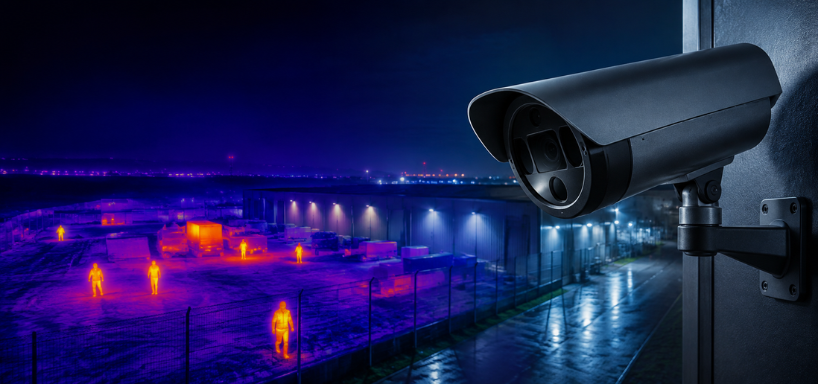
Houston’s metal recycling and scrap yard operations occupy a specific industrial security risk category that differs from most commercial and industrial facilities in two important ways. The security risks they face are not just property crime risks. They are catastrophic event risks where the failure to detect a developing situation early can result in outcomes that standard security systems and insurance policies cannot adequately address.
The first risk is fire. Metal scrap yards regularly accumulate materials that can develop internal heat due to chemical reactions within compressed metal piles, residual fluids in automotive scrap, lithium battery cells hidden in consumer electronics, and the friction and compression of heavy equipment operations. A developing hotspot in a scrap pile can progress from an undetectable internal temperature elevation to an open fire in hours. If it ignites in the middle of the night when the yard is unoccupied, the fire reaches full development before anyone detects it. The resulting loss is rarely limited to the scrap that burns: the fire spreads to the yard perimeter, to equipment, and in the worst cases to adjacent properties.
The second risk is copper and metal theft. Houston’s metal recycling yards are magnets for copper theft operations, which represent one of the most active organized theft categories in the greater Houston area. Thieves operating under cover of darkness, in a yard that has no visible light and where standard cameras are effectively blind, have the time and tools to remove significant quantities of copper wire, catalytic converters, and non-ferrous metals before detection.
Thermal imaging cameras address both risks with a single technology platform. They detect heat, not light, which means they operate equally effectively in pitch-black conditions and produce the early fire detection that visible-light cameras cannot provide.
Get a Free Thermal Camera Assessment for Your Houston Scrap Yard
Nexlar Security designs and installs thermal camera systems for Houston metal recycling yards and industrial operations. Contact Nexlar at nexlar.com/contact or call (281) 407-0768
How Thermal Imaging Works for Metal Recycling Yard Security
Thermal cameras detect infrared radiation (heat energy) emitted by all objects at temperatures above absolute zero. Every object in a scrap yard emits thermal radiation at a level proportional to its temperature. A thermal camera’s sensor array measures these radiation levels across its field of view and renders them as a visual image where the brightness or color of each area corresponds to its temperature.
The result is a camera system that has no dependence on ambient light. A thermal camera positioned above a Houston scrap yard at 2 AM produces as clear and detailed an image of the yard as it does at 2 PM, because it is measuring heat rather than reflected visible light. [1]
Two types of thermal cameras are relevant for Houston scrap yard applications. Uncooled thermal cameras (the standard for most commercial security thermal applications) use a thermal sensor that operates at ambient temperature, are reliable and cost-effective, and provide sufficient thermal sensitivity for both intruder detection and gross hotspot detection in scrap piles. Cooled thermal cameras have a cryogenically cooled sensor that provides significantly higher thermal sensitivity and image resolution, which is relevant for long-range perimeter coverage and for early-stage hotspot detection in large, deep scrap piles where the developing heat source may be several feet below the surface.
For most Houston metal recycling yard applications, uncooled thermal cameras are appropriate for perimeter intruder detection, and a combination of uncooled and cooled cameras may be specified for facilities with large scrap pile footprints where early subsurface hotspot detection is a priority.
Nexlar’s metal recycling yard security solutions page covers the full security technology approach for Texas scrap yard operators, including perimeter access control, gate systems, and integrated camera platforms alongside thermal technology.
Detecting Internal Hotspots in Metal Piles Before Fires Ignite
The fire detection application of thermal cameras in scrap yards is distinct from the perimeter security application in several important ways.
For fire detection, the thermal camera is not looking for human-sized heat signatures moving through the yard. It is monitoring the entire surface of the scrap pile area for anomalous temperature elevations that indicate developing internal heat. This requires a thermal camera positioned to maintain continuous coverage of the scrap pile surface, with AI analytics configured to alert when any surface temperature in the monitored zone exceeds a defined threshold.
The threshold configuration is critical. Metal scrap piles in Houston’s summer climate can reach surface temperatures of 120 to 140 degrees Fahrenheit simply from solar heating. The fire detection alert threshold must be set above the normal solar heating maximum to avoid constant false alarms during summer afternoons while still detecting the abnormal temperature elevations (typically 160 to 200 degrees Fahrenheit and rising) that indicate a developing combustion event. [2]
Time-of-day logic in the AI analytics platform addresses this by establishing separate threshold baselines for daytime (when solar heating is active) and nighttime (when ambient temperatures are lower and any significant elevation above ambient is more clearly anomalous). An area of a scrap pile that is 50 degrees above the surrounding pile temperature at 3 AM is a significantly more reliable fire precursor indicator than the same temperature differential at 3 PM on a Houston summer day.
Early thermal hotspot detection gives the yard operator a response window that does not exist without thermal monitoring: the ability to investigate and address a developing heat situation during the hours before it progresses to open combustion, when intervention options include pile repositioning, water application, and equipment removal.
Perimeter Defense at Long Range in Pitch-Black Yards
For intruder detection at Houston scrap yard perimeters, thermal cameras provide a capability that no amount of visible-light camera specification achieves: effective detection in complete darkness at ranges of 100 to 500 meters or more, depending on the thermal camera specification.
A standard visible-light camera with IR illumination detects intruders at ranges limited by the reach of the IR illuminator, typically 30 to 100 meters for most commercial cameras. Beyond that range, the camera sees nothing useful. A thermal camera with a long-range lens detects the heat signature of a person at 500 meters or more, regardless of visible light. [1]
For Houston scrap yards with large perimeter footprints, this long-range detection capability means that a significantly smaller number of thermal cameras can provide comprehensive perimeter coverage compared to a visible-light camera system attempting the same coverage.
The AI analytics applied to thermal perimeter cameras classify detected heat signatures by size and movement pattern, differentiating between a person-sized signature moving along the fence line (high-priority alert) and a heat signature from a stray animal or passing vehicle outside the perimeter (low-priority or no-alert classification). This classification reduces the false alert rate that would otherwise make a constantly alerting perimeter system operationally unmanageable for the scrap yard’s management team.
The combined Nexlar approach of thermal perimeter detection with integrated commercial security systems including gate access control and alarm monitoring creates a layered security architecture where thermal detection identifies a perimeter approach event, gate access records indicate whether any authorized credential use occurred, and the alarm system is positioned to respond if the perimeter is actually breached.
Industrial-Grade Enclosure Selection for Houston Scrap Yard Environments
Metal recycling yards in Houston present one of the most demanding camera operating environments in the industrial security market. The combination of airborne metal dust, soot from cutting and welding operations, corrosive metal oxides in the atmosphere, diesel equipment exhaust, and the mechanical impact risk of heavy equipment operations requires camera enclosure specifications that go significantly beyond standard outdoor commercial camera ratings.
IP67 or IP68 rating for complete protection against dust ingress and water immersion. IP66 (the standard commercial outdoor rating) allows some dust penetration in sustained exposure conditions; in a Houston scrap yard with continuous metal dust generation, IP67 provides better long-term protection.
IK10 vandal and impact rating for resistance to mechanical impact from flying debris, metal fragments, and the incidental contact that occurs in a busy industrial yard environment.
Corrosion-resistant housings. Standard aluminum camera housings are adequate for most commercial outdoor installations but may corrode prematurely in scrap yard environments with elevated levels of ferrous and non-ferrous metal oxides in the air. Marine-grade aluminum or stainless steel housings provide better long-term corrosion resistance for Houston scrap yard applications.
Operating temperature range. Camera electronics must be rated for the combined effect of Houston ambient temperature extremes and solar heating on a camera housing. Direct-sun surface temperatures on dark camera housings can exceed 160 degrees Fahrenheit in Houston summer conditions.
Industrial camera manufacturers including Axis, Hanwha, and FLIR offer outdoor thermal camera models with IP67, IK10, and extended temperature range specifications appropriate for Houston scrap yard deployment. Nexlar evaluates each installation position for specific environmental exposure and specifies the appropriate housing for each location. For facilities also considering warehouse security camera solutions alongside their scrap yard thermal deployment, Nexlar designs integrated systems covering both environments.
Cost and Pricing for Houston Metal Recycling Yard Thermal Installations
| Installation Scope | Estimated Cost Range |
|---|---|
| Single Perimeter Thermal Camera (installed) | $3,000 to $8,000 |
| Hotspot Detection Camera (per pile coverage zone) | $4,000 to $12,000 |
| Small Yard Full Thermal Perimeter (4 to 6 cameras) | $18,000 to $45,000 |
| Large Yard with Hotspot and Perimeter Coverage | $40,000 to $100,000 |
| AI Analytics and Monitoring Integration | $3,000 to $8,000 system setup |
| Remote Monitoring Service | $500 to $1,500 per month |