

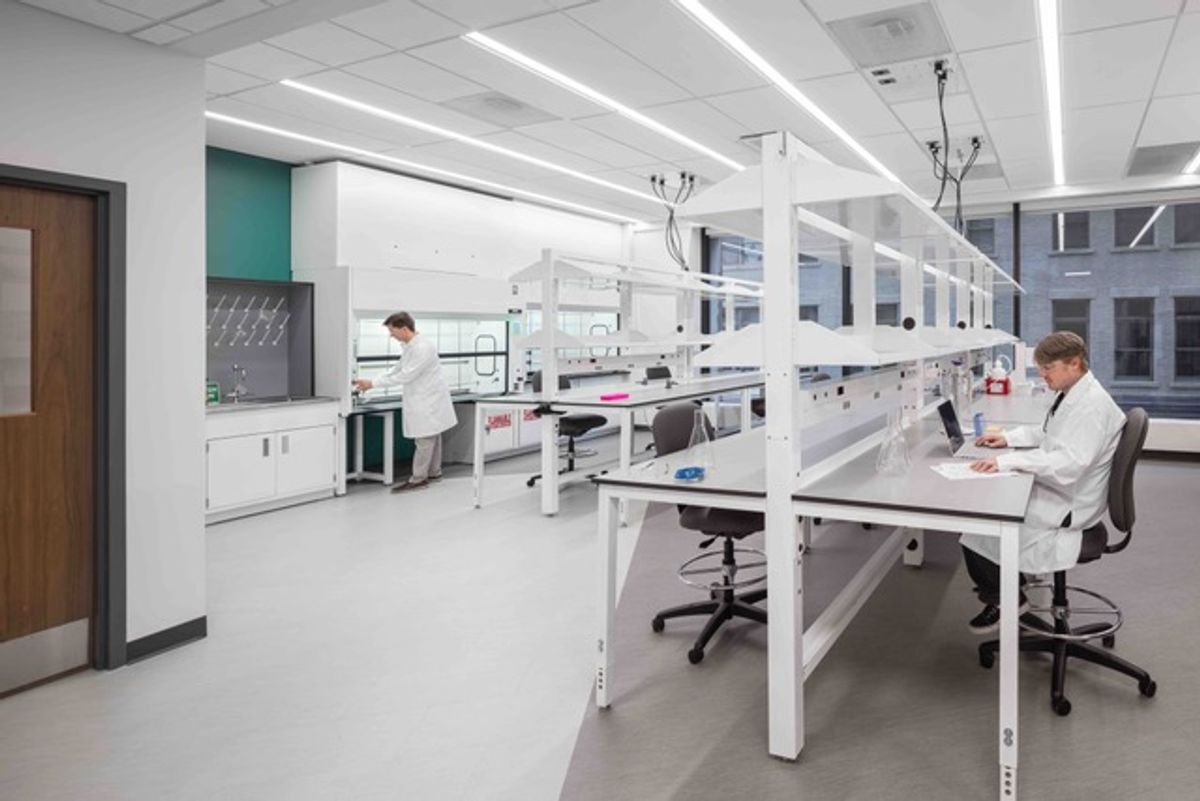
The Austin–Round Rock corridor has emerged as one of the most active life sciences and biotechnology development zones in Texas. Anchored by University of Texas research programs, the Dell Medical School, and a growing cluster of pharmaceutical, genomics, and medical device companies expanding into the region, Austin’s biotech sector is building out laboratory and research infrastructure at a pace that outstrips most of the country.
With that growth comes a specific and complex access control challenge. Biotech and pharmaceutical research facilities in Austin are not typical commercial office environments. They house sensitive R&D intellectual property that represents years of investment and competitive advantage. They contain hazardous materials — biological agents, controlled substances, flammable chemicals — that require restricted access not just for security reasons, but for safety and regulatory compliance. And they are subject to federal audit requirements from agencies including the FDA, DEA, and CDC that mandate documented access records as part of compliance reporting.
A standard commercial office access control system — adequate for managing who enters a downtown Austin office building — is not adequate for a BSL-2 research laboratory, a pharmaceutical API production facility, or a genomics company with a materials archive. These environments require a different level of access architecture: tiered credential zones, multi-door interlocking systems, automated audit trail generation, and hardware specifications that work in controlled laboratory environments.
This guide covers what laboratory access control in Austin’s biotech corridor actually requires — and what compliance-grade systems look like in practice.
🔒 Free Laboratory Security Assessment for Austin Biotech Facilities
Nexlar Security designs and installs high-security access control for biotech labs, pharmaceutical facilities, and R&D campuses across Austin and the Round Rock corridor. 👉 Book Your Free Lab Security Assessment
Protecting R&D IP in the Austin–Round Rock Corridor
Intellectual property security is the primary access control concern for Austin biotech and pharmaceutical R&D facilities — before regulatory compliance, and before physical safety.
An Austin genomics company’s sequencing data, an Austin pharmaceutical company’s synthesis protocols, a medical device startup’s unpatented design specifications — these represent competitive assets that are frequently more valuable than the physical lab equipment that generates them. And unlike financial data, IP theft from a research laboratory may not be discovered until a competing product appears on the market, by which time the harm is irreversible. [2]
The access control architecture that protects R&D IP in an Austin lab environment involves several layers:
Zone-tiered access. The lab facility is divided into security zones — general office and common areas, laboratory support areas (storage, preparation, instrument rooms), primary research areas, restricted materials storage, and server rooms containing data management systems. Each zone carries a higher credential requirement than the one outside it. Not every employee with access to the building has access to every zone. Not every researcher has access to materials storage. IP and data are held in zones with the most restrictive access.
Role-based access profiles. Access permissions are defined by role — principal investigator, research associate, lab technician, external collaborator, facilities, IT. Each role has a defined set of zones it can access. When a collaborator’s engagement ends, their entire access profile is revoked simultaneously. No zone is forgotten.
Visitor and external collaborator management. Academic research environments involve frequent external visitors, collaborators, and regulatory inspectors. Temporary access profiles with defined, automatically expiring authorizations — and logged escort requirements for the most sensitive areas — manage these populations without creating permanent credential holders for visitors.
Complete, timestamped access logs. Every zone entry is logged: who, when, which door. This serves both security investigation (who was in Lab 4 between 2 PM and 6 PM on Tuesday) and IP dispute documentation purposes — an access log that shows only authorized personnel were in a restricted area can be critical evidence if trade secret misappropriation claims arise.
Federal Compliance Frameworks for Austin Lab Security
Austin’s biotech and pharmaceutical facilities operate under multiple federal compliance frameworks that include specific physical security requirements — and that mandate the access documentation that regulatory audits review.
DEA Controlled Substance Registration (21 CFR Part 1300) Any Austin facility that handles DEA-scheduled controlled substances — including many pharmaceutical research and API production operations in the Austin market — must maintain physical security of controlled substance storage areas meeting DEA standards, including access restriction to authorized personnel only, locked storage with physical barrier protection, and access records available for DEA inspection. [3]
FDA Current Good Manufacturing Practice (21 CFR Parts 210 and 211) Pharmaceutical manufacturing and compounding facilities subject to FDA cGMP regulations must control and document access to manufacturing areas, storage areas for drug substances and products, and quality control areas. Access records must be maintained and available for FDA audit. The 21 CFR Part 11 provisions for electronic records establish standards for audit trail integrity that access control event logs must meet if they are submitted as part of an FDA regulatory submission. [4]
NIH Biosafety Guidelines (BSL Classifications) Research facilities operating at Biosafety Level 2 or above under NIH biosafety guidelines must implement access controls that restrict BSL-2 and BSL-3 laboratory areas to personnel with documented training and authorization for the specific biological agents being handled. Access records are required as part of the institutional biosafety program documentation reviewed by the NIH. [5]
CDC/USDA Select Agent Program (42 CFR Part 73) Facilities in Austin registered to possess, use, or transfer select agents and toxins must implement access controls that restrict select agent work areas to CDC/USDA-approved personnel only, maintain access logs for select agent areas, and demonstrate compliance with federal security requirements in their registered security plan. [6]
For most Austin biotech facilities, the applicable frameworks are a combination of NIH BSL requirements, DEA controlled substance regulations, and FDA cGMP — depending on the specific research and production activities the facility conducts.
Multi-Door Interlocking Systems (Mantraps): Design and Application
A mantrap — also called an interlocking door system, an airlock, or a security vestibule — is a physical access control architecture in which two doors are electronically interlocked so that only one can be open at a time. To pass through, a person enters through the first door (which is then locked behind them), presents credentials to access the second door, and is admitted to the secured area.
In biotech and laboratory environments, mantraps serve two distinct functions simultaneously:
Security function. By preventing anyone from following an authorized person through a secured door without presenting their own credentials, a mantrap physically enforces the one-person-one-credential rule. Tailgating — the most common bypass of standard access control at a single door — is eliminated by the physical interlocking architecture. If person A tailgates through the outer door, they are still trapped between the two doors with no way forward without their own valid credential.
Containment function. In BSL-2 and BSL-3 laboratory environments, the mantrap airlock also provides biological containment — preventing the simultaneous opening of both doors, which would break the pressure differential that maintains containment in higher-biosafety-level spaces. The security and containment functions align in these applications. [5]
Design configurations for Austin biotech facilities:
Standard security mantrap. Two doors, electronically interlocked, with a credential reader on the secured side of the second door. Used at entry points to R&D areas, materials storage areas, and restricted instrument rooms. The person enters the outer door using a general lab area credential, then must present a higher-tier credential to open the inner door.
Biometric mantrap. For the highest-security areas — select agent storage, controlled substance vaults, proprietary compound libraries — the inner door of the mantrap uses biometric authentication (fingerprint, iris, or facial recognition) rather than a card credential. This ensures that the physical credential cannot be shared or stolen and used by a non-authorized person to gain access.
Sized single-occupancy vestibule. Some high-security mantrap configurations are sized for single occupancy only — using sensors to detect if more than one person is in the vestibule and refusing to open the inner door until the vestibule is confirmed to contain a single occupant. This eliminates the scenario where two people enter the outer door simultaneously, one with a valid credential and one without.
Hazardous Material Storage: Access Hierarchy and Credential Tiering
Access to hazardous material storage — controlled substances, biological materials, flammable solvents, and restricted reagents — requires a multi-tier access hierarchy that restricts entry to specifically authorized personnel based on their role, training, and the specific materials being stored.
A well-designed credential hierarchy for an Austin biotech facility typically includes three to four tiers:
Tier 1 — General Facility Access. All employees and authorized visitors. Main building entry, common areas, administrative offices, general lab support areas. Standard smart card or mobile credential.
Tier 2 — Laboratory Access. Research personnel with documented training and clearance for the relevant laboratory area. Access to primary research labs, instrument rooms, preparation areas. Requires role assignment in the access control system tied to training record verification.
Tier 3 — Restricted Materials Access. Personnel with specific authorization for controlled substance handling, DEA Schedule access, or BSL-2+ biological agent handling. Access to freezer rooms, cold storage areas, reagent libraries, and controlled substance cabinets within the lab. Requires additional credential tier assignment — may include PIN + card or biometric factor.
Tier 4 — High-Security Areas. Access limited to PI-level personnel and authorized designees. Controlled substance vaults, select agent storage, proprietary compound libraries. Typically requires biometric authentication or two-person access protocols.
The value of this tiering is not just security — it is the audit trail it generates. Every tier 3 and tier 4 access event is logged with the specific personnel identifier, the time of entry, and the duration of access. For DEA compliance inspections and FDA cGMP audits, this log is the primary documentation of controlled substance access control — and it must be complete, unedited, and available on demand.
Automated Audit Trail Reporting for Federal Pharmaceutical Safety Audits
This is the access control feature that Austin’s pharmaceutical and biotech compliance teams find most operationally valuable — and the one that most directly addresses the federal audit requirement that applies to their specific regulatory environment.
Modern cloud-managed access control platforms generate automated, timestamped, tamper-evident access event logs that can be filtered, exported, and formatted for regulatory audit presentation without manual compilation. [7]
What FDA and DEA audit trail requirements look like for access control:
For FDA 21 CFR Part 11 electronic record requirements applicable to pharmaceutical manufacturing: electronic records must include the date and time of the event, a description of the event, and the identity of the person who performed the action. Access control logs satisfy these requirements when they are generated automatically by the system, include timestamps from a synchronized time source, include the specific credential identifier (tied to a specific individual), and are stored in a tamper-evident format that prevents modification. [4]
For DEA Schedule II–V controlled substance access records: the DEA’s physical security requirements (21 CFR Parts 1301 and 1303) require that access to DEA vault storage and controlled substance storage areas be limited to authorized personnel, and that records of access be maintained. Access control event logs for these specific doors constitute the primary documentation of this compliance requirement. [3]
What automated reporting looks like in practice:
The access control platform generates a report showing every access event at each controlled door during a defined time range — including the credential holder’s name (mapped to their system account), the time of entry, and the time of exit (if door position sensors track the exit event). This report is exportable in formats (CSV, PDF) suitable for direct submission in regulatory audit documentation packages. No manual compilation. No spreadsheet reconstruction. The report is generated from the system’s tamper-evident log with the same accuracy and format every time.
For Austin biotech facilities preparing for FDA inspections, DEA compliance audits, or NIH biosafety program reviews, the ability to produce complete, accurate, timestamped access records for any door in the facility over any time range is not a nice-to-have — it is a core compliance requirement. Nexlar configures access control systems for Austin biotech clients with audit reporting as a design requirement, not an afterthought.
Access Control Hardware for Laboratory Environments
Laboratory environments impose specific requirements on access control hardware that differ from standard commercial office installations.
Cleanroom-compatible readers. In ISO-classified cleanrooms, standard commercial access control readers are contamination sources — their housings collect particulates, their surfaces cannot be properly cleaned with laboratory-grade disinfectants, and their physical buttons require contact that compromises glove integrity. Contactless readers — proximity, NFC, or touchless biometric — are required for cleanroom entry points.
Chemical-resistant enclosures. In laboratory environments with airborne chemical exposure (solvent labs, fume hood areas), reader housings must be rated for chemical resistance. Standard plastic housings may degrade in environments with regular exposure to laboratory solvents.
High-cycle-rated door hardware. Laboratory doors at high-traffic entry points — morning entry, shift changes, frequent materials movement — require door hardware (closers, strikes, latch mechanisms) rated for higher cycle counts than standard commercial door hardware.
Intrinsically safe equipment for hazardous material zones. In laboratory areas classified as hazardous locations under NEC Article 500 — areas with flammable vapor or combustible dust risk — access control hardware must meet appropriate hazardous location ratings. This is uncommon but applies to some Austin pharmaceutical manufacturing environments.
How Security Audits Work for Austin Biotech Facilities
A security audit for an Austin biotech or pharmaceutical facility evaluates the access control system against applicable federal and institutional requirements — identifying gaps, documenting current practices, and producing a written report that can be used both for internal compliance review and as documentation in regulatory audit packages.
A Nexlar security audit for an Austin biotech client typically covers:
Physical security assessment of each controlled zone: are the doors, hardware, and readers in proper working condition? Do the access configurations match the intended access policy? Are there physical bypass vulnerabilities (gaps, propped doors, accessible overrides)?
Access policy review: does the current credential configuration match the intended access hierarchy? Do any credential holders have access beyond what their role requires? Are any departed personnel’s credentials still active?
Audit trail review: are access event logs complete, accurate, and appropriately retained? Can the system produce the specific report formats required for the applicable regulatory framework? Are there any gaps in the log coverage (unmonitored doors, offline readers)?
Documentation review: is the access control policy documented in writing? Is the credential issuance and revocation process documented? Are training records tied to access authorization levels?
The written report produced from this audit identifies specific findings and recommended remediations — and constitutes a documented security assessment that both demonstrates due diligence and provides a roadmap for compliance remediation.
System Comparison Table
| Requirement | Standard Office Access Control | Lab-Grade Access Control |
|---|---|---|
| Credential Tiers | 1–2 levels | 3–4 levels (role + material authorization) |
| Biometric Integration | Optional | Required for highest-security zones |
| Mantrap / Interlocking | Not typical | Standard for high-security areas |
| Audit Trail Format | Basic event log | 21 CFR Part 11 / DEA-compliant format |
| Chemical-Resistant Hardware | Not required | Required in chemical lab areas |
| Biosafety Integration | None | BSL-level access profile required |
| Controlled Substance Access | Not applicable | DEA-documented, tiered access |
| Report Export for Audit | Basic | Regulatory-format export |
| Visitor/Collaborator Management | Basic | Time-limited with escort tracking |
Cost and Pricing for Austin Lab Installations
| Facility Scope | Estimated Cost Range |
|---|---|
| Small Research Suite (4–10 doors, basic tiering) | $10,000 – $25,000 |
| Mid-Size Biotech Facility (10–25 doors, full tiering) | $25,000 – $60,000 |
| Pharmaceutical Manufacturing (25+ doors, DEA/FDA compliant) | $50,000 – $150,000+ |
| Mantrap Installation (per unit) | $8,000 – $25,000 |
| Biometric Integration (per door) | $2,000 – $8,000 additional |
| Compliance Audit Report | $3,000 – $8,000 |