

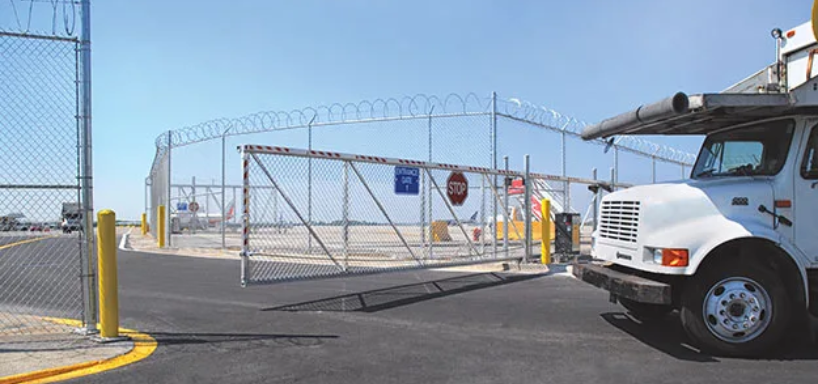
Austin’s industrial corridor has expanded significantly north into Georgetown, Taylor, and the US-130 tollway corridor — with semiconductor fabrication, advanced manufacturing, distribution, and heavy equipment operations establishing facilities in areas that were predominantly agricultural or undeveloped just five years ago.
These industrial yards share a set of perimeter access control challenges that differ from the commercial access control needs of the office buildings and technology campuses that dominate Central Texas’s economic narrative.
The gates are far from the building. The reader hardware is fully exposed to Central Texas weather conditions — summer temperatures regularly exceeding 105°F in direct sun, occasional severe storms, UV exposure that degrades standard commercial-grade plastics and electronics over time. The vehicle population includes not just company fleet vehicles but rotating truck drivers, third-party carriers, equipment delivery vendors, and scale-regulated freight operations. And many gate entry points on large industrial yards are distant from the main facility — too far for practical wired infrastructure in a retrofit or greenfield installation.
Standard commercial access control readers and gate operators — designed for covered parking decks, climate-controlled lobbies, and suburban office entries — are not built for these conditions. The hardware selection, installation approach, and credential management strategy for Central Texas industrial yard access require a different set of specifications than the commercial market standards that many installers default to.
🔒 Free Industrial Perimeter Assessment for Austin and Georgetown Facilities
Nexlar Security designs and installs industrial yard card reader systems, solar-powered gate controllers, and vehicle access management for Central Texas industrial sites. 👉 Book Your Free Onsite Assessment
Why Standard Commercial Readers Fail in Central Texas Industrial Yards
The failure modes of standard commercial card readers installed in outdoor industrial environments in Central Texas are predictable, expensive, and entirely avoidable with proper hardware specification from the start.
Heat degradation. Commercial card readers are typically rated for operating temperatures up to 130°F to 140°F in direct sunlight environments. In Central Texas industrial yards during July and August, direct sun surface temperatures on reader housings can reach 160°F to 180°F — exceeding the operating range of standard commercial hardware. Repeated heat cycling — hot days, cooler nights — stresses plastic housings and electronic components, accelerating degradation and ultimately causing reader failure or erratic behavior. [1]
UV degradation of plastic housings. Standard commercial plastic reader housings, when subjected to Central Texas UV exposure without adequate UV-stabilized materials or protective coatings, yellow, crack, and become brittle within 18 to 36 months. A reader that looked professional and functional at installation looks neglected and fails mechanically within two to three Texas summers.
Condensation and moisture. The temperature differential between a hot Central Texas day and a cooler morning creates condensation that can enter reader housings that aren’t properly sealed for outdoor use. Over time, moisture exposure degrades circuit boards and contacts — producing intermittent failures that are difficult to diagnose and expensive to repair.
Physical abuse from vehicle proximity. Industrial yard gate readers installed at vehicle lane entry points are at risk of vehicle strike — from tractor-trailers with wide loads, from backing trucks, and from equipment delivery vehicles operating in unfamiliar yards. Readers mounted in standard commercial configurations — on pedestals or swing-arm mounts at lane height — are vulnerable in a way that a lobby-mounted interior reader is not.
Correct specification for Central Texas industrial yard readers starts with NEMA 4X enclosure ratings (watertight and corrosion-resistant), operating temperature ranges validated for direct-sun surface temperatures above 140°F, UV-stabilized housing materials, and impact protection appropriate for vehicle proximity.
Ruggedizing Card Readers for Central Texas Heat and Weather
Industrial-grade and outdoor-rated card readers from manufacturers including HID Global, Allegion, Identix, and Nedap are available in specifications appropriate for Central Texas industrial yard deployment.
NEMA Enclosure Ratings NEMA 4X is the minimum recommended enclosure rating for outdoor industrial card reader installations in Central Texas — providing protection against rain, sleet, dust, and corrosion. NEMA 6 (submersion-rated) provides additional protection for installations in areas subject to flooding or standing water. [2]
Operating Temperature Specifications Seek manufacturer specifications that define operating temperature ranges as ambient temperature ranges, not surface temperature ranges — and confirm that the specified range accommodates Central Texas ambient summer temperatures of 100°F to 110°F plus direct sun heating. High-temperature rated readers from industrial manufacturers typically specify operating ranges of -40°F to +150°F, significantly exceeding standard commercial reader specifications.
Corrosion Resistance For Austin and Georgetown industrial sites near the semiconductor manufacturing corridor (where some facilities use chemicals that can produce corrosive atmospheric conditions in the surrounding area) or near construction material operations (concrete dust, aggregate dust), stainless steel or coated aluminum housings with corrosion-resistant mounting hardware are specified over standard steel or powder-coated aluminum.
Long-Range RFID for Vehicle Access For vehicle lane card readers in industrial yards, long-range RFID readers — capable of reading vehicle-mounted transponders from 10 to 30 feet — eliminate the need for drivers to stop, roll down a window, and present a card reader in weather or temperature conditions. The driver never leaves the cab. The gate begins opening as the credentialed vehicle approaches. This is both more operationally efficient for high-volume gate operations and more reliable in extreme weather — the reader is never subject to driver error (wrong card, wrong reader side) under difficult conditions. [3]
Solar-Powered Wireless Access Controllers for Remote Gate Points
Large Austin and Georgetown industrial yards — manufacturing campuses, aggregate and materials operations, construction equipment storage yards, logistics staging areas — often have secondary gate entry points at significant distances from the main facility. Running wired power and data infrastructure to these remote gate points is a major cost item that can price a complete perimeter access system out of budget range.
Solar-powered wireless access control provides the solution: a self-contained gate access controller that operates on battery power charged by an integrated solar panel, communicates with the central access control platform via cellular data rather than hardwired network, and supports credentialed access at remote gate locations without running power or data cable from the main facility. [4]
How solar-powered gate access works:
The gate controller unit includes an integrated solar panel, a sealed battery backup (providing operation through periods of cloudy weather or reduced sunlight), a cellular modem for communication with the cloud access control platform, and the control relay for the gate operator.
The credential reader (long-range RFID or keypad) at the gate communicates with the local controller, which validates the credential against a locally cached copy of the access policy database — functioning correctly even during brief cellular outages. Credential changes made through the cloud platform sync to the controller over the cellular connection, typically within seconds to minutes depending on connectivity.
The gate operator — a solar-powered swing gate operator or battery-backed slide gate operator — operates from the same or a separate solar/battery power system, depending on the gate’s size and duty cycle requirements.
Sizing solar systems for Central Texas industrial gates:
Central Texas’s solar resource is excellent — annual average peak sun hours in the Austin/Georgetown area are approximately 5.5 to 6.0 hours per day, providing reliable charging for properly sized solar access control systems. Nexlar sizes solar panel capacity, battery storage, and charge controller specifications for each installation based on the gate’s duty cycle (how many operations per day), the specific equipment power consumption, and a system reserve designed to maintain operation through at least 3 to 5 days of minimal sun exposure. [5]
Integrating Vehicle Scales and License Plate Recognition with Gate Codes
For Austin and Georgetown industrial facilities that receive regulated freight — aggregate operations, ready-mix concrete plants, hazardous materials logistics, food-grade or pharmaceutical distribution — vehicle weighing requirements create an opportunity to integrate scale operations with gate access control.
Vehicle Scale + Gate Integration In a typical Central Texas aggregate or materials operation, trucks entering the facility must weigh on the inbound scale before loading, and weigh on the outbound scale after loading to verify load weight against permitted limits. The gate control system can integrate with the scale management system so that:
A truck arriving at the entry gate presents a driver gate code (assigned to that driver or that carrier’s fleet). The gate opens and the truck proceeds to the inbound scale. The scale system captures the vehicle’s tare weight and associates it with the driver’s gate code. After loading, the truck proceeds to the outbound scale. The loaded weight is recorded and the gate releases for exit when the outbound scale transaction is complete. The access control system logs the entire transaction — entry time, tare weight, exit time, loaded weight, driver credential — in a single integrated record. [6]
This integration reduces the manual data entry burden at scale houses, reduces the opportunity for fraudulent gate entries (trucks that don’t weigh or don’t match a valid credential-to-truck association), and creates a complete, timestamped freight transaction record.
License Plate Recognition (LPR) Integration LPR cameras at gate entry and exit points capture every vehicle’s license plate and log it against the gate access event — providing a secondary vehicle identity record alongside the driver’s RFID or code credential. For carrier management — particularly for facilities receiving spot loads from carriers whose drivers don’t carry RFID transponders — LPR enables pre-registration of expected truck plate numbers as the gate credential, eliminating the need to issue physical RFID transponders to one-time or infrequent carriers. The dispatch office registers the expected truck’s plate number in the access control system; the truck arrives, the LPR camera reads the plate, and the gate opens. [7]
Driver Gate Code Management for High-Turnover Vehicle Populations
Managing gate access for a large, rotating driver and carrier population is one of the most operationally intensive aspects of industrial yard access control — and one that cloud-managed systems handle significantly better than legacy on-premise systems.
The challenge: An Austin construction materials yard may receive deliveries from 50 to 100 different truck drivers in a week — some returning regulars, some one-time spot loads. Issuing RFID transponders to every driver is impractical. Giving everyone the same PIN code defeats the purpose of access control (there’s no individual audit trail) and creates a code management nightmare when drivers are terminated or a code is compromised.
The solution — time-limited, individually assigned driver gate codes:
The facility’s dispatch or logistics team issues unique, time-limited access codes to expected drivers at the time of delivery scheduling — through a web portal, a mobile app, or a text message with a link. The code is valid for a specific date and time window — today’s delivery window only — and expires automatically when that window closes. [3]
The driver arrives, enters the code at the gate keypad, and the gate opens. The access log records which code was used, at what time, and for how long the gate was open. If a delivery is rescheduled, the old code is cancelled and a new one issued. If a driver’s code is lost or shared, it can be invalidated immediately from the dispatch portal and replaced.
For regular carrier relationships, RFID transponders on fleet vehicles provide a more seamless credential — the truck is recognized on approach and the gate opens without driver action.
Cloud-managed access control platforms allow the dispatch team to manage this entire credential population from a browser or mobile app — not from a system that requires a technician on site to add or remove codes.
System Comparison Table
| Feature | Standard Commercial Reader | Industrial Ruggedized Reader | Solar Wireless Controller |
|---|---|---|---|
| Temperature Rating | Up to ~130°F ambient | Up to 150°F+ ambient | Varies by manufacturer |
| NEMA Enclosure | NEMA 1–2 (indoor) | NEMA 4X (outdoor, watertight) | NEMA 4X sealed enclosure |
| UV-Rated Housing | No | Yes | Yes |
| Long-Range RFID (vehicle) | No | Yes | Yes (integrated) |
| Power Requirement | Wired 12V/24V | Wired 12V/24V | Solar + battery (no wire run) |
| Data Connection | Wired (network) | Wired (network) | Cellular (no wire run) |
| Remote Gate Application | Not practical | With wired infrastructure | Yes — designed for remote gates |
| LPR Integration | No | Yes | Yes |
| Scale Integration | No | Yes | Yes |
| Best For | Indoor / covered use | Outdoor wired industrial gates | Remote or distant gate points |
Cost and Pricing for Austin and Georgetown Industrial Installations
| Installation Scope | Estimated Cost Range |
|---|---|
| Single Wired Industrial Gate (reader + operator + controller) | $6,000 – $18,000 |
| Solar-Powered Wireless Gate Controller + Reader | $8,000 – $22,000 |
| LPR Camera Integration (per lane) | $5,000 – $15,000 |
| Scale Integration (per scale) | $5,000 – $20,000 |
| Multi-Gate Industrial Yard (3–6 gates) | $25,000 – $80,000 |
| Full Perimeter System with LPR + Scale Integration | $40,000 – $120,000+ |