

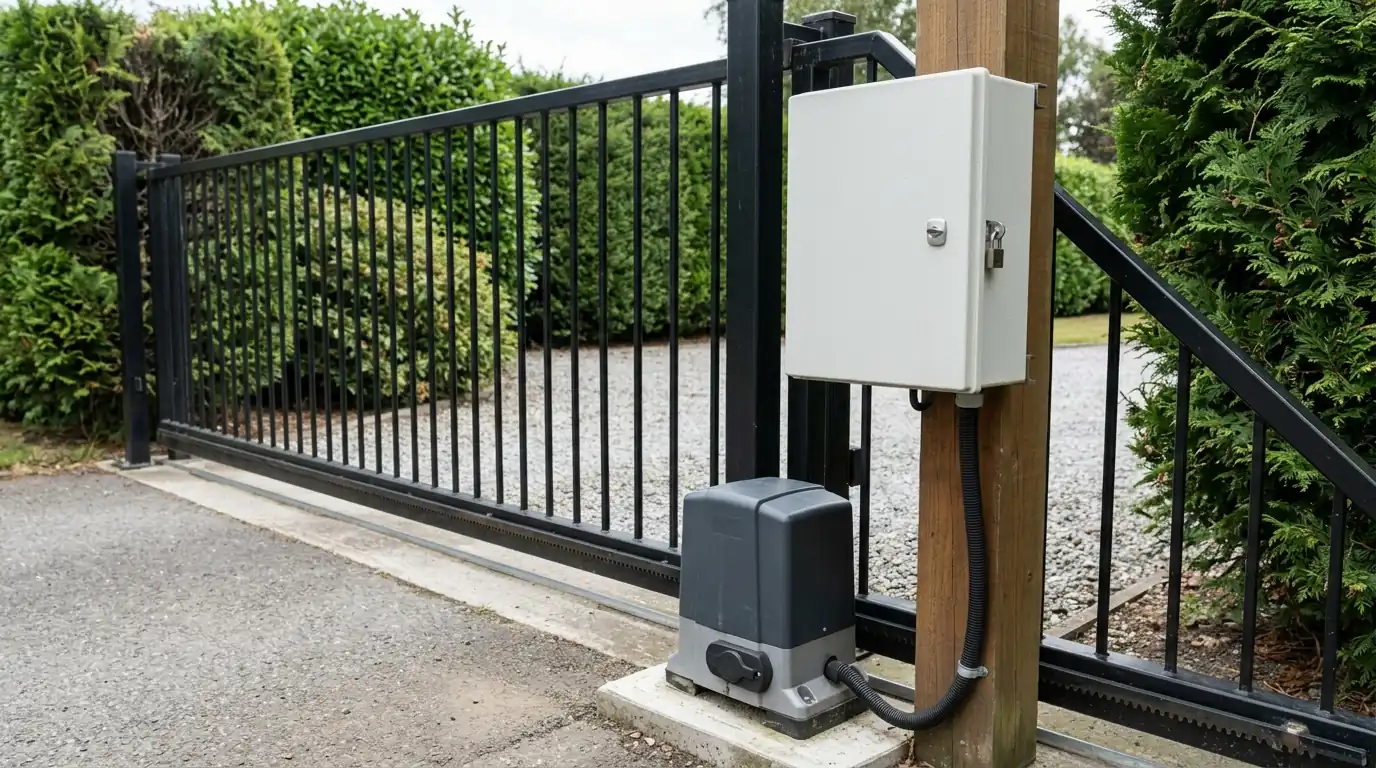
Across San Antonio’s gated residential communities — from The Dominion and Shavano Park in the northwest to the established gated neighborhoods off Stone Oak Parkway and the newer communities along US-281 north of Loop 1604 — the most common gate operator installed when communities were built is a residential or light commercial electromechanical operator. These operators were adequate for the duty cycle of a community at original build-out. They are frequently not adequate for the daily cycle count of a fully occupied community in 2026.
A residential gate operator rated for 200 cycles per day, deployed at a 300-unit community where residents average three gate cycles each per day, is operating at 450% of its rated duty cycle. The mechanical and electronic components degrade proportionally faster. Motors burn out. Drive mechanisms wear. Control boards fail. The community experiences escalating maintenance calls, increasing repair costs, and eventual complete operator failure — often at the worst possible moment (holidays, severe weather, nights and weekends when service response is slowest).
The replacement is not another residential operator. It’s a commercial or commercial hydraulic operator rated for the actual duty cycle the community’s vehicle traffic demands.
🔒 Free HOA Gate Operator Assessment for Your San Antonio Community
Nexlar Security evaluates gate operator condition, duty cycle requirements, and emergency access capability for San Antonio gated communities. Free on-site, no obligation. 👉 Book Your Free Community Gate Assessment
Upgrading to Commercial Hydraulic Gate Openers
Commercial hydraulic gate operators represent a step change in reliability and longevity compared to the residential and light commercial electromechanical operators that most San Antonio gated communities currently run.
How hydraulic operators work differently: A hydraulic gate operator uses a hydraulic pump and cylinder to drive the gate’s movement — pushing or pulling hydraulic fluid to extend or retract an actuating cylinder that moves the gate panel. Rather than an electric motor directly driving a mechanical gear or rack, the hydraulic system provides high torque with low electrical draw and significantly fewer mechanical stress points in the drive train. [1]
Why hydraulic performs better at high-cycle HOA gates: Hydraulic systems are relatively insensitive to temperature extremes compared to electromechanical systems — particularly important in San Antonio’s summer heat where ambient temperatures in exposed gate operator enclosures can exceed 130°F. The hydraulic fluid maintains consistent viscosity and force output across a wider temperature range than the electric motor windings and capacitors of standard operators.
Hydraulic operators also provide built-in soft-start and soft-stop — the gate accelerates gradually at the beginning of travel and decelerates gradually at the end, reducing the mechanical shock at the gate’s travel limits that causes wear in high-cycle electromechanical systems. For heavy swing gates — common in San Antonio’s established gated communities where wide, heavy ornamental gates were installed — hydraulic actuation handles the gate weight with less strain than equivalently powered electromechanical operators. [2]
FAAC Hydraulic Operators for San Antonio HOA Applications: FAAC’s hydraulic swing gate and slide gate operator series — including the FAAC 740, FAAC 760, and FAAC 402 hydraulic models — are widely specified for San Antonio gated community upgrades where the existing gate panel is heavy, the duty cycle is high, or the community’s history of repeated electromechanical operator failure suggests the need for a more robust drive technology.
Emergency Responder Transit: Strobe Sensors and Optical Backup Triggers
The most critical safety function of a San Antonio HOA gate system is ensuring that fire department, EMS, and law enforcement vehicles can access the community immediately in a life-safety emergency — without any delay from a failing gate system, a dead remote battery, or unavailability of a community contact to open the gate manually.
Texas fire codes and the City of San Antonio Fire Prevention Bureau require that gated access points in residential developments provide emergency vehicle access — specifically that the gate not delay emergency response. [3] The standard implementations are:
Knox Box A key safe installed at or adjacent to the gate, accessible only to fire department personnel with the department’s master key. The Knox Box contains the gate’s emergency key or access code. A responding fire engine driver retrieves the code from the Knox Box and opens the gate manually or with the code. This is the minimum compliant approach — it works, but it does require the driver to stop, dismount, access the Knox Box, and operate the gate, adding approximately 30 to 60 seconds to response time.
Strobe-Operated Sensors A strobe-operated gate opener sensor detects the specific flash frequency of emergency vehicle warning lights and automatically commands the gate to open when an emergency vehicle approaches. The gate opens before the vehicle reaches it — no driver action, no dismounting, no code. Full automatic emergency gate opening triggered by the vehicle’s own warning system. [4]
For San Antonio gated communities where emergency response time is genuinely a life-safety concern — communities with elderly populations, communities adjacent to congested arterials where response time margins are tight, or communities where prior emergency response was delayed by gate failure — strobe sensors provide the highest-reliability emergency access capability available.
Optical Backup Triggers Optical triggers — photoelectric sensors at the gate approach that detect the presence of any vehicle stopped at the closed gate for longer than a defined period (typically 5 to 10 seconds) — provide a backup automatic open trigger for emergency vehicles that may not activate a strobe sensor (older emergency vehicles, police vehicles in non-emergency mode). The optical trigger ensures that any vehicle stopped at the gate during an emergency can gain access even without the strobe-operated sensor activation.
The combined configuration: Nexlar specifies all three — Knox Box for passive compliance, strobe sensor for primary automatic emergency access, and optical trigger as a backup — for San Antonio HOA gate installations where emergency response reliability is a priority. This layered approach ensures 100% emergency responder transit capability regardless of the specific vehicle type or equipment configuration approaching the gate.
Battery Backup Systems for Uninterrupted HOA Gate Access
San Antonio experiences power outages from summer thunderstorms, ice events, and the periodic grid management events that Texas’s electricity infrastructure is subject to. For a gated community whose residents depend on gate operation for routine vehicle access, a power outage that disables the gate operator creates an immediate operational problem — often paired with the safety concern of the outage itself.
A battery backup system for an HOA gate operator maintains gate operation for a defined period during a grid power outage — allowing residents to continue accessing the community and allowing the gate to respond to emergency vehicle access triggers, without requiring manual operation or a utility crew to restore power. [5]
Battery backup specifications for San Antonio HOA gates: The battery capacity required for a gate backup system depends on the gate operator’s peak current draw during a gate cycle, the expected number of gate cycles during the outage period, and the target backup duration. For a typical San Antonio residential gate operating at 100–200 cycles per day, a battery backup system providing 24 hours of operation represents a reasonable design target — covering most weather-related outage events without requiring community residents to find alternative access during a prolonged outage.
Sealed lead-acid (SLA) or lithium-ion battery systems are available for commercial gate operator backup. SLA systems have lower initial cost; lithium-ion systems provide better performance in temperature extremes (relevant for San Antonio’s summer heat affecting battery storage areas) and longer calendar life.
Automatic switchover: A properly configured gate battery backup system switches to battery power automatically when grid power is lost — residents experience no interruption in gate operation. When grid power is restored, the system returns to grid power and begins recharging the battery. The switch between grid and battery power is automatic and requires no action from the HOA management team or residents.
Comparison Table
| Feature | Failed Residential Operator | Replaced Electromechanical | Commercial Hydraulic + Backup |
|---|---|---|---|
| Duty Cycle Rating | Under-rated (200/day typical) | Rated for community volume | Rated + extended margin |
| Temperature Performance | Degrades in SA summer heat | Improved | High-temperature rated |
| Emergency Strobe Sensor | Absent or failed | Optional | Standard (Nexlar specification) |
| Knox Box | Absent or non-compliant | Optional | Required |
| Battery Backup | No | Optional | Yes — 24-hour target |
| Soft-Start / Soft-Stop | No | Yes (electronic) | Yes (hydraulic native) |
| Expected Service Life | Already exceeded | 7–12 years | 12–20+ years |
| Best For | Replacement only | Standard upgrade | High-cycle, heavy gates, life safety priority |
Cost and Pricing for San Antonio HOA Gate Installations
| Installation Scope | Estimated Cost Range |
|---|---|
| Electromechanical Operator Replacement (per gate) | $2,500 – $6,000 |
| Commercial Hydraulic Operator (per gate) | $4,000 – $10,000 |
| Strobe Emergency Sensor (per gate) | $800 – $2,000 |
| Knox Box Installation | $300 – $800 |
| Battery Backup System (24-hour, per gate) | $1,200 – $3,500 |
| Complete HOA Gate Upgrade (hydraulic + strobe + Knox + battery) | $6,500 – $16,000 |
💡 Commercial Hydraulic Gate Operators for San Antonio’s Gated Communities — Emergency-Ready by Design
Nexlar upgrades failing HOA gate operators to commercial hydraulic systems with strobe emergency sensors, Knox Boxes, and battery backup — fully compliant with San Antonio fire code requirements. 👉 Schedule Your Free HOA Gate Assessment