

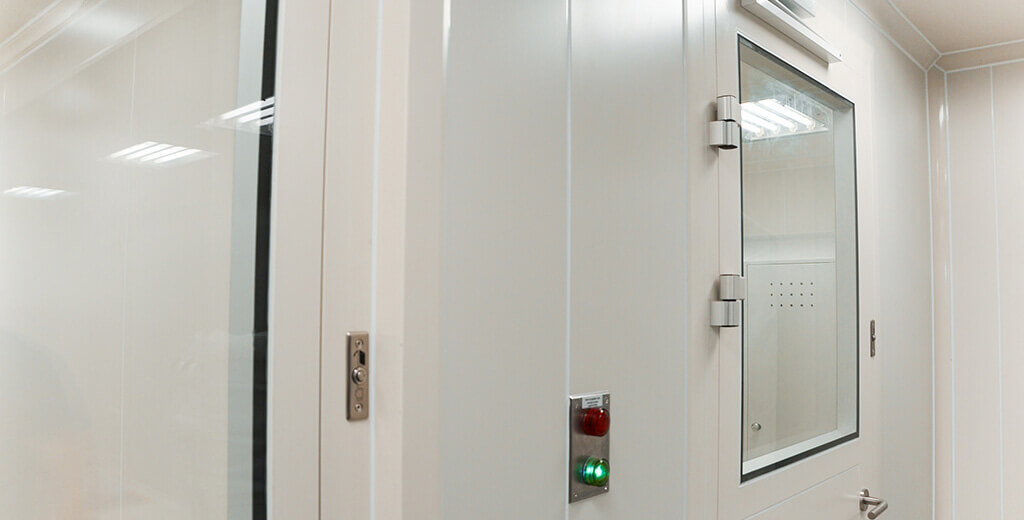
A cleanroom door interlock system — also called an airlock or mantrap in pharmaceutical and biotechnology applications — is a physical and electronic access control mechanism that prevents two adjacent controlled entry doors from being open simultaneously. Its function is simple in principle and critical in consequence: maintaining the pressure differential, contamination control, and security separation between a controlled environment and the spaces adjacent to it.
San Antonio’s pharmaceutical and biotechnology research sector — operating within the South Texas research corridor and the UTSA Science and Technology Park — includes pharmaceutical manufacturing operations, compounding pharmacies, sterile processing facilities, and biotechnology research labs that operate under FDA, USP, and regulatory agency requirements specifying controlled access to cleanroom and sterile manufacturing areas.
For these facilities, a door interlock is not an optional security enhancement. It is a compliance requirement tied to the environmental integrity of the controlled space. If both doors of a cleanroom airlock can be open simultaneously — or if the interlock controller fails to enforce the sequence — the controlled environment’s pressure differential is compromised, particulate contamination risk increases, and the facility’s regulatory compliance posture is directly affected.
🔒 Free Cleanroom Security Assessment for Your San Antonio Lab
Nexlar Security designs and installs compliant door interlock systems for pharmaceutical labs, compounding pharmacies, and biotech cleanrooms in San Antonio and the South Texas research corridor. 👉 Book Your Free Lab Security Assessment
Pneumatic vs. Electronic Door Interlock Controllers
The two primary interlock controller technologies for cleanroom and pharmaceutical lab applications are pneumatic and electronic — each with specific advantages and appropriate application contexts.
Pneumatic Door Interlock Controllers Pneumatic interlocks use compressed air logic to enforce the door sequence — the interlock controller is an air-operated device with no electrical components in the control logic circuit. When Door A is open, a pneumatic signal prevents Door B’s release mechanism from operating. When Door A closes and seals, the pneumatic signal releases and Door B can be opened.
Pneumatic controllers are specified for cleanroom applications where electrical components in the interlock circuit are undesirable — environments with flammable or explosive atmospheres (relevant for pharmaceutical solvent handling areas classified under NEC Article 500), environments with aggressive cleaning chemicals that could degrade electrical components over time, or applications where the simplicity and robustness of a purely mechanical/pneumatic control logic is preferred over electronic logic. [1]
Electronic Door Interlock Controllers Electronic interlocks use programmable logic controllers (PLCs) or dedicated interlock control boards to monitor door sensor inputs (door position switches indicating open/closed/latched status) and control door release outputs (electric strikes, magnetic locks, or electronic latches on each door).
Electronic interlocks provide capabilities that pneumatic systems cannot: real-time event logging of each door state change with timestamp, configurable alarm outputs when interlock rules are violated, integration with the facility’s access control platform (requiring a valid credential in addition to satisfying the interlock sequence), and remote monitoring of interlock status from a building management interface.
For San Antonio pharmaceutical labs requiring FDA 21 CFR Part 11 audit trail documentation for interlock events, electronic controllers with integrated event logging are the appropriate specification — pneumatic controllers generate no electronic record of door events.
The Rule-Based Logic: Door B Cannot Open Until Door A Is Locked and Sealed
The fundamental operating principle of a door interlock is a rule-based state machine: the controller monitors the position and lock state of each door and enforces the rule that only one door of the interlocked pair can be in an open or unlocked state at any time.
The sequence in practice:
Person approaches from the exterior. Door A (outer airlock door) is released with a credential (badge or PIN). Person enters the airlock vestibule.
Door A must fully close and its position sensor must confirm the door is closed and, in pressure-differential applications, that the door has sealed (the door frame gasket is compressed). The controller confirms Door A’s closed/sealed status.
Only after Door A is confirmed closed and sealed does the controller release Door B (inner cleanroom door) for opening. Person opens Door B and enters the cleanroom.
If Door A opens again while Door B is still open (someone else pressing the exterior reader, or Door A being manually held open), the controller immediately re-locks Door B, preventing simultaneous open states. [2]
Door status sensing accuracy is critical: The reliability of this logic depends entirely on the accuracy of the door position and seal sensors. A door that is physically closed but whose position switch indicates “open” will prevent Door B from releasing — locking the person in the airlock. A door that is physically ajar (not fully closed) but whose switch indicates “closed” will falsely release Door B — allowing a simultaneous open condition.
For pharmaceutical cleanroom applications, Nexlar specifies magnetic reed switches or inductive proximity sensors at each door position and seal point — not simple mechanical micro-switches that can degrade in the frequent wet-clean environments of pharmaceutical airlocks.
Pharmaceutical Lab Airlock Compliance Requirements
San Antonio’s pharmaceutical facilities operate under several regulatory frameworks that address cleanroom airlock design and interlock requirements:
USP (United States Pharmacopeia) Chapter 797 — Sterile Compounding USP 797 establishes standards for compounding sterile preparations, including requirements for the design and operation of cleanrooms used in sterile compounding. USP 797 requires that classified cleanrooms (ISO 7, ISO 8) have airlocks that maintain the pressure differential between the cleanroom and adjacent spaces — a requirement that is operationally enforced by a door interlock that prevents both airlock doors from being simultaneously open. [3]
FDA Current Good Manufacturing Practice (21 CFR Parts 210/211) FDA cGMP regulations for pharmaceutical manufacturing require controlled access to manufacturing areas, documented access control, and environmental controls that maintain the integrity of the manufacturing environment. For facilities under FDA oversight, the cleanroom airlock interlock is part of the physical access and environmental control infrastructure that FDA inspectors evaluate during facility inspections. [4]
ISO 14644 Cleanroom Classification ISO 14644 standards for cleanrooms specify that cleanroom entries be designed to prevent contamination — a requirement that is operationally implemented through interlocked airlocks. ISO classification review for San Antonio pharmaceutical facilities includes assessment of airlock design and operation as part of the overall contamination control evaluation. [5]
Fire Alarm Override Safety Switches for Emergency Escape
The most critical life-safety design element of a cleanroom door interlock system is the emergency override — the mechanism that allows immediate, unrestricted egress from the airlock vestibule and from the cleanroom in a fire or evacuation emergency, overriding the interlock logic that normally prevents both doors from opening simultaneously.
NFPA 101 egress requirements apply: The interlock’s normal rule-based logic (Door B cannot open while Door A is open) constitutes an access restriction that NFPA 101’s egress requirements require to be overridden in an emergency. An interlock that prevents egress from the airlock vestibule during a fire alarm event is a life safety violation — regardless of the cleanroom contamination control requirements that the interlock normally serves. [6]
How fire alarm override is implemented: The interlock controller is wired to the facility’s fire alarm panel through a normally-closed relay circuit. In normal operation, the relay is closed and the interlock logic operates normally. When the fire alarm activates, the relay opens, cutting power to the interlock controller’s lock outputs — simultaneously releasing all door locks in the airlock assembly and allowing free egress through any door in either direction.
This means: in a fire alarm event, both doors of the airlock can be simultaneously open, and all doors open freely without credential or interlock sequence. The contamination control function is sacrificed for life safety — which is the correct priority. Facility cleanroom re-qualification protocols address the contamination event after the emergency is resolved.
Manual override switches inside the airlock: In addition to the fire alarm interface, NFPA 101 requires that occupants inside an airlock vestibule can initiate emergency egress without special knowledge. Manual override switches — green emergency release buttons inside the airlock — allow the person in the vestibule to release both doors simultaneously by pressing the button, without requiring the fire alarm to be activated first. These switches are typically break-glass or guarded to prevent accidental activation during normal operations.
System Comparison Table
| Feature | No Interlock | Pneumatic Interlock | Electronic Interlock (PLC) |
|---|---|---|---|
| Prevents Simultaneous Door Open | No | Yes | Yes |
| Pressure Differential Maintenance | No | Yes | Yes |
| Event Log / Audit Trail | No | No | Yes (21 CFR Part 11 capable) |
| Access Control Integration | No | No | Yes |
| Remote Status Monitoring | No | No | Yes |
| Fire Alarm Interface | N/A | Required | Required |
| Manual Emergency Override | N/A | Required | Required |
| Appropriate for Flammable Environments | N/A | Yes (no electrical in logic) | Requires hazardous-rated components |
| USP 797 / FDA cGMP Applicable | No | Yes | Yes (preferred for documentation) |
| Best San Antonio Application | None | Solvent/flammable lab areas | Standard pharmaceutical cleanroom |
Cost and Pricing for San Antonio Lab Interlock Installations
| Installation Scope | Estimated Cost Range |
|---|---|
| Electronic Interlock Controller (per airlock pair) | $3,000 – $8,000 |
| Pneumatic Interlock Controller (per airlock pair) | $2,500 – $6,000 |
| Fire Alarm Interface (per interlock) | $500 – $1,500 |
| Manual Emergency Override Buttons | $300 – $800 per airlock |
| Door Position and Seal Sensors | $400 – $1,200 per door |
| Access Control Integration (per interlock) | $1,500 – $4,000 |
| Complete Airlock Installation (2-door, full compliance) | $8,000 – $20,000 |
Nexlar provides itemized quotes for San Antonio pharmaceutical lab and cleanroom interlock projects after a free on-site assessment of the airlock configuration, applicable regulatory framework, and existing door hardware.
💡 Compliant Cleanroom Door Interlocks for San Antonio Pharmaceutical Labs — FDA and USP Audit Ready
Nexlar installs pneumatic and electronic cleanroom door interlock systems for San Antonio pharmaceutical, compounding, and biotech facilities — with fire alarm interface and 21 CFR Part 11 audit trail capability. 👉 Schedule Your Free Lab Interlock Assessment