

When law enforcement, school safety researchers, and educators analyze the outcomes of school active threat incidents, classroom door security consistently emerges as one of the most impactful physical security factors. A secured, locked classroom door — even a hollow-core door with a basic lock — creates a meaningful barrier that changes the probability of harm to the occupants inside. [1]
The research behind this finding, developed by organizations including ALERRT (Advanced Law Enforcement Rapid Response Training) at Texas State University in San Marcos, is direct: in active threat events, classroom lockdown is among the most life-protective actions available to teachers and students. A locked door forces an attacker to take additional, time-consuming steps to breach it — steps that in many documented incidents were not taken. [2]
The technology that makes lockdown effective — or limits it — is the classroom door lock itself. A lock that requires a key to engage from inside the classroom, that a teacher under extreme stress must fumble for in a pocket or desk drawer, is a lockdown mechanism that may not function as intended during an actual event. A lock that engages instantly with a single button press — from inside the classroom, without a key — removes the fumble entirely.
This guide covers the classroom lockdown hardware options available to Austin school districts, the Texas safety requirements they align with, and the visual lock indication capability that tells teachers and students, in an instant, whether their classroom door is secured.
🔒 Free School Security Assessment for Austin Campuses
Nexlar Security evaluates classroom door hardware, campus access control, and emergency protocol integration for Austin school campuses. Licensed, experienced, and fully coordinated with Texas school safety standards. 👉 Book Your Free Campus Security Assessment
Texas School Safety Requirements and Austin District Obligations
Texas school districts operate under a layered framework of state safety requirements that directly address classroom door security and emergency lockdown capability.
Texas Education Code Chapter 37 — Campus Safety Texas Education Code §37.108 requires school districts to adopt a multi-hazard emergency operations plan (EOP) that addresses prevention, mitigation, preparedness, response, and recovery for a range of emergency scenarios — including active threat and intruder events. The EOP must be submitted to the Texas School Safety Center for review on a defined schedule. [3]
Texas School Safety Center (TxSSC) Standards The Texas School Safety Center, based at Texas State University, provides guidance, training, and standards for Texas school safety programs. TxSSC’s school security audit framework evaluates physical security elements including exterior door security, classroom door locking capability, and visual communication capability during lockdown events. TxSSC’s guidance directly addresses the classroom door as a critical lockdown security component. [4]
Senate Bill 11 (86th Texas Legislature, 2019) SB 11 significantly expanded Texas school safety requirements, including mandating annual safety and security audits for all Texas school districts, conducted by licensed school safety and security experts. Physical security deficiencies identified in these audits — including inadequate classroom door locking mechanisms — become findings that districts are expected to remediate. [5]
Austin ISD and Surrounding District Obligations Austin ISD, Pflugerville ISD, Hays CISD, Leander ISD, Round Rock ISD, and other Central Texas districts are all subject to these requirements. Annual safety audits generate findings that include door hardware adequacy — and district safety budgets are increasingly directed toward remediating classroom door security deficiencies identified in those audits.
The One Critical Factor: Speed of Classroom Lockdown
The single most important performance characteristic of a classroom lockdown lock is how quickly a teacher can secure the door under stress.
Research from law enforcement training programs and active event case studies consistently identifies the first 60 to 90 seconds of an active threat event as the window in which lockdown decisions and actions most directly affect outcomes. A teacher who can lock their classroom door in under five seconds — with one action, from inside the room, without a key — is meaningfully better positioned than one who must locate a key, insert it into a cylinder while their hands are shaking, and turn it to engage the lock. [2]
This performance difference is measurable. In training scenarios, key-operated classroom locks that require the teacher to exit the doorway to engage the lock from the key cylinder in the corridor — a design common in older Texas school buildings — are documented to take 15 to 30 or more seconds to engage under simulated stress conditions. Some teachers cannot successfully engage them at all under high-stress conditions.
Single-action inside-lockdown mechanisms — a push button on the interior, a thumb turn that engages from inside, or an electronic one-touch lockdown button — reduce this to under three seconds in the same training scenarios.
For Austin school districts making hardware decisions, this performance gap is the primary evaluation criterion. Everything else — cost, aesthetics, key management — is secondary to whether the teacher can lock the door fast enough to matter.
Visual Lock Indicators: Confirming Secure Status Under Pressure
The second critical performance characteristic of a classroom lockdown lock is visual confirmation of locked status.
In a lockdown scenario, a teacher who has engaged the lock needs to know, with certainty, that the door is locked — without opening the door to test it. And in some scenarios, another adult (a principal, a counselor, a law enforcement officer doing a room check) needs to see from the corridor whether a classroom door is secured or unsecured without knocking or making noise that could endanger occupants inside.
Standard classroom locks provide no visual indication of locked status from either side. The only way to know if the door is locked is to try the handle.
Modern classroom lockdown hardware addresses this through dedicated visual indicators:
Interior status indicators. Some classroom lockdown devices include a visual indicator — a colored LED or a physical flag that changes position — on the interior side of the door hardware, showing the teacher whether the lock is in the locked or unlocked state. This provides immediate confirmation without testing the door.
Exterior status indicators. Some systems include an exterior status indicator — a small colored window or LED in the door hardware on the corridor-facing side — that shows an observer outside the classroom whether the door is locked. This allows administrators or law enforcement conducting room checks to quickly assess status from the corridor. Green indicates unlocked and operating normally; red (or a covered indicator) indicates locked and secured. [6]
ADA and visibility requirements. Visual indicators in classroom lockdown hardware must be designed to be visible and distinguishable by users with color vision deficiency — using shape or symbol differentiation in addition to color where applicable.
For Austin school campuses, visual lock indicator capability is increasingly a specification requirement in post-audit security improvement projects — both because it confirms lockdown success to the teacher and because it enables efficient room status checks during and after an event.
Classroom Lockdown Hardware Options
Classroom Security Locks (Single Cylinder, Inside Thumb Turn) A step up from standard classroom locks — these have an inside thumb turn that allows the teacher to lock the door without a key, from inside the room, without reaching into the doorway. Available with ADA-compliant lever handles. The lock can still be locked or unlocked from the outside with a key (for entry by administrators and emergency responders). This is the most widely retrofitted lockdown improvement for older Austin school buildings with standard mortise or cylindrical classroom locks.
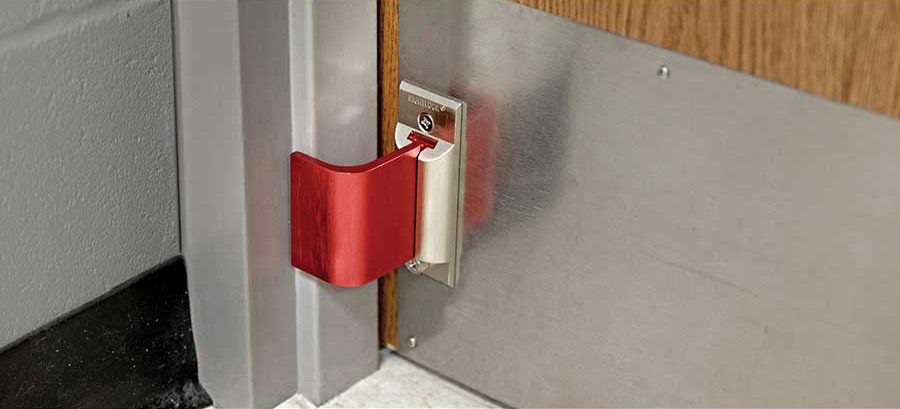
Barricade Devices and Door Blocking Hardware Non-permanent barricade devices — steel bars, wedge mechanisms, or door-mounted brackets that physically brace the door against opening — provide an additional layer of physical security beyond the lock itself. However, Texas Education Code and local fire codes impose specific limitations on barricade device use in schools — devices must allow egress from inside at all times, must not require special knowledge to operate, and must be AHJ-approved for the specific building. [5] Austin district administrators should confirm fire marshal acceptance of specific barricade device designs before installation.
Electronic Lockdown Locks (One-Touch Lockdown) Electronic classroom lock hardware — including products in the Allegion ENGAGE and SARGENT/Corbin Russwin CX10 series — allows a teacher to engage the lock with a single button press on the interior side. Some configurations also allow remote lockdown activation from the school administration office or a campus security management platform — a single command from the office can simultaneously lock all classroom doors on the campus. [7]
These systems support both normal keyless entry (teachers enter with a credential or code from the corridor) and instant one-touch lockdown from inside the classroom. They also integrate with campus-wide access control systems, enabling the administration office to see which classroom doors are locked and which are not in real time.
Crisis Alert Integrated Hardware Some classroom lockdown hardware platforms integrate with school crisis alert systems — when a teacher activates the lockdown button at the door, the event is simultaneously logged in the campus security system, generates an alert to the administration office, and in some configurations initiates a campus-wide lockdown notification. This integration means that a single teacher’s lockdown action can cascade into a coordinated campus response.
Keyless Classroom Entry: Managing Access During Normal Operations
Classroom lockdown hardware doesn’t exist in isolation — it must also function correctly during normal school operations, where teachers need to enter and exit their classrooms multiple times daily.
Electronic lockdown locks address this by supporting credential-based normal entry: teachers enter their classroom using a credential (PIN, smart card, or mobile credential) at the exterior reader, rather than a physical key. This eliminates the key management challenge that physical classroom keys create — keys that are lost, duplicated, and not returned when a teacher leaves — while maintaining a credentialed access record for every classroom entry.
During normal operations, the classroom door may be set to free-egress mode (always unlocked from inside, credential required from outside), or to scheduled modes that automatically adjust access based on the school day schedule.
During a lockdown, the electronic lock’s lockdown function supersedes the normal access schedule — the door is locked from inside with a single press, and no credential (including an authorized credential from outside) can open it until the lockdown is cancelled by an authorized administrator.
For Austin campuses with existing access control infrastructure, electronic classroom locks from compatible platforms can be added to the existing system — extending the same credential management and administration tools the district already uses to classroom door hardware without requiring a separate standalone system.
Integrating Classroom Locks with Campus-Wide Access Control
For Austin school districts with campus-wide IP access control systems, integrating electronic classroom locks with the broader access control platform provides capabilities that standalone classroom hardware cannot:
Real-time lockdown status monitoring. The administration office sees which classroom doors are locked and which are not, in real time, during a lockdown event — enabling more informed decisions about where to deploy personnel and how to communicate with specific classrooms.
Centralized lockdown activation. A single command from the administration office’s access control software can simultaneously lock all classroom doors on the campus — or all doors in a specific wing or building — rather than relying on each teacher individually to engage their classroom lock.
Access event logging for investigation. Every classroom door entry is logged — supporting post-incident investigation, safety audit documentation, and the TxSSC audit requirements that address access record maintenance for school facilities.
Visitor management integration. Classroom electronic locks integrated with the campus visitor management system mean that an authorized visitor entering a specific classroom for a scheduled purpose is granted temporary access without requiring the teacher to open the door.
Nexlar’s educational security systems for Austin campuses combine classroom lockdown hardware with campus-wide access control, visitor management, and surveillance in an integrated platform designed to meet TxSSC standards.
Aligning with Texas School Safety Center Standards
The Texas School Safety Center’s school security audit framework evaluates classroom door security across several criteria that directly map to the hardware decisions described in this guide. [4]
Auditors evaluate whether classroom doors can be locked from the inside without a key — a documented deficiency when a key is required to engage the lock. They evaluate whether locked status is visually indicated on the door. They evaluate whether the door hardware and locking mechanism are ADA-compliant. They evaluate whether the lock can be bypassed from outside with a key or credential by authorized personnel (emergency response access). And they evaluate the training provided to teachers and staff on the lockdown procedure for their specific hardware.
A classroom security improvement project for an Austin school that addresses all of these criteria — inside-lockable without a key, visual status indication, ADA compliance, authorized override capability, and staff training — produces audit documentation that directly demonstrates remediation of the deficiencies most commonly found in Texas school security audits.
Hardware Comparison Table
| Hardware Type | Inside Lock Without Key | Visual Status Indicator | Remote Campus Lockdown | Access Log | ADA Compliant |
|---|---|---|---|---|---|
| Standard Classroom Key Lock | No | No | No | No | Varies |
| Single Cylinder + Inside Thumb Turn | Yes | No | No | No | Yes (w/ lever) |
| Barricade Device (code-compliant) | Yes | No | No | No | Varies |
| Electronic Lockdown Lock (Allegion ENGAGE etc.) | Yes (1 touch) | Yes | Yes (integrated) | Yes | Yes |
| Electronic + Crisis Alert Integration | Yes (1 touch) | Yes | Yes (cascade) | Yes | Yes |
Cost and Pricing for Austin School Installations
| Hardware Type | Estimated Cost Per Classroom |
|---|---|
| Inside Thumb Turn Cylinder Replacement | $200 – $450 per door |
| ADA Lever Upgrade + Inside Thumb Turn | $350 – $700 per door |
| Electronic Lockdown Lock (hardware + install) | $800 – $1,800 per door |
| Electronic Lockdown + Access Control Integration | $1,200 – $2,500 per door |
| Campus-Wide Lockdown Command Integration | $3,000 – $10,000 (system-level) |
| Full Campus Classroom Hardware Upgrade (30 classrooms) | $25,000 – $75,000 |