

Securing Large-Scale Warehouses: Best Access Control Systems in Houston
If you operate a distribution center, 3PL facility, or industrial yard along the I-10 corridor or near the Port of Houston, you already know the hard truth: a padlock and a clipboard are not security. Choosing the right warehouse access control systems in Houston is now a core operational decision, one that affects loss prevention, insurance premiums, OSHA compliance, and how fast your trucks move through the gate. This guide breaks down the hardware, the integration strategy, and the local Houston compliance factors that separate a system that actually protects your facility from one that just looks the part.
At Nexlar Security, we’ve designed and installed commercial access control for warehouses, logistics hubs, and trucking yards across the Houston metro for over 15 years. Below is the same framework our engineers use when we walk a client’s site for the first time.
1. The Real Challenges of Securing High-Traffic Houston Warehouses
Warehouses are uniquely difficult to secure because they are designed for flow, not for control. Product, people, and vehicles move constantly. And every dock door, man-gate, and truck entrance is a potential breach point. In a high-volume Houston facility, the security challenges stack up fast:
- High personnel turnover. Seasonal labor, temp staff, and contractors cycle through constantly. Physical keys and fobs get lost, copied, or walk out the door, and rekeying a large facility is expensive and slow.
- Vehicle gate bottlenecks. Trucks idling at a slow gate cost you money and clog the yard. But speeding up entry without verifying who’s coming in trades security for convenience.
- Tailgating and piggybacking. One badge swipe, three people through the door. In a busy shift change, this is constant, and it’s how most internal theft starts.
- No audit trail. When inventory goes missing, “who was in the building at 2 AM” should be a two-minute query, not a guessing game.
- Sprawling, multi-zone footprints. A warehouse isn’t a single space; it’s a shipping office, a climate-controlled storage area, a hazmat cage, a server closet, and a yard, each requiring different access rules.
The Houston climate adds its own pressure. Gulf Coast heat, humidity, and storm exposure punish outdoor readers, gate operators, and cabling that wasn’t spec’d for the environment. A system that works in a showroom can fail in a Houston summer.
2. Key Hardware: Card Readers, Gate Integration & Vehicle Tracking
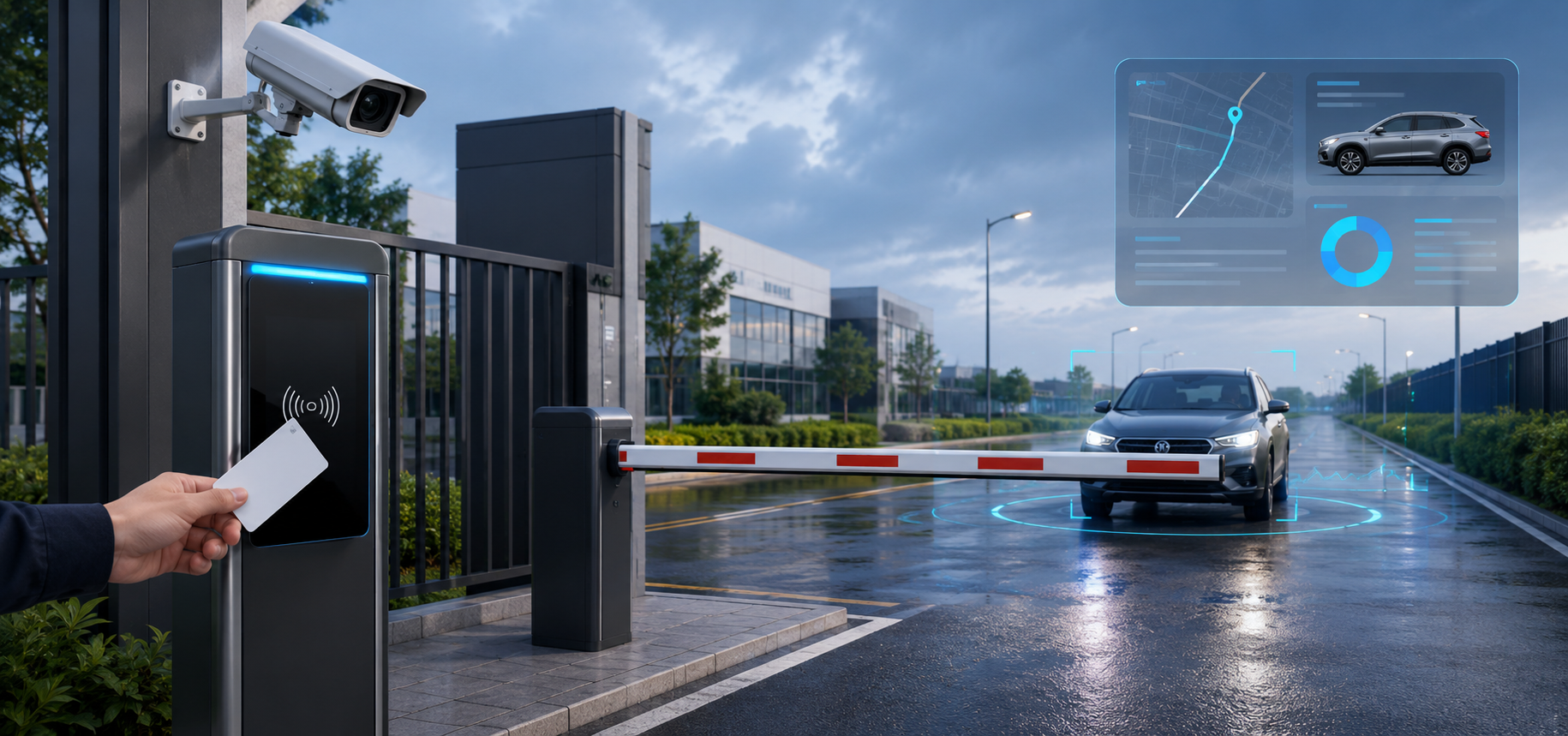
The heart of any warehouse system is the credential reader, and modern commercial card readers in Houston have moved far beyond the old swipe-card era. Here’s how the core hardware layers fit together.
Multi-Factor Credential Readers
For a warehouse, the right credential strategy is usually layered; different doors warrant different levels of verification. The strongest systems support multiple credential types on the same platform so you can apply the right level of friction to the right door:
- Mobile credentials (Apple Wallet / Google Wallet): employees tap a phone or smartwatch, the same gesture as paying for coffee. No physical card to print, lose, or clone, and credentials are revoked instantly from a dashboard the moment someone leaves.
- Encrypted smart cards & fobs: still the workhorse for shift workers, backward-compatible with HID Prox, iClass, and standard RFID.
- PIN keypads: low-cost second factor for sensitive interior doors (server room, hazmat cage, cash office).
- Biometrics: fingerprint or facial readers for the highest-security zones, where you need to know it’s the actual person, not just their badge.
This is where platform choice matters. Brivo is built cloud-native, which makes managing one Houston warehouse, or twenty across Texas, a single-dashboard job, with automatic overnight software updates and no on-site server to maintain. PDK (ProdataKey) is the integrator’s favorite for fast, scalable installs, with controllers built for both indoor and outdoor doors and gates, plus battery backup that keeps the system running during a power outage, a real consideration during Houston storm season.
Gate Integration & Industrial Gate Security

Your perimeter is your first line of defense, and industrial gate security in Houston is where access control and physical barriers meet. A modern warehouse gate ties the credential system directly to the gate operator, so the same platform that controls your doors also controls who drives onto the property:
- Slide and cantilever gates with heavy-duty operators rated for high cycle counts and continuous truck traffic.
- Barrier arm gates for employee lots and staging areas, integrated with RFID or LPR for fast, hands-free entry.
- Telephone / intercom entry for visitor and delivery verification before the gate ever opens.
- Crash-rated barriers and bollards where a facility needs anti-ram protection at the perimeter.
Vehicle Tracking & License Plate Recognition (LPR)
For truck-heavy facilities, vehicle tracking is the upgrade that pays for itself. LPR cameras at the gate read every license plate entering and leaving, automatically logging the vehicle, the time, and, when paired with access control, matching it to an authorized carrier or appointment. No fumbling for a fob, no manual gate logs, and a searchable record of every vehicle that touched your yard.
This is where camera hardware enters the picture. Axis network cameras are an industry benchmark for LPR and perimeter analytics, with on-camera processing that flags events at the edge. Hanwha (Wisenet) cameras bring AI object classification that can distinguish a person from a forklift from a truck, and tie that detection to an access event, so a door forced open triggers the nearest camera to flag and record automatically.
Hardware Platform Comparison at a Glance
Here’s how the four platforms we most often deploy for Houston warehouses compare:
Platform | Best For | Credential Types | Standout Feature |
|---|---|---|---|
Brivo | Multi-site cloud management | Mobile (Apple/Google Wallet), HID Prox, iClass, RFID, PIN | Cloud-native since 2002; unified Security Suite + AI video (Eeva) |
PDK (ProdataKey) | Fast, scalable wired/wireless installs | Mobile, cards, fobs, stickers, wristbands | “Any device” cloud control + battery backup during outages |
Axis | Network cameras + edge analytics at the gate | Integrates with access via I/O + ONVIF | Best-in-class IP cameras for LPR & perimeter analytics |
Hanwha (Wisenet) | AI video tied to access events | Integrates with access platforms | On-camera AI object classification for loading docks |

3. Compliance: Logistics Security Standards & Houston Fire Marshal Regulations
A warehouse access control system isn’t just about keeping bad actors out; it has to keep your people safe and keep you on the right side of regulators and insurers. This is the part many low-bid installers ignore, and it’s where a non-compliant system becomes a liability.
Life-Safety & Houston Fire Marshal Requirements
Any access-controlled door that sits on an egress path is subject to fire and life-safety code. In Houston, that means your system has to satisfy the local fire marshal’s interpretation of NFPA 101 (Life Safety Code) and the International Fire Code, including:
- Fail-safe egress: controlled doors must release and allow free exit on fire alarm activation or power loss. Locking people in is never acceptable, and it’s an inspection failure.
- Integration with the fire alarm panel so that an alarm automatically unlocks designated egress doors.
- Request-to-exit (REX) devices and proper signage on delayed-egress hardware where it’s permitted.
- Permitting and inspection of low-voltage work in commercial Houston facilities must be performed by appropriately licensed technicians and must pass AHJ (Authority Having Jurisdiction) inspection.
Logistics & Supply-Chain Security Standards
If you move freight, your customers and partners may hold you to formal supply-chain security frameworks. The right access control system provides the documented controls these programs require:
- C-TPAT (Customs-Trade Partnership Against Terrorism) requires controlled access, visitor management, and documented procedures for issuing and removing credentials, all native to a modern access platform.
- TAPA FSR (Freight Security Requirements) specifies access control, CCTV, and audit-trail standards for facilities handling high-value goods.
- Insurance & audit requirements: many carriers now require access logs and video retention as a condition of coverage, and a clean audit trail can lower your premiums.
The common thread: every one of these standards depends on a complete, exportable audit trail, exactly what a cloud platform like Brivo or PDK delivers, and exactly what a box of disconnected card readers cannot.
Why Houston Warehouses Choose Nexlar Security
Picking the hardware is only half the battle; the install, the integration, and the support determine whether the system actually performs. As a licensed Texas integrator (License #B14634) with an A+ BBB rating and over 1,000 commercial clients secured, Nexlar delivers single-source design, installation, low-voltage cabling, and ongoing service so there’s never any finger-pointing between vendors.
Explore our core commercial access control systems, see how we approach warehouse and distribution center security, or learn about our commercial security camera installation and industrial gate and access integration.
Frequently Asked Questions
Q: How much does a warehouse access control system cost in Houston?
Cost depends on the number of doors and gates, the credential types you choose, and how much cabling and gate hardware your facility needs. Cloud software like Brivo or PDK is typically licensed per door per month (commonly in the $4–$8 range), on top of one-time hardware and installation. A small facility with a handful of doors is a modest project; a large multi-zone distribution center with gate integration and LPR is a larger investment. Nexlar provides a free onsite survey and a transparent, line-itemed quote so you see exactly what your facility requires.
Q: What are the best commercial card readers for a Houston warehouse?
For most Houston warehouses we recommend cloud-managed platforms — Brivo for multi-site, single-dashboard management, and PDK for fast, scalable installs with outdoor-rated controllers and battery backup. Both support mobile credentials (Apple/Google Wallet), encrypted cards, fobs, and PIN, so you can layer security door by door. The best reader for your site depends on traffic volume, environment, and whether you need biometrics on sensitive interior doors.
Q: Can access control integrate with my warehouse gate and cameras?
Yes. Modern systems tie credential readers, gate operators, and cameras into one platform. The same system that unlocks a man-door can trigger your slide gate, while LPR cameras (commonly Axis) read license plates at the entrance and AI cameras (such as Hanwha Wisenet) tie video to access events — so a forced door automatically flags and records. This integration is exactly what supply-chain security standards and insurers look for.
Q: Does warehouse access control need to meet Houston fire codes?
Absolutely. Any controlled door on an egress path must fail safe — releasing on fire alarm or power loss to allow free exit — and integrate with the building’s fire alarm panel. Houston facilities must pass inspection by the Authority Having Jurisdiction, and low-voltage work should be performed by licensed technicians. Nexlar designs every system to satisfy NFPA 101 and the International Fire Code and to pass local fire marshal inspection.
Q: How long does installation take and will it disrupt operations?
Timelines depend on facility size and scope. A few doors can be completed in days; a large multi-zone facility with gate integration and LPR typically runs one to three weeks. Nexlar schedules around your shifts and dock activity to minimize downtime, and we commission and test every door and gate before handover so the system works on day one.
Do You Have A Project
Free quote for your security system or low voltage installation project.
About Us
At Nexlar, security isn’t just a service—it’s our commitment to excellence. As an expert security system company, we are proud to offer a wide range of integrated security system solutions.
Follow Us