

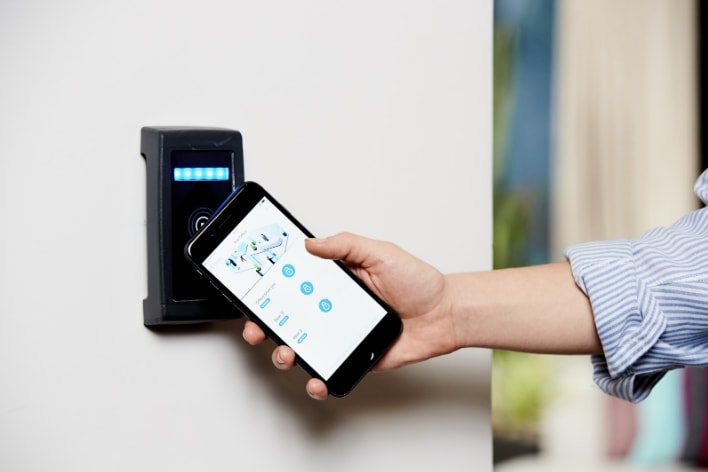
Phone RFID Reader: What is it & How does it work
RFID technology has quietly transformed how businesses manage access control, track assets, and secure environments. What once required bulky hardware is now built directly into the device most people carry every day. The rise of the smartphone RFID reader has changed how organizations approach security, efficiency, and identity verification. At Nexlar, we frequently help businesses integrate advanced RFID systems into commercial security solutions, and one of the most common questions we hear is about the phone RFID reader and how it truly works in real-world applications.
To fully understand this innovation, it is important to first explore RFID meaning, how RFID works at a technical level, and how modern smartphones have evolved into powerful RFID reader devices.
Understanding RFID meaning and its real purpose
For many people, RFID meaning is still unclear even though it is used every day in key cards, access badges, toll tags, inventory tracking systems, and retail security. RFID stands for Radio Frequency Identification. When people ask what does RFID stand for or what does RFID mean, the answer always points back to the same core concept which is identifying objects or users using radio waves instead of physical contact.
An RFID system works by transmitting data wirelessly between a small electronic tag and an RFID reader. The tag stores information such as an ID number, user credentials, or product data. The RFID reader scans the tag using radio waves and instantly verifies or records the information without requiring a physical connection.
This wireless communication is what makes RFID technology so powerful for modern security environments. It allows fast authentication, hands-free operation, and real-time tracking with a very high level of reliability.
How does RFID work in simple terms
To understand how does RFID workRFID Gate Access Control in practical use, imagine a secure office where employees tap a badge on a reader to enter. That badge contains a tiny RFID chip and antenna. When it comes close to the RFID reader, the reader sends out a radio signal. The RFID tag absorbs energy from that signal and responds with its stored data. The reader captures that data and sends it to the access control system to approve or deny entry.
This same principle applies whether it is a keycard, a vehicle tag at a gated facility, or a smartphone RFID reader. The difference today is that the RFID reader no longer has to be a dedicated piece of hardware mounted on a wall. The modern RFID device can now be a mobile phone.
Understanding how RFID works at this level helps businesses see why it is so effective for secure identification and tracking without delays.
The evolution of RFID technology into smartphones
RFID technology was once reserved for large enterprise systems, warehouses, government facilities, and high-level access control environments. Over time, the hardware became smaller, faster, and easier to integrate into everyday devices. This evolution gave rise to the smartphone RFID reader.
Today, many modern smartphones contain Near Field Communication hardware which is a specialized form of RFID technology. This allows a smartphone RFID reader to scan RFID tags, authenticate users, read encoded credentials, and even emulate an RFID card for access control.
This capability is what allows a mobile device to function as both an RFID reader and an RFID tag, depending on how it is configured within an RFID system.
What makes a cell phone RFID reader different
A traditional RFID reader is typically fixed in one location and connected directly to a central access control system. A cell phone RFID reader, however, brings mobility and flexibility into the equation. With the right software and permissions, a smartphone RFID reader can perform functions that once required expensive, dedicated scanning equipment.
A smartphone RFID reader can be used to enroll new access credentials, verify identity on the go, conduct mobile security checks, and manage assets remotely. In high-security environments, this eliminates the need for manual data entry and reduces human error.
A true RFID cell phone solution also allows businesses to push encrypted credentials directly to an authorized user’s phone, turning the phone itself into a secure RFID device for access control.
How a phone RFID reader works inside an RFID system
Inside a modern RFID system, a phone RFID reader plays a highly interactive role. When the smartphone scans an RFID tag, it captures encrypted credential data using its built-in radio antenna. That data is passed through security software inside the phone, which then communicates with cloud-based or on-premise access control servers.
The system verifies permissions, confirms identity, logs activity, and issues an immediate response whether approval or denial. This entire process takes place in milliseconds.
What makes this model powerful is scalability. Businesses are no longer limited to how many fixed readers they install. Every authorized smartphone RFID reader becomes an extension of the access control infrastructure.
Practical business use cases for smartphone RFID readers
In real-world security deployments, smartphone RFID reader solutions are being used across healthcare, property management, warehouse operations, manufacturing, education, and government facilities. These devices are used to issue temporary credentials, validate contractor access, manage equipment, and log entry history without installing additional hardware.
In healthcare environments, a phone RFID reader helps staff securely verify patient wristbands. In logistics, it scans tagged pallets without stopping manual workflows. In commercial buildings, it allows security teams to perform mobile audits and instantly verify badge authenticity.
Each of these applications relies on the same core concept of how RFID works within a broader security system.
Security and encryption in RFID devices
A major concern we hear at Nexlar is whether a smartphone RFID reader is secure enough for commercial environments. Modern RFID technology relies on advanced encryption standards, rolling credentials, tokenization, and multi-layer authentication.
A properly configured RFID device does not simply transmit raw data. It encrypts communication between the reader, the tag, and the backend system. Additionally, many access control platforms require biometric verification on the phone before activating the RFID reader function.
This means that even if a phone is lost, unauthorized users cannot simply walk into secure spaces without authentication layers being satisfied.
Limitations of RFID cell phone solutions
While RFID cell phone solutions offer tremendous flexibility, they are not always a replacement for fixed RFID readers in every scenario. Some high-security environments still require wall-mounted enterprise-grade readers for perimeter protection. Additionally, older smartphones may not support the necessary radio frequencies required for advanced RFID systems.
Interference from metal surfaces, distance limitations, and environmental conditions can also impact scanning range and performance. This is why professional system design and consultation are critical in any large-scale RFID deployment.
Why businesses are adopting phone RFID readers rapidly
Businesses are rapidly adopting phone RFID reader solutions because they reduce infrastructure costs, simplify onboarding, and improve operational efficiency. A single smartphone RFID reader can replace multiple handheld scanners, keycard programmers, and verification terminals.
It also supports remote management, cloud integration, and real-time visibility across distributed locations. These capabilities make RFID technology far more agile than older access control methodologies.
The future of RFID technology in mobile access
The future of RFID technology is deeply connected to mobile authentication. As artificial intelligence, biometric security, and cloud processing continue to advance, the smartphone RFID reader will become the primary gateway to identity-based security systems.
Eventually, mobile devices will not only verify access but also analyze usage behavior, detect anomalies, and predict security risks before they escalate.
Why choose Nexlar for reliable RFID security integration
At Nexlar, we do not simply sell security hardware. We design, integrate, and support full-scale RFID systems tailored to real business environments. Whether you need a smartphone RFID reader deployment, a traditional RFID reader system, or a hybrid solution, our team ensures that performance, security, scalability, and compliance are aligned with your operational goals. Our experience across commercial security, access control, and enterprise surveillance systems allows us to build solutions that work not only today but continue protecting your organization as it grows.
Frequently asked questions about phone RFID readers
Q. What does RFID stand for?
RFID stands for Radio Frequency Identification. It is a wireless technology used to identify objects, people, or assets using radio waves instead of physical contact.
What does RFID mean in mobile security?
In mobile security, RFID refers to the ability of smartphones to read, transmit, or emulate encrypted credentials for access control and identity verification.
Q. How does RFID work inside a smartphone?
A smartphone uses its built-in radio frequency hardware to communicate with an RFID tag. The phone transmits a signal, the tag responds with encoded data, and the phone processes that data through secure software linked to an RFID system.
Q. Is a smartphone RFID reader as secure as a traditional RFID reader?
Yes when configured properly with encryption, authentication layers, and system controls. In many cases, smartphone RFID readers provide additional security through biometric verification.
Q. Can any phone function as an RFID device?
Not all phones support RFID technology. Only devices equipped with compatible radio frequency hardware and approved software can function as an RFID device or smartphone RFID reader.
Q. What is the difference between an RFID reader and a cell phone RFID reader?
A traditional RFID reader is a fixed scanning unit. A cell phone RFID reader is a mobile device that performs the same scanning and authentication functions through built-in hardware and security applications.
Q. Is RFID safe for daily use?
Yes RFID technology operates at very low power levels and is considered completely safe for everyday use in personal, commercial, and industrial environments.
Q. How does RFID work for access control?
The RFID reader scans a credential tag, sends encrypted data to the access control server, verifies permissions, and grants or denies access in real time.
Q. Is RFID technology used only for security?
No RFID technology is also used in inventory tracking, logistics, healthcare, retail, transportation, manufacturing, and asset management systems.
Final thoughts on phone RFID reader technology
Understanding RFID meaning, how RFID works, and how a smartphone RFID reader fits into a modern RFID system empowers businesses to make smarter security decisions. The ability to transform a mobile phone into a secure RFID device is not just a convenience. It is a major shift in how access control and identity management are designed, deployed, and maintained.
As threats continue to evolve, mobile-first RFID technology provides the adaptability and intelligence required to protect today’s connected environments.
For expert consultation on RFID systems, smartphone RFID reader integration, and advanced commercial security solutions, contact Nexlar today and let our specialists guide your next security upgrade.
Follow Us