

Product Review: Delta DSC501 – The HQ Standard
When a facility requires more than a sign or a gate to stop a determined threat, the conversation shifts to crash-rated perimeter protection. At Nexlar, we have installed, evaluated, and recommended vehicle barrier systems across commercial, government, and critical infrastructure sites throughout Texas. After years of working hands-on with high-security hardware, we can say with confidence that the Delta DSC501 sits at the top of the heap. This delta dsc501 review covers everything you need to know before specifying this system — from raw crash performance to real-world installation factors and the site types where it genuinely earns its price tag.
DSC501 Crash Specs
The delta 501 is not a conventional wedge barrier dressed up with impressive marketing language. It is the only K54-certified vehicle barricade in the world, a designation that reflects a performance level most competing products do not even attempt to reach. In full-scale testing, the DSC501 stopped and destroyed a 65,000-pound dump truck traveling at 50 mph — an impact energy equivalent to 5.4 million foot-pounds. After the crash test, the barrier was repaired and returned to full operational status within three hours. The foundation was undamaged.
For comparison, K12 certification — already considered a high-security threshold — requires stopping a 15,000-pound vehicle at 50 mph. The DSC501 surpasses that standard by a significant margin, and it carries K12/L3 certification as its baseline, exceeding the requirements of both the U.S. Department of State and the U.S. Department of Defense. In the United Kingdom, it has been independently tested to BSI Standard PAS:68 2007, successfully stopping a 7,500-kilogram vehicle traveling at 80 kph.
What makes the crash performance more noteworthy is that the barrier does not simply stop the first impact and fail. Because the structure remains functional after a primary strike, it actively prevents a second attack from a follow-on vehicle — a vulnerability that many lesser barriers leave wide open.
Pass-through timing under normal operation is configurable between 3 and 15 seconds, which makes the system workable for active vehicle inspection lanes and controlled access points. In an emergency, the wedge rises in under two seconds. That combination of routine flexibility and rapid threat response is rare in a single product.
Installation Timeline
One of the more practical aspects of the delta dsc501 product reviews that gets overlooked in comparison to the crash numbers is the shallow foundation requirement. The DSC501 requires a foundation depth of only 18 inches (46 centimeters). This is a substantial advantage in urban environments, retrofits, and sites where buried utilities — pipes, power conduits, fiber optic lines — make deep excavation costly and complicated.
Shallower excavation translates directly into shorter installation timelines and lower civil costs. A project that would otherwise require multiple days of trenching and concrete curing can move faster when the foundation footprint is compact. That means less disruption to active facilities, shorter closures for existing access lanes, and reduced labor costs on the civil side of the project.
The open channel construction design also allows for optional hot-dip galvanization, which matters in high-humidity environments, coastal installations, or sites with corrosive soil conditions. The DSC501 was originally designed for the U.S. Navy — an environment where salt air and corrosive conditions are a daily reality — so this durability was engineered in from the beginning, not added as an afterthought.
Hydraulic operation is managed through Delta's patent-pending hydraulic power unit, which can be configured to drive one or multiple DSC501 units from a single power source. The system includes a vehicle detector safety loop as an available option, which helps prevent the barrier from rising under a vehicle that is partially through the opening.
For facilities that are planning a phased perimeter upgrade, the scalable hydraulic configuration is a meaningful benefit. You can start with a single lane and expand the system later without replacing the power unit.
Ideal Use Cases
The delta dsc501 review conversation does not end at specifications — it needs to address where this product actually belongs. The DSC501 is purpose-built for high-consequence environments where a vehicle intrusion would represent more than a property crime. That includes federal buildings, military installations, U.S. embassies (for which it has been specifically selected), power generation facilities, data centers, port authority checkpoints, and critical infrastructure sites.
It has a documented history of real-world performance. At Mayport Naval Station in Florida, the DSC501 prevented two separate vehicle attacks within an eight-day period. That kind of operational track record is not replicable in a test lab, and it speaks directly to the system's reliability under actual threat conditions rather than controlled crash scenarios.
Corporate campuses that house sensitive research, pharmaceutical manufacturing sites, government contractor facilities, and large distribution centers handling high-value cargo are also strong candidates. Anywhere that a motivated driver in a heavy vehicle poses an existential risk to people or operations, the DSC501 is a reasonable specification.
It is also worth noting that the barrier is suitable for high water table locations. Many sites that sit near rivers, coastal floodplains, or areas with elevated groundwater find that deep-foundation barriers become impractical. The DSC501's shallow footprint eliminates that barrier to deployment.
How the DSC501 Compares to Other Wedge Barrier Options
When evaluating this wedge barrier against alternatives in the Delta Scientific catalog — such as the HD300 or the DSC2000 — the DSC501 occupies the top performance tier. The HD300 achieves an M50/P1 rating, which is strong, but it does not approach K54. The DSC2000 is modular and suited for remote or temporary deployments. The DSC501 is the choice when permanence and maximum impact resistance are both non-negotiable.
Compared to products from other manufacturers entirely, the K54 certification is genuinely exclusive. No other manufacturer has achieved it. That is not a marketing claim; it is a verifiable certification standard. For facilities subject to specific government contracting requirements, that distinction can be the deciding factor in the specification process.
The SAFETY Act certification from the U.S. Department of Homeland Security adds another layer of credibility that competitors have not matched. Delta Scientific holds Red Seal Certification — the higher of two SAFETY Act tiers — covering the DSC501 alongside other products in their catalog. For facilities where liability management and federal compliance intersect, this certification is a legitimate competitive advantage in the procurement process.
Operational Features Worth Noting
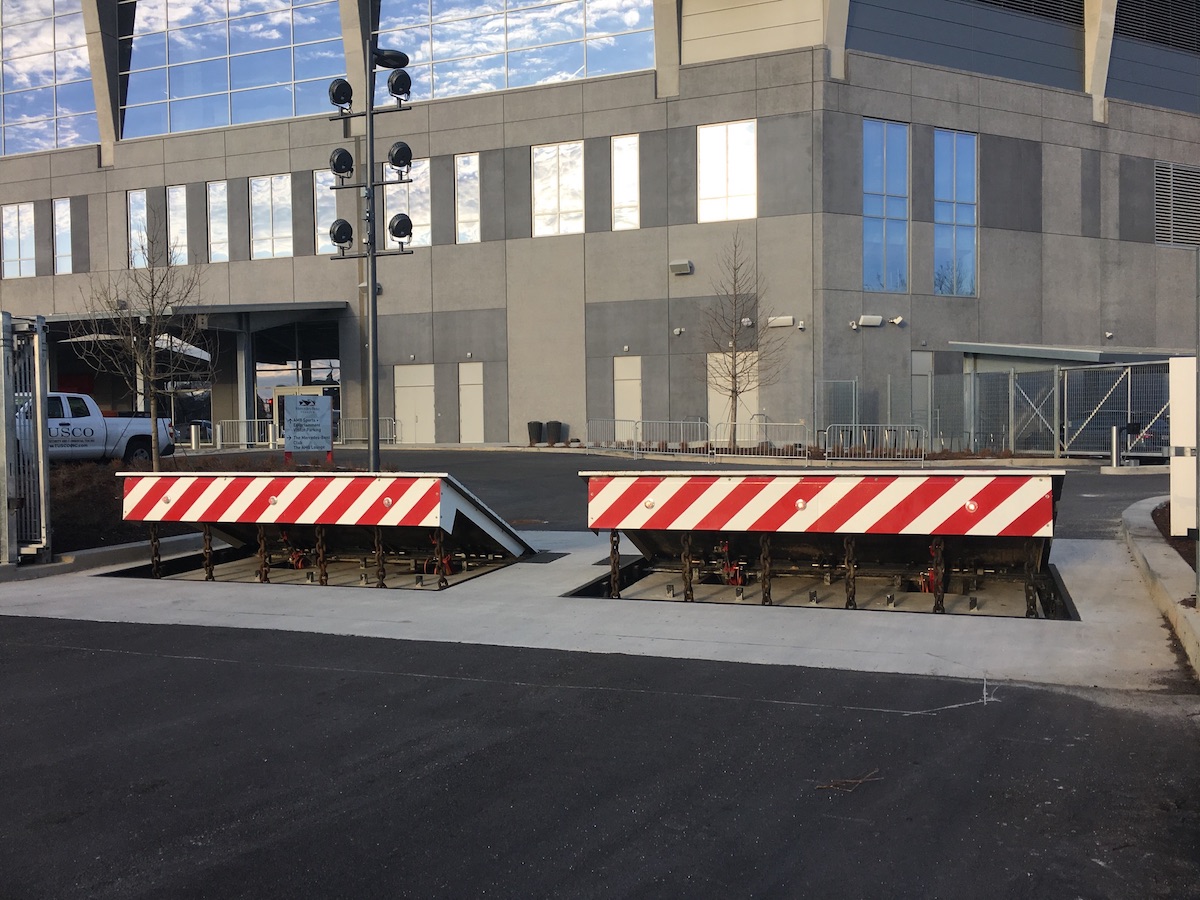
Beyond the headline crash numbers, several operational details make the DSC501 easier to live with as a long-term installation. The barrier ramp sits completely flush with the roadway in the lowered position, meaning there are no buttresses, counterweights, or road plates creating obstacles for pedestrians or authorized vehicles. That flush profile matters enormously at high-traffic checkpoints where even a minor surface irregularity creates operational complaints or liability concerns.
Front-facing warning lights notify approaching drivers when the barrier is in the raised position, reducing the risk of accidental contact. The front face also includes space for signage, which supports compliance with local traffic ordinances and internal access control procedures. Standard diagonal yellow and white stripe markings are included, with optional custom colors and graphics available for facilities that require specific visual protocols.
After its crash test, the DSC501 was documented to complete 27,000 operational cycles with no measurable wear. That kind of cycle life means reduced maintenance costs over the system's lifespan and fewer service calls interrupting facility operations.
Why Choose Nexlar for Your Wedge Barrier Installation
At Nexlar, we do not simply drop equipment at a jobsite and hand over a manual. We approach every wedge barrier project as an integrated security problem that requires site assessment, civil coordination, access control integration, and post-installation support. Our team has the experience to evaluate whether the DSC501 is the right specification for your site or whether a different Delta Scientific product — or a complementary combination of barriers — better matches your threat model and budget.
We work with commercial properties, government facilities, and critical infrastructure clients across Houston, Dallas, San Antonio, Austin, Fort Worth, and San Marcos. We carry the proper licensing, maintain a rigorous background-check process for all technicians, and hold an A-plus BBB rating that reflects our commitment to delivering on what we promise. When you invest in a K54-rated barrier system, you deserve an installation partner who treats that investment with the same seriousness you do. That is what Nexlar brings to every project.
Frequently Asked Questions About the Delta DSC501
Q. What crash rating does the Delta DSC501 carry?
The DSC501 is the only K54-certified vehicle barrier in the world. It also carries K12/L3 certification as a baseline and has been independently tested to the UK's BSI Standard PAS:68 2007.
Q. How deep does the DSC501 foundation need to be?
The foundation requires a depth of only 18 inches (46 centimeters), which is significantly shallower than most deep-foundation barrier systems. This makes it suitable for sites with high water tables, buried utilities, or corrosive soil conditions.
Q. How quickly does the DSC501 raise in an emergency?
Under normal operating conditions, the barrier cycles in 3 to 15 seconds depending on configuration. In an emergency, the wedge rises in under two seconds.
Q. What kinds of facilities use the Delta DSC501?
The DSC501 has been deployed at U.S. Navy installations, U.S. embassies, and other high-security government and military sites. It is appropriate for any facility where a vehicle intrusion poses a serious risk to personnel, critical infrastructure, or national security assets.
Q. Is the DSC501 covered by SAFETY Act certification?
Yes. Delta Scientific holds SAFETY Act Red Seal Certification from the U.S. Department of Homeland Security covering the DSC501 and other products in their portfolio.
Q. Can the DSC501 be operated remotely?
Yes. The hydraulic power unit supports remote operation and can be configured to control multiple DSC501 units from a single system. A vehicle detector safety loop is also available as an option.
Q. Does the DSC501 work in coastal or corrosive environments?
Yes. The open channel construction supports hot-dip galvanization, and the system was originally engineered for U.S. Navy applications where corrosive conditions are standard.
Q. What happens to the DSC501 after a major vehicle impact?
In K54 crash testing, the barrier survived a 65,000-pound truck impact, was repaired, and returned to full operational status within three hours. The foundation was undamaged, and the system subsequently completed 27,000 additional cycles with no wear.
Follow Us