

Houston’s construction market is one of the most active in the United States, with major residential, commercial, and infrastructure projects running across Harris County and the surrounding growth corridors at any given time. That volume of active construction also makes the Houston market one of the highest-loss markets in the country for construction site theft.
The Inland Marine Underwriters Association estimates that equipment theft costs the U.S. construction industry $300 million to $1 billion annually. Texas consistently ranks among the top states for construction equipment theft, and the Houston metropolitan area is among the highest-concentration markets within Texas. [1]
Copper wire, heavy equipment, power tools, generators, and HVAC materials are the most frequently targeted items at Houston construction sites. The theft pattern is predictable: after-hours entry through a fenced perimeter, typically on a Friday night or holiday weekend when the site will be unoccupied until Monday morning. By the time the project superintendent arrives to find the theft, the opportunity to catch the perpetrators has passed and the only remaining question is how to document the loss for insurance.
Solar mobile surveillance trailers address this problem by moving the detection window from after the theft to during the approach. This guide covers how these systems work, where they are deployed, and what Houston general contractors and site operators need to know about deploying them on active job sites.
Get a Free Construction Site Security Assessment
Nexlar Security designs and deploys mobile surveillance systems for Houston construction sites. Free on-site evaluation, no obligation. Contact Nexlar at nexlar.com/contact or call (281) 407-0768
Why Traditional Security Fails During Framing and Excavation Phases
The framing and excavation phases of a construction project are the periods of highest theft vulnerability for two reasons that compound each other. First, significant quantities of valuable, portable materials are present on site. Copper rough-in, structural lumber, HVAC equipment deliveries, and portable power equipment all concentrate on the site during these phases. Second, the infrastructure that typically supports permanent security systems is not yet available.
A wired security camera system requires power infrastructure and network connectivity. During framing and excavation, neither is consistently available at a Houston construction site. The permanent electrical system is not yet energized. Hardwired network infrastructure does not exist. Site office trailers may have generator power, but running hardwired camera infrastructure to all perimeter positions from a generator-powered trailer is both expensive and impractical for a site geometry that changes weekly.
This infrastructure gap means that the phases of highest theft risk are also the phases of lowest fixed security capability. The conventional workaround is a security guard, which is expensive and provides inconsistent coverage. The effective solution for Houston construction sites is a self-contained surveillance unit that brings its own power, its own connectivity, and its own processing capability to any position on the site where it is needed, without requiring any site infrastructure.
For an overview of how Nexlar approaches construction site security systems across the full project lifecycle, including the transition from mobile to permanent infrastructure as the build progresses, visit the construction industry page on the Nexlar website.
How Solar Mobile Surveillance Trailers Work
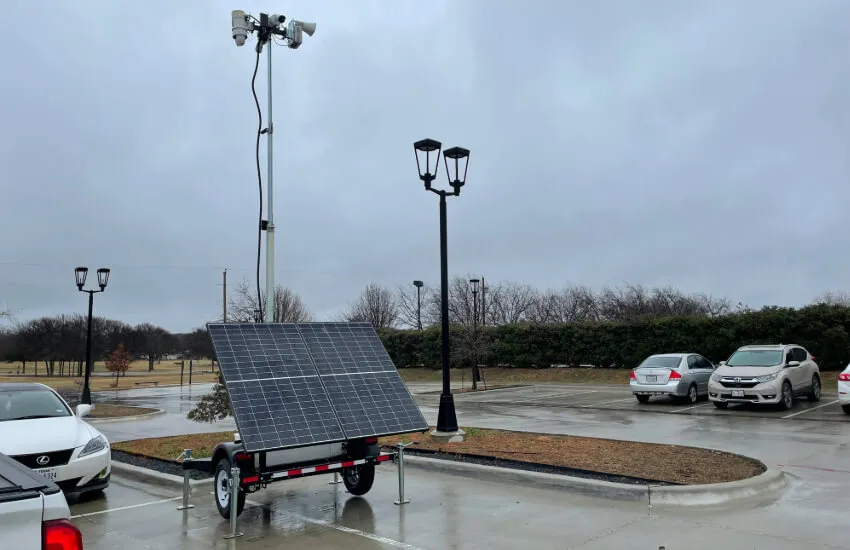
A solar mobile surveillance trailer is a purpose-built security platform mounted on a towable trailer chassis. The key components of a complete unit include:
Solar panel array. Roof-mounted solar panels (typically 200 to 600 watts of panel capacity depending on the unit size) charge an onboard battery bank. Panel capacity and battery bank size are engineered to maintain continuous operation through the night and through periods of reduced solar charging during overcast conditions. Houston’s average annual peak sun hours of approximately 5.5 per day support reliable solar charging for properly sized units. [2]
Battery bank. Sealed lithium iron phosphate (LiFePO4) or sealed lead-acid battery banks provide stored energy for overnight and cloudy-day operation. Battery capacity is specified to maintain full camera and cellular operation for a minimum of three to five days without solar charging, providing resilience during Houston’s storm weather events.
Camera array. Most solar surveillance trailers deploy a mast-mounted camera array elevated 20 to 30 feet above the ground for maximum coverage radius. Common configurations include PTZ cameras for operator-directed active monitoring, fixed cameras for continuous perimeter recording, and thermal cameras for after-dark and adverse-weather detection.
Cellular connectivity. A 4G LTE or 5G cellular modem provides internet connectivity without any site infrastructure. Camera feeds stream to cloud-based NVR storage, and real-time alerts and remote access are available to site managers and monitoring centers through the cellular connection.
Control and processing unit. Onboard computing processes AI analytics, manages camera control, handles cellular communication, and controls output devices including lights and audio sirens.
Equipment and Copper Theft Mitigation During High-Risk Build Phases
The deployment strategy for solar mobile surveillance trailers on a Houston construction site changes as the project phases progress, following the concentration of high-value materials rather than occupying fixed positions for the duration of the project.
During the site preparation and excavation phase, heavy equipment is the primary target. Excavators, skid steers, and grading equipment parked on site overnight represent tens of thousands to hundreds of thousands of dollars of theft or vandalism exposure. Trailer deployment during this phase prioritizes equipment staging areas and site perimeter entry points.
During the framing phase, copper wire and HVAC rough-in materials become the primary target. Theft during this phase is typically faster and lower-tech than equipment theft: a crew with a truck, wire cutters, and 30 minutes can strip several thousand dollars of copper rough-in from a residential development or commercial building frame. Trailer deployment shifts to the building perimeter and material laydown areas during this phase.
During the MEP rough-in and finishing phase, portable equipment and tool theft is the primary concern. Tool trailers, generator sets, and finish materials concentrate on site. Surveillance coverage of tool storage areas and site entry points remains the priority.
For Houston general contractors managing multiple concurrent projects, a fleet of solar surveillance trailers can be repositioned between projects as phases change, with each unit following the highest-risk phase of the project cycle rather than sitting at a low-risk project while a high-risk project goes uncovered.
4G LTE Connectivity and Self-Powered Solar Operation
The combination of solar power and 4G LTE cellular connectivity is what makes solar mobile surveillance trailers deployable anywhere on a Houston job site regardless of the site’s infrastructure status. These two features solve the two constraints that make traditional hardwired camera systems impractical during early construction phases.
4G LTE connectivity provides upload bandwidth sufficient for streaming multiple compressed video feeds to cloud NVR simultaneously, for delivering real-time analytics event clips to monitoring personnel, and for remote PTZ camera control by security operators. On Houston construction sites, cellular signal from AT&T, T-Mobile, and Verizon is reliable across most Harris County and surrounding county project locations, including suburban and exurban development sites that are outside the footprint of typical business-class wired internet service.
For remote project locations in the Houston exurbs or along the coastal corridor, 4G LTE signal can be supplemented with directional antenna systems that improve signal strength from the nearest tower. Nexlar evaluates cellular signal at each project site during the deployment assessment.
Self-powered solar operation eliminates the generator fuel cost, refueling logistics, and noise that make generator-powered temporary surveillance impractical for residential construction neighborhoods. Solar surveillance trailers operate silently, require no fuel deliveries, and maintain continuous operation through the typical Houston overnight without any site personnel present.
This combination means that a Houston GC can order a solar surveillance trailer deployed to a new site on Monday morning and have it operating by Monday afternoon, with remote viewing accessible from the project superintendent’s phone before close of business that day. Explore how Nexlar integrates mobile surveillance with broader security camera system solutions for Texas construction operators.
Thermal Analytics for After-Dark Perimeter Monitoring
Thermal imaging cameras detect heat rather than visible light, which makes them highly effective for perimeter monitoring on Houston construction sites during the after-dark periods when most theft occurs. In a pitch-dark job site with no active lighting, a standard camera produces footage of limited usefulness. A thermal camera detects the heat signature of any person or vehicle approaching the perimeter and produces a clear image of their movement regardless of ambient light level. [3]
For solar surveillance trailers on Houston construction sites, thermal cameras are typically deployed on the mast-mounted array for perimeter detection, providing wide-area thermal coverage of the site boundary and early detection of anyone approaching before they reach the fence line.
AI-powered thermal analytics extend the thermal camera’s capability beyond passive recording to active detection. The AI analytics layer monitors the thermal camera stream continuously and generates an alert when a human heat signature is detected within a configured perimeter zone. This alert is immediate, occurring the moment the detection event triggers rather than requiring a human monitor to be actively watching the feed. The alert is delivered as a push notification to the monitoring center and/or the site superintendent’s mobile device, with a clip of the detection event attached.
For Houston sites being monitored by a remote security operations center, the thermal analytics alert drives an immediate camera response: a monitoring operator receives the alert, reviews the clip, and directs a PTZ camera to the detection zone for live assessment of the situation and, where appropriate, audio challenge through the site’s siren and speaker system.
Audio Deterrent Sirens and Active Intervention
The most effective active deterrence element of a solar mobile surveillance trailer system for Houston construction sites is the audio siren and two-way speaker system. When a detection event triggers on the thermal camera system and is confirmed by a monitoring operator, the operator can broadcast a live or pre-recorded voice warning to the intruder through the trailer’s speakers at volume levels audible across a large construction site.
A live voice challenge stating that the site is monitored, that the intruder has been detected, and that police have been notified is highly effective at deterring most opportunistic thieves. The majority of construction site theft is opportunistic rather than professional: thieves who believe they are unobserved in a dark, unmonitored site change their behavior immediately when confronted with evidence that they have been detected.
Automated pre-recorded deterrent messages play within seconds of a confirmed detection event, providing a deterrent response even during brief monitoring operator inattention. Siren tones in addition to voice messages further increase the attention-getting impact of the challenge.
For Houston construction sites in residential neighborhoods where noise ordinances may restrict late-night siren use, voice messages at moderate volume serve as the primary deterrent. For industrial or commercial site locations without neighboring residences, full siren activation is appropriate.
System Comparison Table
| Feature | Security Guard | Fixed CCTV (When Available) | Solar Mobile Surveillance Trailer |
|---|---|---|---|
| Power Independent | N/A | No (requires site power) | Yes (solar + battery) |
| No Infrastructure Required | N/A | No (cabling, network) | Yes |
| Repositionable as Phases Change | N/A | No | Yes |
| Thermal Night Detection | Limited | No | Yes |
| Active Audio Challenge | Yes | No | Yes |
| AI Perimeter Analytics | No | Optional | Yes |
| Remote Live Monitoring | No | Yes (if connected) | Yes (4G LTE) |
| Cost Per Month | $4,000 to $15,000 | Installation cost only | $800 to $2,500 rental |
Cost and Pricing for Houston Construction Site Surveillance
| Scope | Estimated Cost Range |
|---|---|
| Single Trailer Rental (per month) | $800 to $2,500 per unit |
| Purchase (single unit) | $15,000 to $45,000 per unit |
| Remote Monitoring Service (per site) | $500 to $1,500 per month |
| Multi-Trailer Site Package (3 to 5 units) | $2,500 to $8,000 per month rental |
| AI Analytics Activation (per unit) | Included in most rental packages |
For Houston GCs managing project portfolios, Nexlar provides fleet rental programs with flexible repositioning between project sites as phases change.
Protect Your Houston Job Site Now
Nexlar deploys solar mobile surveillance trailers for Houston and Harris County construction projects. Same-week deployment available. Call (281) 407-0768 or visit nexlar.com/contact