

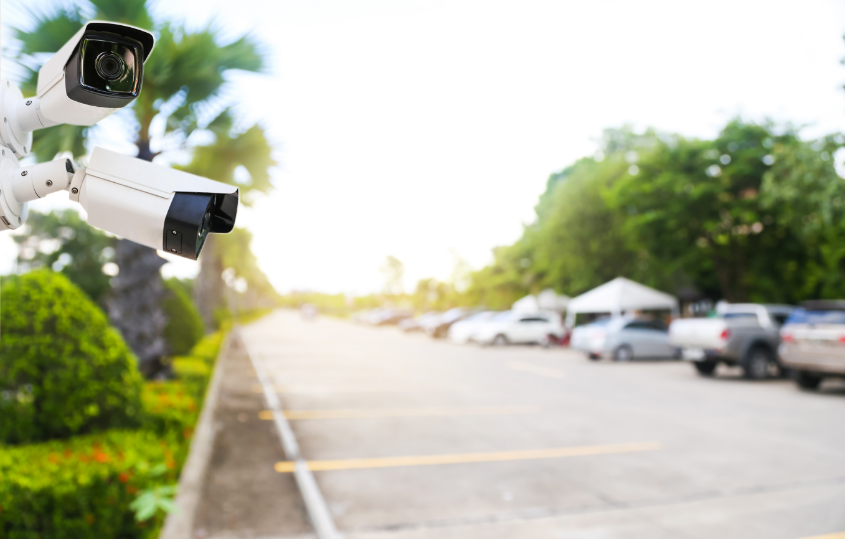
Vehicle crime in Houston apartment complex parking lots — break-ins, catalytic converter theft, vehicle theft, and the crimes against persons that occur in parking areas — is among the most commonly reported property crime categories across Harris County. For apartment community managers and HOA boards in Houston’s dense multifamily housing corridors — along I-10, US-290, I-45, and the southwestern Harris County apartment belt — vehicle parking lot crime is not an abstract risk. It is a regular occurrence that generates resident complaints, management time, and increasingly, liability claims. [1]
The liability dimension matters. When a resident’s vehicle is broken into in a community parking lot, the resident’s first call is often to the management office — not the police. And their first question, inevitably, is: “Doesn’t the parking lot have cameras?” If the answer is no, or if the cameras exist but didn’t capture anything useful, the community’s liability posture becomes the subject of the conversation.
Conversely, apartment communities with well-designed parking lot camera systems — specifically systems with cameras that produce identification-quality footage in the low-light conditions where most Houston parking lot crime occurs — have a documented visual record of every person and vehicle that moved through the lot. When an incident occurs, that record is either the evidence that identifies the perpetrator or the evidence that demonstrates the community’s reasonable security posture. Both outcomes serve the community’s legal and operational interests.
🔒 Free Apartment Parking Lot Camera Assessment for Your Houston Community
Nexlar Security designs and installs parking lot CCTV systems for Houston apartment communities — ultra low-light cameras, LPR, weatherproof pole mounting, and wireless backhaul. 👉 Book Your Free Property Camera Assessment
How Camera Systems Deter Vehicle Break-Ins
Visible camera presence in a parking lot changes the risk calculation for opportunistic vehicle thieves — Houston’s dominant vehicle crime pattern — in a measurable way.
Opportunistic vehicle break-ins (window smash for visible items, catalytic converter removal in under 60 seconds) are fundamentally deterred by visible surveillance. Research from the Crime Prevention Research Center and multiple municipal crime data analyses confirms that visible camera presence in parking lots reduces vehicle crime frequency — not because cameras prevent a criminal from physically acting, but because the risk of identification and prosecution significantly increases their perceived risk. [2]
For Houston apartment communities, the deterrence effect is amplified when cameras are clearly visible at multiple positions — including at lot entry/exit points where license plates can be captured. A criminal who knows that their vehicle’s plate is captured on camera at both entry and exit has much less anonymity than one operating in an uncovered lot. The combination of presence deterrence (cameras visible throughout the lot) and exit LPR (plate capture at the way out) creates a risk environment that makes opportunistic crime in the lot significantly less attractive than an uncovered alternative.
Ultra Low-Light Cameras for Houston’s Outdoor Parking Conditions
Vehicle break-ins in Houston apartment parking lots peak during evening and early morning hours — the hours when most residents are home from work (7 PM–11 PM) and before the morning commute (3 AM–6 AM). These are also the lowest ambient light conditions in an outdoor parking environment.
Standard commercial cameras — adequate for well-lit indoor environments — produce high-noise, low-contrast imagery in these conditions that defeats the identification purpose of the camera system. A camera that captures a blurry silhouette at 50 feet in a dimly lit parking lot is not a security camera — it is a false sense of security.
Ultra low-light camera specifications for Houston apartment parking lots:
Sony Starvis or Starvis 2 CMOS sensors: Cameras built on these sensor platforms produce color, identification-quality imagery in lighting conditions as low as 0.001 lux — approximately the light level of a parking lot illuminated only by moonlight and distant streetlights, with no on-site security lighting. [3]
Wide dynamic range (WDR): Houston apartment parking lots frequently have extreme contrast conditions — illuminated canopy areas adjacent to shadowed lot interiors, or vehicle headlights entering a dark lot. WDR capability (120dB or greater) prevents blown-out highlights and crushed shadows simultaneously.
IR illumination for complete darkness: For the darkest Houston parking lot positions — between buildings, at fence-adjacent corners, or in areas where lighting maintenance is inconsistent — built-in IR illumination provides reliable monochrome coverage in complete darkness conditions.
Camera brands including Axis (Lightfinder series), Hanwha (QNO outdoor series), and Hikvision (DarkFighter series) represent the principal low-light outdoor camera options Nexlar specifies for Houston apartment parking lot applications.
LPR (License Plate Recognition) at Exit Points
License Plate Recognition cameras at parking lot exit points provide the most directly actionable surveillance data available for a Houston apartment parking lot security system — a database of every vehicle that exited the lot and the exact time it left.
When a vehicle break-in is discovered and reported to Houston apartment management, the first investigative question is: what vehicle was in the lot during the incident window and left afterward? An LPR camera at the lot exit answers this question with a searchable, timestamped database of every exit event with associated plate capture.
LPR camera specification for Houston apartment parking exit points:
LPR cameras are distinct from standard surveillance cameras — they are optimized for plate capture rather than general surveillance, with narrow fields of view, specific focal lengths calibrated for the exit lane distance, and specialized IR illumination that produces the high-contrast plate image the LPR software requires to read the plate accurately. [4]
Key specification parameters: identification distance (matching the camera’s placement distance from passing vehicles to the lens focal length), illumination for plate capture in any lighting condition (dedicated IR illumination independent of ambient light), and integration with the LPR software that converts the raw plate image to a searchable text record.
Practical LPR deployment for Houston apartment parking:
One LPR camera per exit lane, positioned to capture plates of vehicles exiting at normal speed without requiring any driver action. The LPR system maintains a rolling database of exit plate captures — searchable by plate, by time range, and by incident window. For gated communities with vehicle access control (RFID transponders or app credentials), LPR exit capture is correlated with access control entry records — creating a complete vehicle ingress/egress log for every vehicle.
Nexlar’s apartment security systems include LPR integration as a standard option for Houston communities with active parking lot security concerns.
Liability Shielding: What Clear Video Evidence Means for Houston HOA Boards
The liability shielding value of a well-documented parking lot camera system goes beyond the ability to identify a specific perpetrator in a specific incident. It establishes the community’s documented reasonable care — evidence that the property took appropriate steps to deter crime and protect residents in the parking area.
In Texas premise liability cases involving crimes in parking lots, courts evaluate the property owner’s reasonable care against the foreseeable risk of crime given the property’s location, prior incident history, and available security measures. [5] A community with:
- Documented prior parking lot incidents
- No functioning cameras or cameras that captured unusable footage
- No documented security response to known vulnerabilities
…is in a materially different liability position than a community with documented, functioning, maintained cameras covering the full lot with identification-quality footage.
The distinction is not whether an incident occurred — incidents occur even at well-secured properties. The distinction is whether the property took reasonable steps to prevent and document it.
Pole Mounting, Conduit Protection, and Structural Requirements
Houston apartment parking lot camera installations frequently face a specific installation challenge: the cameras need to cover large outdoor areas from elevated positions, but the lot infrastructure was designed for vehicles, not camera mounts.
Pole mounting for Houston parking lot cameras:
Prefabricated steel security camera poles — powder-coated for Houston’s outdoor climate — are the standard mounting solution for freestanding parking lot camera positions. Pole height for parking lot overview cameras is typically 14 to 18 feet for standard lot coverage positions, with 20 to 25 foot poles used for overview positions covering large lot segments from a single elevated mount.
Conduit protection for Houston outdoor installations:
All wiring to pole-mounted cameras in Houston parking lots should be run in rigid metal conduit — protecting cable from weather, UV degradation, physical damage from lawn equipment, and the occasional vehicle impact that can contact low-mounted runs. Burial depth for underground cable runs to parking lot poles follows NEC Article 300 requirements — typically 24 inches for rigid conduit. [6]
Weatherproof ratings for outdoor Houston camera positions:
Cameras in Houston’s outdoor parking environments must be rated IP67 or higher for dust and water ingress protection — IP66 (protected against high-pressure water jets) is the minimum appropriate for positions exposed to Houston’s heavy rain events. Camera housings should also be rated for the UV exposure and temperature extremes of Houston’s outdoor summer conditions.
Long-Range Wireless Backhaul for Remote Parking Areas
Many Houston apartment community parking areas are positioned at the perimeter of the property — at distances from the main building and NVR that make wired cable runs expensive or infrastructure-disruptive. Long-range wireless backhaul provides a cost-effective alternative for connecting remote parking lot cameras to the community’s NVR and network infrastructure without running long conduit and cable runs.
Point-to-point wireless bridges:
Licensed or unlicensed point-to-point wireless bridges (from Ubiquiti, Cambium Networks, or similar) provide a dedicated wireless link between a remote parking lot pole-top access point and the community’s main building network — typically capable of supporting multiple HD camera streams over distances up to 500 to 1,000 meters with proper antenna alignment.
Cellular-connected cameras:
For isolated parking structures or satellite lots with no line-of-sight to the main building, 4G LTE or 5G cellular-connected cameras provide network connectivity without any physical cable infrastructure. Camera-embedded cellular modems connect to the LTE/5G network and stream to a cloud NVR or VPN-connected local NVR. Ongoing cellular data plan costs apply but may compare favorably to the cost of running conduit across a long parking area.
System Comparison Table
| Feature | Standard Fixed Camera Grid | Low-Light Optimized System | Low-Light + LPR + Wireless Backhaul |
|---|---|---|---|
| Night-Time ID Quality | Poor | High | High |
| Vehicle Exit Documentation | No | No | Yes (LPR) |
| Liability Shielding Documentation | Basic | Medium | Comprehensive |
| Remote Lot Coverage (no cable run) | Not feasible | Not feasible | Yes (wireless) |
| Coverage of Full Parking Perimeter | Partial | Planned | Planned + documented |
| Deterrence Effect | Low (poor night cameras) | High | High + LPR deterrence at exit |
Cost and Pricing for Houston Apartment Parking Camera Installations
| Installation Scope | Estimated Cost Range |
|---|---|
| Small Lot (8–15 cameras, standard size) | $8,000 – $20,000 |
| Medium Complex (15–30 cameras, poles + conduit) | $18,000 – $45,000 |
| Large Multi-Building Community (30–60 cameras) | $40,000 – $90,000 |
| LPR Exit Camera (per lane, installed) | $3,000 – $8,000 |
| Wireless Backhaul Bridge (per remote lot) | $1,500 – $5,000 |
💡 Houston Apartment Parking Lot Cameras — Ultra Low-Light, LPR, Weatherproof Installation
Nexlar installs parking lot CCTV systems for Houston apartment communities — specified for Houston’s low-light conditions, with LPR at exits and documented coverage for liability protection. 👉 Schedule Your Free Property Camera Assessment