

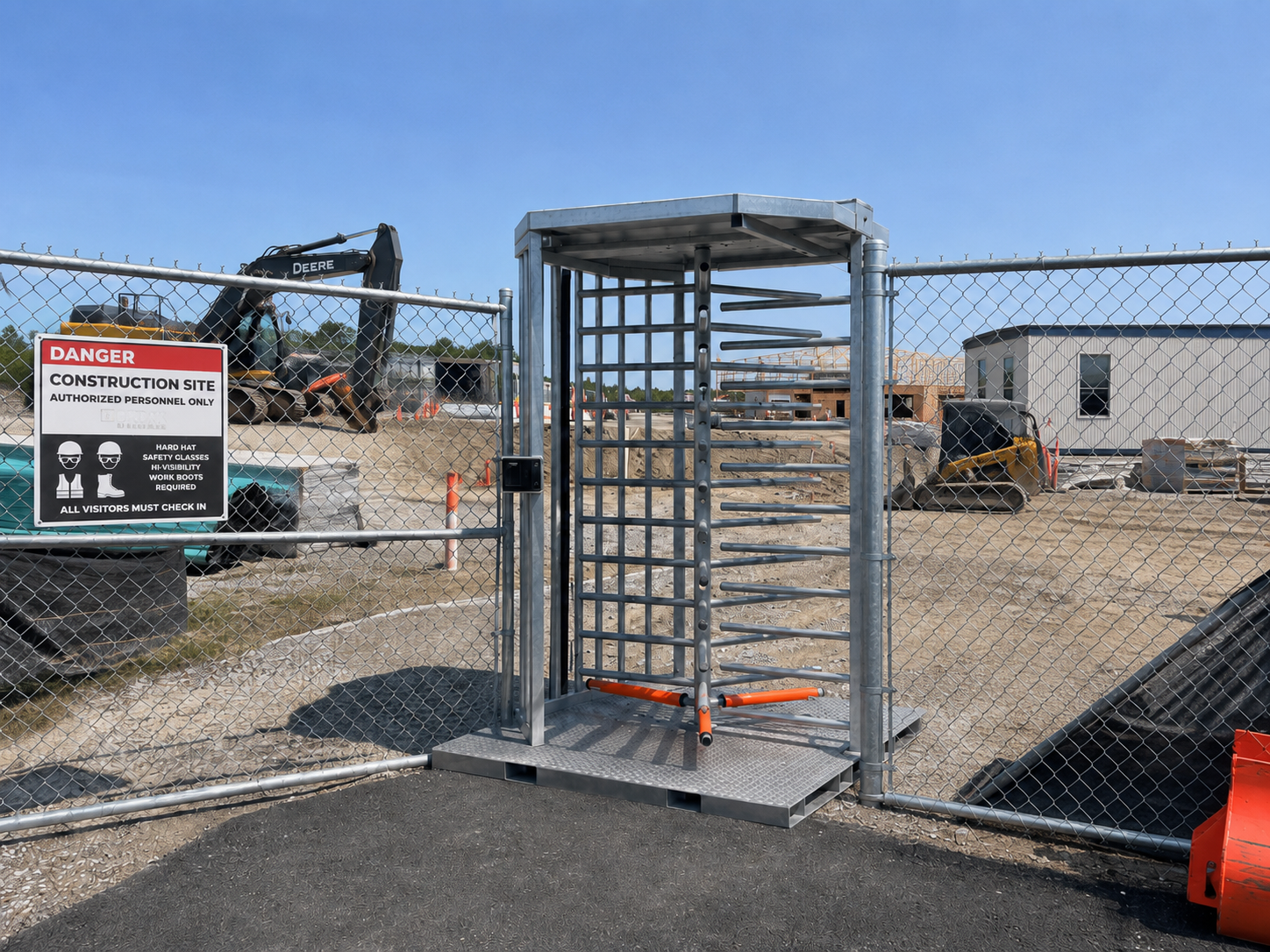
San Antonio’s manufacturing and heavy industry sector has expanded significantly over the past decade — anchored by automotive and aerospace supply chain operations, heavy fabrication, food and beverage manufacturing, and a rapidly growing construction industry driven by the city’s population growth and large infrastructure projects. The Kelly/Lackland industrial corridor, the Southeast Side manufacturing zone, and the major construction sites across northern Bexar County all share a common security and access management challenge: controlling who crosses the facility perimeter, and when.
Fence lines and gates manage vehicle access. But pedestrian perimeter control at manufacturing and construction sites — managing the foot traffic of workers, contractors, safety inspectors, and authorized visitors crossing from the unsecured exterior into the secured facility — requires a different physical security architecture. A card reader at a door that anyone can hold open for the next person doesn’t prevent tailgating. A guard who waves people through during shift changes doesn’t create an individual access record. A swinging gate arm at a pedestrian entry that anyone can step around doesn’t enforce authorized-only access.
Industrial turnstiles — full-height or high-security designs in commercial-grade steel — solve these problems by creating a physical mechanism that enforces individual, credentialed passage. One credential, one person, one direction at a time.
🔒 Free Industrial Perimeter Assessment for Your San Antonio Facility
Nexlar Security designs and installs industrial turnstile systems for manufacturing, construction, and heavy industry facilities across San Antonio and Bexar County. 👉 Book Your Free Facility Assessment
Full-Height vs. Half-Height Turnstiles: Which Does Industrial Work Require
The most fundamental design choice in industrial turnstile specification is height — and for manufacturing and construction perimeter applications, the choice has a security implication beyond aesthetics.
Half-Height (Waist-Height) Turnstiles Tri-bar turnstiles that extend approximately 40 to 42 inches from the floor. Effective deterrent at low-threat environments — the physical barrier is sufficient to require deliberate action to bypass. However, a person who is motivated to bypass a half-height turnstile can step over or around it without significant difficulty, particularly in a high-distraction environment like a shift change at a manufacturing facility. Half-height turnstiles are appropriate for lower-security perimeter control where the primary objective is access logging and traffic management rather than absolute physical barrier. [1]
Full-Height Turnstiles Floor-to-ceiling rotating structures — typically 7 to 8 feet tall — that provide a physical barrier that cannot be stepped over or around. A person must pass through the turnstile to cross the perimeter. Full-height turnstiles are the appropriate specification for manufacturing and construction perimeter applications where the objective is both access logging and physical enforcement of the authorized-only access requirement.
For San Antonio’s heavy fabrication and construction yard applications — where tailgating by unauthorized workers represents a genuine liability, an OSHA compliance concern (unauthorized individuals on a construction site), and a safety risk — full-height turnstiles provide the physical barrier that half-height designs cannot. [2]
Mechanical vs. Electric Turnstiles: Choosing the Right Drive for Heavy Use
Mechanical (Rotor) Turnstiles Mechanically driven full-height turnstiles use a mechanical indexing mechanism — a spring-and-ratchet system — to control rotation direction and advance. In the default state, the turnstile is locked. A valid credential presentation releases the mechanism for a single clockwise (entry) rotation and re-locks. Mechanical turnstiles require no electrical connection for their locking and rotation function — though credential readers and access control integration require power and data.
Mechanical turnstiles are highly durable in outdoor industrial environments — the absence of powered drive components reduces the number of failure-prone components in a weather-exposed installation. They are appropriate for outdoor perimeter applications where electrical power availability is limited or where maximum simplicity and minimum maintenance are priorities.
Electric (Motor-Driven) Turnstiles Electrically driven turnstiles use a controlled motor to manage rotation — enabling features that mechanical systems cannot provide: bi-directional rotation control (the same unit handles entry and exit rather than requiring separate entry/exit units), emergency full-open mode (all barriers retract for emergency evacuation), speed control, and soft-start/soft-stop operation that reduces mechanical wear in high-cycle applications.
For San Antonio manufacturing facilities with high daily cycle counts — large workforces at shift changes — electrically driven full-height turnstiles with soft-start drive technology extend service life in high-use applications by reducing the mechanical shock loading that occurs when mechanical systems engage at full rotational velocity.
Emergency full-open mode is a critical feature for any industrial facility with fire code egress requirements — the ability to retract all barriers simultaneously on fire alarm activation ensures that turnstiles never impede emergency egress. This integration with the fire alarm panel is a code compliance requirement that Nexlar manages as part of every industrial turnstile installation. [3]
Securing Heavy Fabrication Perimeters in San Antonio
Heavy fabrication facilities — metal fabrication shops, structural steel fabricators, equipment manufacturing operations — have specific perimeter security requirements that combine access control, safety, and OSHA compliance concerns.
OSHA General Industry Standards and Perimeter Control OSHA 29 CFR 1910 General Industry Standards establish requirements for hazardous area access control in manufacturing environments — specifically, that only trained, authorized employees enter areas with specific safety risks. A turnstile-based perimeter control system that limits entry to credentialed, authorized workers provides a physical enforcement mechanism for this requirement — the turnstile won’t open for an unauthorized individual, preventing untrained personnel from accessing hazardous work areas. [4]
Credential Type for Manufacturing Perimeters For San Antonio fabrication facilities with large hourly workforces, proximity card credentials — or increasingly, mobile credentials on smartphones — are the standard. Workers badge in at the turnstile, the credential is validated, the turnstile rotates for entry. The entry event is logged with the worker’s credential identifier and the timestamp.
For facilities requiring PPE compliance verification before entry — hard hat zones, respirator-required areas — some industrial turnstile installations integrate height and weight sensing or camera verification at the turnstile approach, providing a check that the worker is wearing required safety equipment before the turnstile releases for entry. This is an advanced configuration more common at refineries and chemical plants than at general fabrication shops, but available for San Antonio facilities with specific safety zone requirements.
Integrating Turnstile Readers with Time and Attendance Software
The access control event log from a turnstile-integrated credential reader is the same data that time and attendance systems need: who entered, when. For San Antonio manufacturing facilities that run payroll based on shift attendance — particularly those with hourly employees paid for hours worked rather than hours scheduled — direct integration between turnstile credential readers and time and attendance software eliminates the need for separate time clock hardware. [5]
How the integration works:
The turnstile credential reader records each badge event with the credential identifier and timestamp. The access control platform, or a middleware integration layer, pushes these events to the time and attendance software (ADP, Kronos/UKG, Paychex, or the facility’s specific platform). The time and attendance software treats the turnstile entry event as a clock-in and the exit event as a clock-out.
For facilities that run multiple shifts, the integration must correctly handle: workers who badge in before or after their scheduled shift window, workers who badge out early or late, and overtime situations where the turnstile time log needs to populate correctly into the overtime calculation.
Nexlar configures turnstile-to-time-and-attendance integration for San Antonio manufacturing clients — including the specific field mapping and exception handling required for each client’s payroll platform and shift structure.
Additional benefits of turnstile-based time and attendance:
Buddy punching elimination — a worker cannot badge in another worker’s credential and have the physical turnstile allow entry (it only opens for the person holding the valid credential). This is one of the most commonly cited operational benefits of turnstile-integrated time and attendance over traditional keypad punch clocks.
Weatherproofed Steel Turnstiles for San Antonio’s Climate
San Antonio’s climate — sustained summer heat, significant humidity particularly in the rainy season, and occasional severe weather including hail and high winds — imposes specific material and protection requirements on outdoor turnstile installations.
Material Requirements Full-height outdoor turnstiles for San Antonio installations should be specified in Type 316 stainless steel or heavy-gauge carbon steel with appropriate protective coating — hot-dip galvanizing or industrial powder coat rated for outdoor weather exposure. Type 304 stainless steel is adequate for most outdoor environments; Type 316 provides additional resistance to chloride corrosion for facilities near wastewater treatment, food processing environments with cleaning chemical exposure, or coastal-influence humidity.
Standard carbon steel turnstiles without adequate weatherproofing will rust at weld points and fasteners within one to two years of outdoor installation in San Antonio’s climate — accelerating to structural degradation that compromises both the appearance and the physical security function of the unit.
IP Rating for Electronics All electronic components integrated into an outdoor San Antonio turnstile installation — credential readers, control panels, intercom units at the turnstile entry — must carry IP54 or higher enclosure ratings. Readers and control panels exposed to direct rain must be IP65 rated (dust-tight and protected against water jets from any direction). [6]
Temperature Rating for Reader Electronics RFID and smart card reader electronics in outdoor Texas installations must be specified for operating temperatures above 130°F ambient — the surface temperature of a reader in direct San Antonio summer sun can exceed 160°F in peak conditions, as discussed in the Austin industrial yard reader section. Industrial-rated readers from HID Global and Allegion specify operating temperature ranges appropriate for these conditions.
Construction Yard Applications Across Bexar County
San Antonio’s active construction market — residential and commercial development across the expanding northern and western Bexar County growth corridor — creates consistent demand for temporary or semi-permanent turnstile installations at major construction sites.
Construction site turnstile installations differ from permanent manufacturing facility installations in several important ways:
Temporary vs. Permanent Mounting Construction site turnstiles are frequently mounted on temporary concrete footings or heavy base plates rather than permanent foundations — allowing relocation as the project progresses or disassembly when the project completes.
Trailer-Mounted Turnstile Configurations Some Bexar County construction operators deploy trailer-mounted turnstile units — self-contained units with integrated power supply, credential reader, and access control panel mounted on a portable trailer chassis. These units can be repositioned to follow the active work zone as a project develops.
Contractor Workforce Management Large San Antonio construction projects typically employ workers from multiple subcontractors whose workforce composition changes week to week. A turnstile credential system for a construction site must accommodate: initial enrollment of subcontractor workers when they first arrive on site, tracking of which workers are on site on any given day (for emergency muster accountability), and deactivation of workers who complete their scope and leave the project. Cloud-managed access control with web-based credential enrollment handles this more efficiently than traditional on-premise systems that require a system administrator physically at the site for each enrollment.
System Comparison Table
| Feature | Half-Height Turnstile | Full-Height Mechanical | Full-Height Electric |
|---|---|---|---|
| Physical Barrier | Partial (can step over) | Complete | Complete |
| Emergency Full-Open | No | No | Yes (fire alarm integration) |
| Bi-Directional Control | Requires two units | Requires two units | Single unit, bi-directional |
| Soft-Start / High-Cycle | No | No | Yes |
| Outdoor Weatherproof Option | Yes | Yes | Yes |
| Time & Attendance Integration | Yes | Yes | Yes |
| Buddy Punch Prevention | Yes | Yes | Yes |
| Best San Antonio Application | Lobby traffic management | Outdoor industrial perimeter | High-cycle manufacturing, fire code applications |
| Estimated Cost Range (per lane) | $3,000 – $8,000 | $5,000 – $15,000 | $8,000 – $25,000 |
Cost and Pricing for San Antonio Industrial Installations
| Installation Scope | Estimated Cost Range |
|---|---|
| Half-Height Turnstile (single lane, installed) | $3,000 – $8,000 |
| Full-Height Mechanical Turnstile (per lane) | $5,000 – $15,000 |
| Full-Height Electric Turnstile (per lane) | $8,000 – $25,000 |
| Time & Attendance Integration (per system) | $2,000 – $6,000 |
| Fire Alarm Interface (per turnstile location) | $500 – $1,500 |
| Multi-Lane Perimeter Entry (4 lanes, full system) | $30,000 – $80,000 |
| Temporary Construction Site Installation | $6,000 – $18,000 |
Nexlar provides itemized quotes for San Antonio industrial turnstile projects after a free on-site facility assessment covering perimeter layout, lane count, workforce size, and time-and-attendance platform compatibility.
💡 Industrial Turnstiles for San Antonio Manufacturing and Construction — Licensed, Weatherproofed, Integrated
Nexlar installs full-height industrial turnstiles for San Antonio facilities with time and attendance integration, fire alarm interface, and weatherproof specifications for South Texas conditions. 👉 Schedule Your Free Industrial Security Assessment