

San Antonio sits at the intersection of NAFTA trade flows moving between Mexico and the continental United States. The I-35 corridor through Bexar County hosts one of the highest volumes of commercial truck traffic in Texas — freight terminals, intermodal facilities, distribution centers, and manufacturing operations all concentrate along the highway’s commercial corridor from the South Side through the Northeast Side.
For the gate access systems at these facilities, the operational demands are categorically different from suburban office parks and commercial retail properties. The gates must handle vehicles ranging from bobtails and short-box trucks to Class 8 tractor-trailers with 53-foot trailers and specialized oversize loads. They cycle hundreds of times per day, seven days a week, in a climate that subjects mechanical components to sustained summer heat exceeding 100°F. And in many facilities, gate throughput speed directly affects dock scheduling — a slow gate that adds two minutes per truck to the ingress cycle creates compounding delays at scale.
The gate access challenge for San Antonio logistics operators is not just security — it’s operational efficiency. The right system controls who enters while moving freight traffic through as quickly as the dock schedule allows.
🔒 Free Commercial Gate Assessment for Your San Antonio Facility
Nexlar Security designs and installs heavy-duty commercial gate access systems for San Antonio logistics terminals and distribution facilities. Free on-site assessment, no obligation. 👉 Book Your Free Facility Assessment
Heavy-Duty Slide Gates for High-Volume Freight Truck Operations
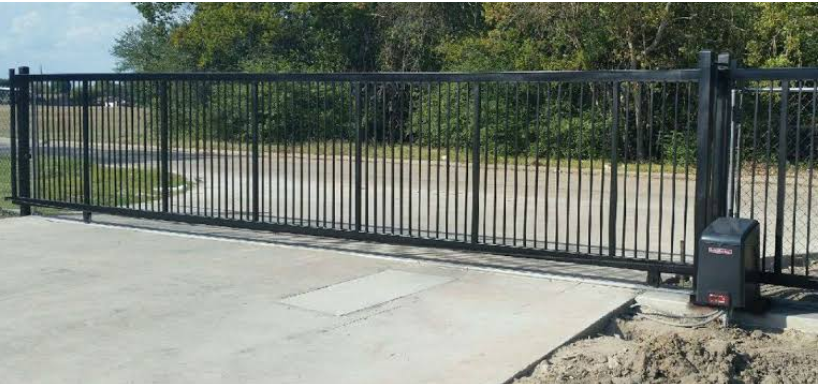
The structural starting point for any San Antonio logistics terminal gate access project is the gate itself — and for high-volume freight operations, that means a heavy-duty commercial slide gate capable of handling thousands of cycles per week under the stress of San Antonio’s operational and climate conditions.
Commercial slide gates for logistics applications are specified by gate weight (which determines operator capacity requirements), gate travel distance (the full opening width required to clear the widest vehicles the facility receives), and duty cycle rating (the number of daily or weekly cycles the gate is rated for in continuous operation). [1]
For San Antonio freight terminals receiving Class 8 tractor-trailers with 53-foot trailers, gate opening widths of 24 to 40 feet are typical — depending on whether the lane is configured for single or dual truck traffic. Gate panels of this width and commercial construction (steel frame, steel infill or chain link fabric) can reach several hundred to over a thousand pounds, requiring commercial operators with appropriate torque ratings.
Gate construction considerations for San Antonio facilities:
Wind loading is a significant structural consideration for large-panel slide gates in San Antonio, where severe weather including strong straight-line winds, thunderstorms, and occasional tornado events can impose lateral loads on a large gate panel. Gate panel construction and operator bracket specifications must account for local wind load requirements.
Corrosion protection for the gate’s steel components — a requirement for San Antonio’s humid climate — means galvanized or powder-coated steel with appropriate edge treatment to prevent rust nucleation at cut edges, particularly in facilities near industrial or chemical operations on the South Side and Southeast Side.
Track and roller systems for slide gates in high-cycle commercial applications should be specified in commercial-grade configurations — V-groove track with steel rollers, not residential cable or bottom-drive systems that are inadequate for the weight and cycle requirements of a logistics terminal gate.
High-Speed Gate Operators: How Ingress Cycle Time Affects Throughput
Gate operator speed — specifically the time from gate closed to gate fully open, measured in feet per second of panel travel — directly affects the maximum vehicle throughput rate at a facility’s entry lanes.
A standard commercial slide gate operator opens at approximately 1 foot per second. For a 30-foot gate opening, that means 30 seconds from gate closed to gate fully open. In a facility receiving 200 trucks per shift through a single entry lane, a 30-second open time per cycle (plus the closed cycle time) is a significant throughput constraint — particularly during shift change windows when arrival density peaks.
High-speed commercial operators — purpose-built for high-volume logistics and freight terminal applications — operate at 2 to 4 feet per second or faster. A 30-foot gate opening on a high-speed operator takes 8 to 15 seconds rather than 30 seconds. [2]
At 200 trucks per 10-hour shift through a single lane, the difference between a 30-second cycle and a 12-second cycle is not trivial. A 30-second cycle means the gate supports a maximum theoretical throughput of 2 trucks per minute — 120 per hour if vehicles arrive perfectly spaced. A 12-second cycle raises that ceiling to 5 trucks per minute — which, with real-world queuing dynamics, can clear the same shift volume with significantly less peak-hour queuing.
HySecurity and FAAC high-speed operators for San Antonio freight terminals:
HySecurity’s SlideSmart HD and related series are specifically engineered for high-cycle, high-speed operation at freight and logistics facilities — rated for over 1,000 cycles per day, with variable speed drive technology that allows full-speed travel with controlled deceleration approaching the fully-open position (reducing mechanical stress from abrupt stops). [3]
FAAC’s J1000 series provides hydraulic-powered operation with comparable speed and duty cycle ratings, with the additional benefit of hydraulic system operation that is less sensitive to extreme temperature variations — relevant for San Antonio’s summer heat conditions.
Both series are available with battery backup for operation during power outages — a meaningful consideration for 24/7 freight facilities where gate access must be maintained regardless of utility power status.
Automated Driver Intercom Booths for Shipping Document Check-In
For San Antonio logistics terminals requiring shipping document verification before admitting inbound freight — a standard practice at facilities handling regulated cargo, food-grade distribution, pharmaceutical logistics, and government contract freight — the gate entry process involves more than credential verification. It involves a driver check-in workflow where shipping documents, delivery orders, and load information are confirmed against the facility’s inbound schedule.
At high-volume facilities, this check-in process historically meant a guard booth staffed with a person who physically received documents from truck drivers. For facilities with a continuous document review requirement but limited staffing for dedicated gate personnel, automated driver intercom booths provide the communication infrastructure for a remote check-in process. [4]
How an automated driver intercom booth works at a San Antonio freight gate:
The intercom booth is positioned at the gate entry lane at a height appropriate for Class 8 truck cab occupants — typically mounted on an adjustable pole or pedestal at truck cab window height, eliminating the need for drivers to step out of the vehicle. The booth includes:
A weatherproof two-way audio and video intercom — allowing the driver to communicate with the gate dispatcher or check-in staff who may be located in a remote office, a central security room, or an off-site monitoring center.
A document scanning surface or camera — allowing the driver to hold shipping documents, bill of lading, delivery orders, or load manifests up to a camera for review by the remote check-in staff.
A gate release interface — the check-in staff, after verifying documents through the intercom camera, releases the gate from their remote workstation.
An audit log — the intercom system logs each driver interaction with a timestamp and video recording of the exchange, creating a complete inbound freight verification record.
This configuration allows San Antonio logistics terminals to maintain a documented driver check-in process without maintaining a continuously staffed physical gate booth — the intercom connects to wherever the check-in personnel are, and the gate opens only after the remote staff confirms the shipment.
Access Credential Options for San Antonio Truck and Driver Populations
The specific mix of vehicles and drivers using a San Antonio freight terminal gate determines which credential approach is operationally appropriate.
Dedicated Fleet RFID (for company vehicles and regular carriers) Long-range passive RFID windshield tags on company fleet vehicles and dedicated contract carrier vehicles provide automated gate opening as vehicles approach — no driver action required. Appropriate for the regular truck population where all vehicles are known, enrolled, and consistent.
Driver PIN Codes (for spot and infrequent carriers) For trucks from carriers whose drivers vary — spot market loads, infrequent carriers — time-limited PIN codes issued by the dispatch team provide a scalable credential solution without RFID tag issuance. The driver enters the code at the gate keypad and proceeds to the intercom check-in if required.
Driver License OCR at Intercom (for unscheduled arrivals) Some San Antonio logistics terminals deploy driver license OCR (optical character recognition) scanners integrated with the gate intercom — the driver presents their CDL to the camera, the system reads the license data, and creates an inbound driver record linked to the gate entry event. This provides a documented driver identity record for every inbound truck without requiring a pre-issued credential.
Multi-Lane Configurations for Peak Volume Management High-volume terminals on the I-35 San Antonio corridor frequently operate with dedicated lane configurations: a pre-credentialed RFID express lane for regular carriers with enrolled vehicles, and a check-in lane for spot carriers requiring intercom verification. This lane segregation maintains throughput on the high-volume regular carrier lane while providing the additional check-in time needed for less frequent arrivals in the separate lane.
Integrating License Plate Recognition with Gate Access
License Plate Recognition (LPR) cameras at San Antonio freight terminal gate lanes provide a secondary vehicle identity layer alongside driver credentials — capturing and logging every vehicle’s plate number against the gate entry event, whether or not the vehicle carries an RFID transponder credential. [5]
For terminals receiving a high proportion of vehicles from the spot market — where a different driver may be delivering the same carrier’s load at different times, or where the carrier relationship doesn’t justify RFID transponder issuance — LPR enables advance plate registration as the primary gate credential:
The dispatch team, when receiving a load booking, records the expected truck’s plate number in the access control system along with the scheduled arrival window. When the truck arrives, the LPR camera reads the plate, the system matches it to the expected delivery record, and the gate opens without driver action.
This approach is particularly effective for San Antonio’s cross-border freight market, where Mexican freight carriers with consistent business may operate specific assigned tractors whose plate numbers can be pre-registered for expected loads — providing automated access without the logistics of RFID transponder coordination across the border.
After-Hours and Remote Gate Management for 24/7 Operations
San Antonio’s freight market operates around the clock — and so do the gate access requirements that serve it. For facilities running 24/7 receiving operations, the gate access system must be able to operate without continuous on-site staffing.
Cloud-managed gate access with remote monitoring and management provides this capability. The gate controller communicates with the access control platform via internet connection — and authorized personnel at any location can:
Review live gate camera feeds and recent access events from any device. Release the gate for specific vehicles through a web interface or mobile app when an authorized remote verification is appropriate. Receive alerts for unauthorized access attempts, gate malfunction conditions, or unusual after-hours activity.
For San Antonio freight terminals where the gate check-in function is managed by a central dispatch team who may not be physically at the terminal during all shifts, this remote management capability allows the dispatch team to perform gate verification and release functions from their office or monitoring center — with the intercom, camera feed, and gate release all accessible through the same remote management interface.
Nexlar’s automatic gate systems for San Antonio commercial and industrial facilities include cloud-managed controllers, remote access capability, and 24/7 monitoring service options for facilities requiring continuous after-hours gate oversight.
Gate Hardware Selection: What San Antonio’s Climate and Traffic Demands
Beyond operator speed and duty cycle, San Antonio’s specific climate and operational environment impose hardware selection criteria that distinguish well-specified freight terminal gate systems from undersized commercial installations:
Operator power and torque. Class 8 tractor-trailers approaching a gate create significant wind turbulence that imposes additional lateral load on gate panels. Commercial operators must be sized for gate panel weight plus wind load — not just static gate weight.
Heat-rated component specifications. Drive components, control boards, and limit switch hardware in San Antonio’s summer heat must be rated for sustained ambient temperatures at or above 110°F. Standard residential-grade components degrade significantly faster in sustained South Texas summer temperatures.
Vehicle detection loops for anti-collision. All commercial vehicle gate installations should include vehicle detection loops in the pavement at the gate entry and exit positions — confirming that a vehicle is not in the gate’s path before the gate closes, preventing damage to both the vehicle and the gate. For large freight vehicles where the vehicle footprint may extend beyond a standard loop position, loop placement and sensitivity must be configured for the specific vehicle types using the gate.
Hydraulic operator backup. Hydraulic gate operators provide reliable operation across a wider temperature range than electric motor operators — particularly in freeze events that San Antonio experiences infrequently but with operational consequences when they occur.
System Comparison Table
| Feature | Standard Commercial Slide Gate | Heavy-Duty High-Speed Freight Gate |
|---|---|---|
| Gate Opening Speed | ~1 ft/sec (30 sec for 30-ft opening) | 2–4 ft/sec (8–15 sec for 30-ft opening) |
| Daily Cycle Rating | 300–500 cycles/day | 1,000–2,500+ cycles/day |
| Duty Rating | Light-medium commercial | Heavy industrial / freight |
| Driver Intercom Integration | Optional | Standard |
| LPR Integration | Optional | Standard for freight terminals |
| Remote Management | Optional | Yes — standard |
| Battery Backup | Optional | Recommended |
| Anti-Collision Vehicle Loops | Optional | Required |
| Wind Load Specification | Basic | Engineered for I-35 corridor conditions |
| Best San Antonio Application | Office / light commercial | Freight terminal, logistics, distribution |
Cost and Pricing for San Antonio Logistics Installations
| Installation Scope | Estimated Cost Range |
|---|---|
| Heavy-Duty Slide Gate + Standard Operator | $8,000 – $20,000 |
| Heavy-Duty Slide Gate + High-Speed Operator | $15,000 – $35,000 |
| Driver Intercom Booth (per lane) | $5,000 – $15,000 |
| LPR Camera Integration (per lane) | $5,000 – $15,000 |
| Multi-Lane Terminal Entry (2 lanes, full system) | $35,000 – $90,000 |
| Remote Cloud Management Setup | $2,000 – $6,000 |
| 24/7 Remote Monitoring Service | $150 – $500/month |
Nexlar provides complete, itemized quotes for San Antonio freight terminal gate access projects after a free on-site facility assessment, including gate engineering recommendations based on vehicle type and daily cycle requirements.
💡 High-Speed Commercial Gate Systems for San Antonio Logistics — Engineered for I-35 Freight Volume
Nexlar designs and installs commercial freight gate access systems for San Antonio distribution and logistics facilities — heavy-duty operators, intercom check-in, LPR, and cloud management. 👉 Schedule Your Free San Antonio Gate Assessment