

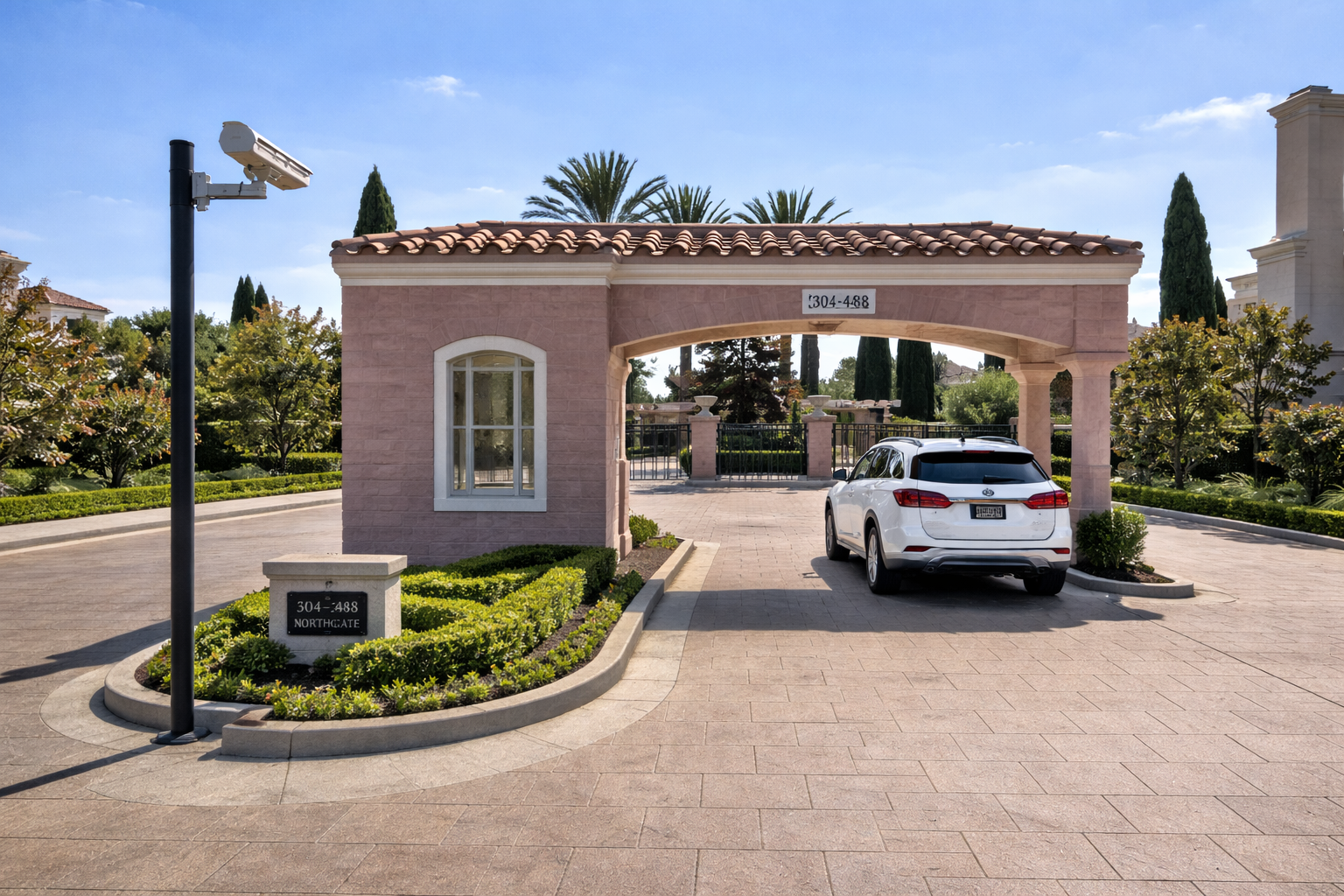
In established Austin-area gated communities — from Westlake’s lakefront estates to Circle C Ranch to Steiner Ranch and the gated neighborhoods off Southwest Parkway — the daily vehicle access experience for residents is frequently more frustrating than the security benefit justifies.
The most common setup: a gate armed receiver on each vehicle that responds to a handheld remote controller. The resident pushes a button. Sometimes the gate opens immediately. Sometimes it takes three button presses. Sometimes the battery is dead and nothing happens at all. During morning rush — when fifty residents are all trying to leave for work between 7:45 and 8:15 AM — the stack of cars waiting for slow-responding gate remotes stretches back into the neighborhood.
This matters more than it might seem. Resident satisfaction surveys in planned community developments consistently identify gate access frustration as one of the most frequently cited quality-of-life complaints — above common area maintenance, above HOA fee amounts. [1] In Westlake, where homes routinely sell at significant premiums and HOA fees reflect a standard of community management, a gate access experience that involves dead batteries and line backups is a visible failure.
RFID vehicle access — specifically long-range passive RFID windshield tags paired with fixed readers at the gate lane — addresses all of these issues simultaneously. This guide covers how it works and what an installation looks like for Austin and Westlake HOA communities.
🔒 Free HOA Gate Access Assessment for Your Austin or Westlake Community
Nexlar Security designs and installs RFID vehicle access systems for Austin and Westlake gated communities. Zero cost, no obligation. 👉 Book Your Free Community Assessment
Why Remote Controller Batteries Fail and RFID Solves It
The handheld gate remote — whether it’s a traditional RF transmitter clipped to a visor or a rolling-code remote programmed to the gate’s receiver — has a fundamental operational problem: it requires an active power source in the vehicle, managed by the resident.
When that battery dies — typically at an inconvenient moment, often without warning — the resident has no access. They either wait for a following neighbor to open the gate, drive around to the management office, or call the HOA’s after-hours line. Every one of those outcomes is a friction point that reflects poorly on the community’s management.
The HOA’s management burden from battery failures is not trivial either. Help calls for dead gate remotes, battery replacement coordination, programming new remotes for replacements, and managing the resident complaints associated with access failures all consume management staff time.
Passive RFID windshield tags eliminate this problem entirely by operating without any battery. [2]
A passive RFID tag — a thin, adhesive-backed tag affixed to the inside of the vehicle’s windshield, typically near the rearview mirror — contains an antenna and a microchip but no power source. When the vehicle approaches the gate’s RFID reader, the reader emits a low-power radio frequency field. The tag’s antenna harvests energy from that field, powers the microchip momentarily, and transmits the tag’s unique identifier back to the reader.
The resident does nothing. The gate opens as the vehicle approaches. No button to push. No battery to die. No fumbling in the car or slowing to a stop while the remote is located. The vehicle drives through at normal approach speed.
Passive vs. Active RFID Windshield Tags: The Key Difference
Both passive and active RFID tags appear in gated community vehicle access installations — and the distinction matters for HOA decision-makers evaluating the technology.
Passive RFID Tags (Recommended for most Austin/Westlake HOA applications) No battery. Power is harvested from the reader’s RF field during the read event. Read range is typically 10 to 30 feet depending on the reader specification. Tags have an essentially unlimited operational lifespan since there is no battery to deplete. The resident never interacts with the tag after it is installed on their windshield. [2]
The tag is typically an adhesive label format applied to the interior windshield surface — thin, unobtrusive, and not visually obvious from outside the vehicle. Common passive UHF RFID frequency for vehicle access applications is 860–960 MHz (EPC Gen 2 standard). Brands commonly used in Austin HOA installations include HID Global’s ISOProx II and DualTech formats, as well as Nedap’s windshield tag product line. [3]
Active RFID Transponders (Appropriate for longer-range or high-security applications) Battery-powered transponders that actively broadcast their identifier. Read ranges extend to 100 feet or more, enabling faster gate opening at distance. More expensive per unit than passive tags. Battery replacement required every 3 to 7 years depending on transponder model. More appropriate for high-speed highway access points and commercial fleet applications than residential HOA use. [3]
For Austin and Westlake HOA gated community applications, passive RFID tags are the appropriate specification in most cases. The read range (10–30 feet) is sufficient for residential gate lanes where vehicles approach at normal ingress speeds, the no-battery advantage directly addresses the primary resident complaint, and the per-tag cost is significantly lower than active transponders — reducing the HOA’s cost per resident credential.
How Long-Range RFID Readers Work at HOA Gates
A long-range RFID reader at an HOA gate entry lane is a fixed reader unit, typically mounted on a pedestal or post at the gate approach, positioned to read tags on approaching vehicles from 10 to 30 feet before the vehicle reaches the gate.
The read sequence: As the resident’s vehicle approaches the gate lane, the RFID reader continuously emits a radio frequency field. When the vehicle enters the read zone (typically 15 to 25 feet from the reader), the passive windshield tag harvests the reader’s RF field and transmits its unique ID. The reader receives the tag ID, communicates it to the access control panel or gate controller, and the controller validates the ID against the authorized vehicle database. If the ID is authorized, the gate operator receives the open command and begins opening. [3]
The entire sequence — from the tag entering the read zone to the gate beginning to open — takes less than one second in a properly installed system. The gate is opening before the vehicle reaches the gate arm or slide gate panel.
Installation positioning is critical: Reader mounting height, angle, and distance from the gate entry point must be calibrated for the specific gate lane geometry and the typical vehicle windshield positions in the community’s resident vehicle mix. A reader positioned correctly for standard-height sedans and SUVs but not calibrated for tall pickup trucks (common in the Austin market) will miss reads on truck-height windshields. Nexlar conducts a lane geometry assessment during system design to ensure the reader is positioned for consistent reads across the community’s actual vehicle mix.
Eliminating Peak-Hour Gate Backup for Austin and Westlake Residents
Peak-hour gate backup — the line of residents waiting to exit during morning rush or enter during evening return — is the community experience problem that RFID access most directly solves.
With a remote-controller-based system, each vehicle in the queue requires the driver to locate the remote, point it at the receiver, and wait for gate response — a process that takes 5 to 10 seconds per vehicle under good conditions, and longer when remotes are slow to respond, buried in a bag, or have weak batteries. At a single-lane gate with 30 vehicles queued over a 30-minute window, those seconds accumulate into meaningful delay that stacks vehicles onto community streets.
With passive RFID, the gate is opening as the vehicle approaches — the gate arm is already rising when the vehicle arrives at the gate. A well-timed installation (reader positioned so the gate is fully open before the vehicle reaches it) enables non-stop vehicle flow through the gate lane at normal driving speed. Back-to-back vehicles clear the gate at their own approach pace rather than waiting for a previous vehicle’s gate cycle to complete. [3]
For communities with two-lane entry configurations — one inbound, one outbound — RFID installation with properly timed gate cycles can essentially eliminate peak-hour backup for well-designed installations with sufficient gate cycle speed. For single-lane configurations, RFID reduces vehicle dwell time at the gate from 8–12 seconds per vehicle to 2–3 seconds, significantly reducing queue formation during peak windows.
Security Logging: Knowing When and Which Vehicle Entered
The security logging capability of RFID vehicle access is one of the most underappreciated benefits for Austin and Westlake HOA communities — and one that becomes critically important when a security incident requires investigation.
Every passive RFID tag has a unique identifier associated with a specific registered vehicle (plate number, make, model) and resident (unit number, owner name). Every gate read event — every time a tag is read and the gate opens — is logged by the access control system with the tag ID, the associated vehicle and resident record, and the exact timestamp. [4]
For the HOA’s management team, this creates a complete, searchable vehicle access record:
When did resident X enter the community? Query the access log for that tag ID. Every entry event is timestamped to the second.
What vehicle entered at 11:47 PM last Tuesday? Query the log for that time window. Every vehicle that passed through the gate during that window is listed with its associated resident record.
Has Tag Y been used since resident Z moved out? Pull the access log for that tag’s usage history. If it’s been used after move-out, that tag needs to be deactivated and the credential management process needs review.
This logging capability also supports the community’s security posture in a way that remote controller systems cannot. A remote controller system can tell you that the gate opened — not which resident opened it, not which vehicle passed through, and not the specific time with second-level precision. An RFID system with vehicle logging provides all of this.
Gate Hardware: What Works for Austin-Area HOA Vehicle Traffic
Slide Gate Operators For main community entry lanes with high daily vehicle volumes, commercial-grade slide gate operators — from manufacturers including FAAC, HySecurity, and LiftMaster’s commercial operator line — are the appropriate specification. Commercial operators are rated for significantly higher daily cycle counts than residential operators. [5]
For Westlake communities with premium aesthetic requirements, slide gate operators with reduced noise specifications (FAAC’s hydraulic slide operators, for example) are available for residential environments where gate motor noise during late-night or early-morning cycles is a consideration.
Swing Gate Operators For secondary entry points and communities where the gate geometry requires swing operation, commercial swing operators from FAAC and similar manufacturers provide the cycle rating and reliability appropriate for HOA use. Dual-leaf swing gates for wider entry points require dual operators synchronized for simultaneous opening and closing.
Barrier Arm Operators For high-volume communities or communities with both resident RFID lane and visitor lane configurations, barrier arm operators (FAAC B680 series, CAME, or equivalent) provide fast cycle times and clear lane demarcation — residents use the RFID arm lane for non-stop access while visitors use a separate attended or intercom-based entry.
Guest and Visitor Vehicle Management
Resident RFID windshield tags manage the credential population for registered community residents. Visitor and guest vehicle access requires a separate, parallel management approach.
Telephone entry for visitor management. A telephone entry or IP video intercom panel at the visitor lane allows guests to call the resident, who then remotely releases the gate for visitor entry. ButterflyMX or a standard SIP-based video intercom handles this in the same configuration used for apartment community visitor management.
Temporary guest codes. Some HOA communities issue temporary single-day or date-range gate codes to residents for their expected guests — entered on a keypad at the visitor lane. The resident requests the code through the HOA management portal, enters the expected guest’s visit dates, and the system generates a time-limited code. The code is valid only during the authorized visit window.
Delivery and service vehicle management. Delivery carriers (Amazon, UPS, FedEx), contracted landscape and maintenance vendors, and other service vehicles require a separate access protocol. Options include dedicated delivery codes issued to specific carriers for business-hours access, intercom-based entry for other service vehicles, or license plate recognition pre-registration for expected service vehicles.
System Comparison Table
| Feature | Handheld RF Remote | Passive RFID Windshield Tag | Active RFID Transponder |
|---|---|---|---|
| Battery Required in Vehicle | Yes | No | Yes (3–7 year life) |
| Read Range | 20–50 ft (line of sight) | 10–30 ft | 50–100+ ft |
| Driver Action Required | Yes (button press) | No — automatic | No — automatic |
| Per-Credential Cost | $15–$60 (remote) | $5–$20 (tag) | $40–$120 |
| Individual Vehicle Logging | No | Yes — full log | Yes — full log |
| Gate Open Before Vehicle Arrives | Possible | Yes (consistent) | Yes (extended range) |
| Management Platform | Receiver programming | Cloud management | Cloud management |
| Battery Replacement Hassle | Frequent | None | Every 3–7 years |
| Best For | Small communities, low volume | Most Austin/Westlake HOA communities | High-speed/high-security applications |
Cost and Pricing for Austin and Westlake Installations
| Installation Scope | Estimated Cost Range |
|---|---|
| Single-Lane RFID Reader + Gate Operator (new install) | $5,000 – $15,000 |
| RFID Reader Upgrade (existing gate operator) | $2,000 – $6,000 |
| Passive Windshield Tag Issuance (per vehicle) | $15 – $35 per tag |
| Community-Wide Tag Program (50 vehicles) | $750 – $1,750 (tags only) |
| Visitor Lane Intercom + Keypad | $2,500 – $6,000 |
| Full Community Entry Upgrade (2 lanes + visitor management) | $12,000 – $35,000 |
Nexlar provides itemized quotes for Austin and Westlake HOA gated community gate access projects after a free on-site assessment. Tag issuance programs include resident enrollment documentation and HOA management portal training.
💡 Eliminate Gate Remote Batteries and Morning Backups for Your Westlake or Austin Community
Nexlar installs passive RFID vehicle access systems for gated communities across Austin, Westlake, Steiner Ranch, Circle C, and surrounding areas. 👉 Schedule Your Free Community Gate Assessment