

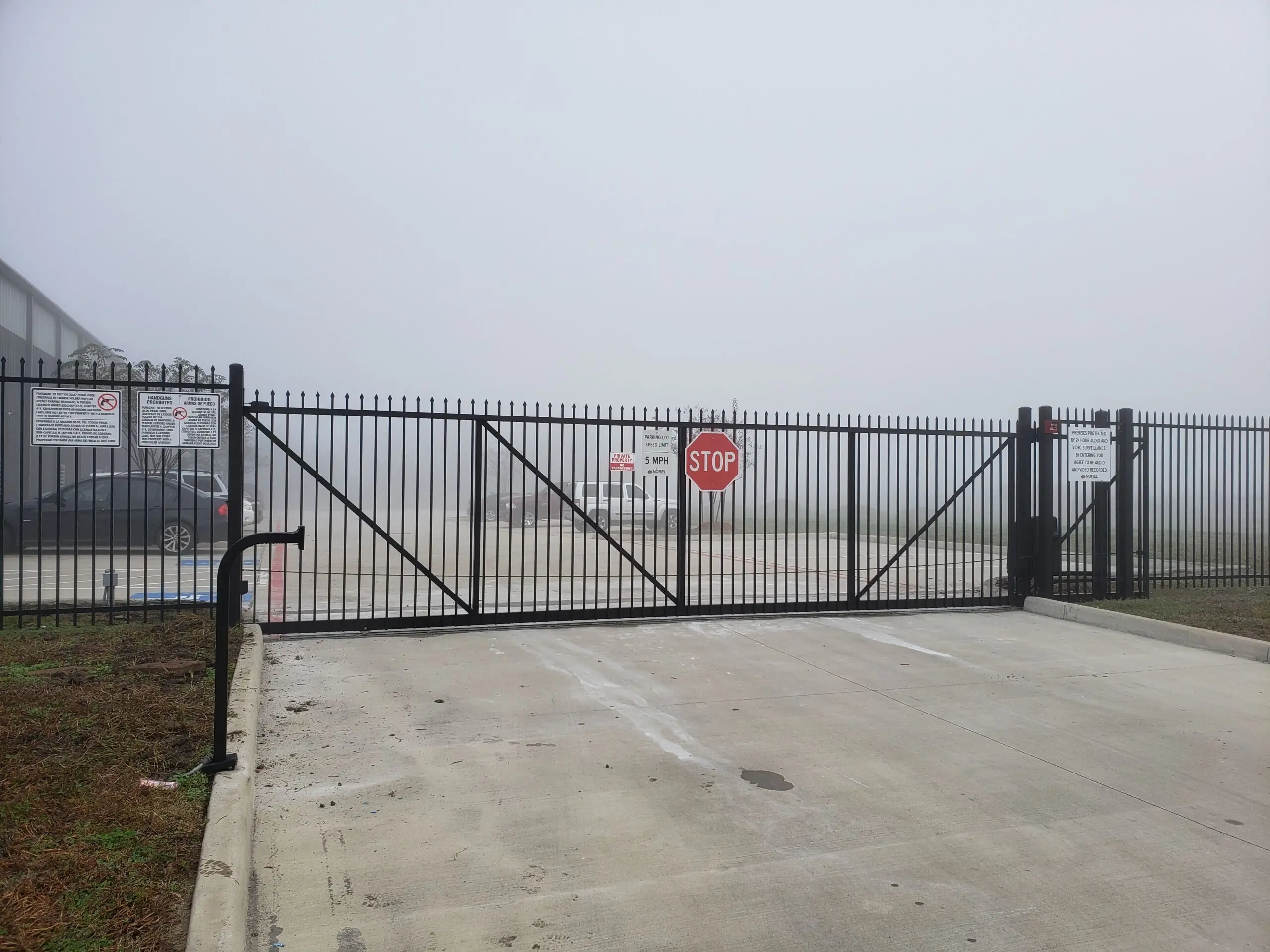
For a Houston-area HOA or gated community, the main gate is both the community’s most visible security feature and one of its highest-liability assets. When a community gate fails — whether it’s stuck open, won’t open for residents, or malfunctions at the worst possible moment — the HOA faces simultaneous problems: unauthorized access while the gate is out of service, resident frustration, and potential liability if the failure was foreseeable and maintenance was deferred.
In Harris County and Fort Bend County — where gated communities span from established neighborhoods in Cypress Forest Lakes and Woodtrace to newer master-planned developments in Katy, Sugar Land, and Pearland — commercial gate failures are among the most common service calls that community management companies field. The good news is that most gate failures are foreseeable, and most liability-creating situations are preventable with a structured approach to gate maintenance and a clear understanding of the fire marshal compliance requirements that many Houston-area HOAs are not meeting.
This guide covers gate failure identification, fire marshal compliance, and the path to modern smart access for Houston and Katy gated communities.
📞 Schedule Fast Gate Repair or Assessment for Your Houston HOA
Nexlar Security provides commercial gate repair and access upgrade services for Houston and Katy-area HOA communities. Contact us for a FREE on-site assessment. 👉 Book Your Free Gate Assessment Today
Why HOA Gate Failures Create Liability in Houston-Area Communities
An HOA gate that isn’t functioning as intended creates liability in multiple directions simultaneously.
When a gate is stuck open — one of the most common failure modes — the community loses its primary controlled-access feature. If an incident occurs involving an unauthorized individual who entered through the inoperative gate, the HOA may face questions about whether the gate failure was known, how long it had been inoperative, and whether reasonable maintenance practices would have prevented it.
When a gate is stuck closed — the less common but more immediately disruptive failure — emergency access is blocked or significantly delayed. Fire departments and emergency medical services attempting to reach a resident inside a gated community through a malfunctioning gate face life-safety delays that both the emergency and the HOA may be held accountable for.
Texas HOA law (Chapter 22 of the Texas Business Organizations Code and applicable community deed restrictions) establishes the community association’s duty to maintain common property — including gate systems — in working order. Documented patterns of deferred gate maintenance, or gate failures that were reported and not addressed promptly, create documented evidence of liability exposure.
How Commercial Gate Systems Work and Fail
A community gate system consists of several integrated components: the gate structure itself (the moving gate panel), the gate operator (the motor and drive mechanism), the control board (which manages operator logic and communication with access credentials), the access control interface (credential readers, keypad, or telephone entry panel), and the entrapment protection system (safety sensors that prevent the gate from closing on a vehicle or person).
Gate failures typically originate in one of these components:
Gate Operator Motor Failure — Motor wear from continuous cycling, heat exposure (a significant factor in Houston summers), or moisture intrusion eventually causes motor failure. This is the most common cause of complete gate inoperability.
Drive Mechanism Wear — Slide gates use a rack-and-pinion or chain drive system; swing gates use a linear actuator or arm drive. Drive mechanism wear causes sluggish operation, irregular movement, and eventually complete mechanical failure if not addressed.
Control Board Failure — Electronic control boards are vulnerable to power surge damage, moisture intrusion, and component aging. Control board failures can cause erratic gate behavior, failure to respond to access commands, or complete inoperability.
Safety Sensor Failure — Entrapment protection sensors can fail in the “triggered” state — causing the gate to refuse to close — or in the “untriggered” state — causing the gate to operate without active entrapment protection, which is both a safety hazard and a code violation.
Identifying Wear in Swing and Slide Gates
Early identification of gate wear allows proactive repair before failure — preventing the liability exposure and resident disruption of an unplanned outage.
Swing Gates — Watch for: slower than normal opening and closing speed; hesitation or jerking motion at the beginning or end of gate travel; unusual sounds from the gate arm or pivot points during operation; sagging of the gate panel causing the bottom to drag on pavement; and visible wear or cracking in rubber pivot seals or arm bushings.
Slide Gates — Watch for: hesitation or stuttering during gate travel (indicating rack or pinion wear); unusual grinding or clicking sounds during operation; gate panels that are out of alignment with the gate post or travel path; visible rust or damage to the gate track; and gate panels that are consistently getting slower to fully open or close.
General Warning Signs — Any gate that requires multiple access attempts before responding, that reverses unexpectedly during operation, that leaves one direction of travel significantly slower than the other, or that has exhibited any component failure within the past 24 months should be proactively serviced rather than operated until the next failure.
Fire Marshal Compliance: Knox Boxes and Emergency Gate Release
Harris County and City of Houston Fire Marshal requirements for gated community vehicle access have specific implications for HOA gate systems that many community boards are not aware of — and not complying with.
Knox Box Requirement — Commercial and community gates that prevent fire department vehicle access to a gated area must have a Knox Box (or equivalent approved emergency access mechanism) at the gate location containing the gate’s emergency key or code. The Knox Box is accessed only by fire department personnel using a master key, allowing emergency vehicles to bypass the access control system during an emergency response without contacting community management or damaging the gate.
Siren-Operated Sensors — Some Houston-area communities use automatic gate operators equipped with siren-operated sensors — devices that detect the siren frequency of an emergency vehicle and automatically open the gate without requiring any other access mechanism. Siren-operated sensors provide an additional layer of emergency access capability and are preferred in some jurisdictions over relying solely on a Knox Box.
Emergency Manual Release — All commercial gate operators must include a manual release mechanism allowing the gate to be operated manually during a power outage. The manual release must be accessible to emergency responders — either through the Knox Box mechanism or a separate, clearly identified emergency release.
NFPA 1 and Local Ordinance Compliance — The specifics of fire marshal gate access requirements in Houston and surrounding Harris and Fort Bend County jurisdictions vary by municipality. Nexlar verifies current local requirements during every gate assessment and designs systems that meet applicable fire marshal standards.
Transitioning to Smart Access for Houston HOA Communities
The gate repair visit is frequently the point at which community boards evaluate whether to simply restore the existing system to function or take the opportunity to upgrade to modern access management technology.
In Houston-area communities like Cypress Forest Lakes, Woodtrace, Cinco Ranch, and other established master-planned communities, the transition from legacy telephone entry systems to cloud-managed smart access platforms is accelerating — driven by the operational limitations of aging systems, resident expectations for modern convenience features, and the availability of cellular and IP-based platforms that work independently of increasingly obsolete landline infrastructure.
Cloud-Managed Access — Modern cloud-managed gate access platforms allow HOA management to update resident directories, issue and revoke guest access codes, review entry logs, and receive gate status alerts from any device — without service technician visits for routine administrative changes.
Video Entry Integration — IP video entry panels at community gates allow residents to see who is at the gate on their smartphone before remotely granting access — the same video verification capability described in the apartment telephone entry section, now standard for upscale Houston HOA communities.
Smart Phone App Access for Residents — Resident mobile apps allow homeowners to open the community gate from their car, issue temporary guest codes to visiting family members, and review their own entry history — significantly improving the resident experience compared to a phone call from a gate entry panel. Nexlar’s HOA security systems for Houston-area communities combine gate access management with the full range of community security infrastructure.
Key Benefits of Proactive Gate Maintenance
Prevention of Liability-Creating Failures — A documented gate maintenance schedule demonstrates that the HOA is meeting its duty to maintain common property — and prevents the foreseeable failures that create the most significant liability exposure.
Extended Gate System Lifespan — Commercial gate operators have design lifespans of 10 to 20 years depending on cycle rating and maintenance. Proactive maintenance — lubrication, alignment checks, component inspection, and early replacement of wearing parts — extends operational life and defers major replacement costs.
Compliance Documentation — Regular maintenance records document fire marshal compliance, safety sensor function testing, and Knox Box verification — supporting the HOA’s compliance posture in any regulatory or legal review.
Cost and Pricing for Gate Repair and Upgrade in Houston
| Service | Estimated Cost Range |
|---|---|
| Emergency Gate Repair (operator/control board) | $400 – $2,500 |
| Gate Operator Replacement | $1,500 – $5,000 |
| Knox Box Installation | $300 – $800 |
| Siren-Operated Sensor Installation | $500 – $1,500 |
| Telephone Entry System Upgrade | $2,500 – $8,000 |
| Full Gate System Replacement + Smart Access | $8,000 – $25,000+ |