

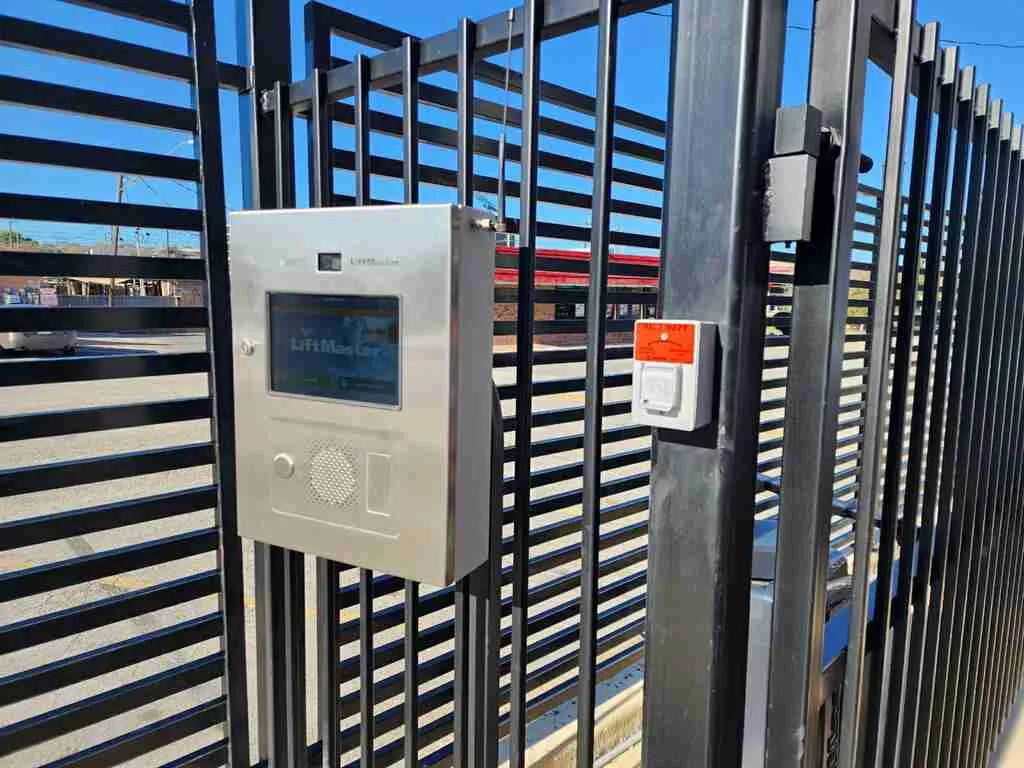
An industrial gate at a Houston refinery, chemical processing plant, or heavy manufacturing facility is not a standard commercial gate. It controls access for tanker trucks, heavy equipment, contractor fleets, and hazmat vehicles — under operational conditions that include continuous 24/7 cycling, exposure to petrochemical environments, Houston’s heat and humidity, and regulatory requirements that simply don’t exist in a standard commercial property context.
Choosing the wrong gate operator, the wrong credential technology, or the wrong access control architecture for an industrial Houston facility creates operational problems — gates that fail under heavy use, credential systems that can’t reliably authenticate vehicles without stopping traffic, and remote management gaps that force on-site staff to manually manage gate access during every shift.
This guide covers what a properly engineered industrial gate access control system looks like for Houston’s manufacturing and energy sector facilities — from gate operator selection through vehicle-level credential technology and remote cloud management.
📞 Get a Free Industrial Security Assessment
Nexlar Security offers FREE on-site consultations for Houston industrial and manufacturing facilities. Our licensed team evaluates your gate operations and designs the right access control solution. 👉 Book Your Free Industrial Site Survey Today
Why Industrial Gate Security Is Different in Houston
Houston’s industrial zone — concentrated in the Ship Channel, Baytown, Pasadena, La Porte, Texas City, and the outer Loop 610 and 610 industrial corridors — operates at a scale and intensity that puts fundamentally different demands on gate access control than a standard commercial property.
High vehicle cycle rates — A refinery or distribution facility may cycle a main gate hundreds of times per shift. Gate operators and hardware rated for light commercial use fail quickly under this demand. Industrial-rated operators with higher cycle-per-day ratings and heavier-duty mechanical components are required.
Mixed access populations — A single facility may need to authenticate permanent employees, rotating contractor crews, tanker truck operators, vendor delivery vehicles, inspection personnel, and emergency response vehicles — each requiring different credential types and access level configurations.
Hazardous environment requirements — Electrical components at facilities classified under NEC Article 500 for hazardous locations must use explosion-proof or intrinsically safe equipment rated for that classification. Standard access control readers and gate control panels cannot be used in these zones.
Remote and unmanned gate operation — Many Houston industrial facilities operate remote gate locations or secondary access points with limited or no on-site staff. Cloud-based remote gate management is not optional in these environments — it is the difference between operational efficiency and a staffing problem.
How Industrial Gate Access Control Systems Work
An industrial gate access control system integrates a heavy-duty gate operator with vehicle-level credential reading capability, a commercial-grade access control panel, and a cloud management platform into a single controlled system.
When an authorized vehicle approaches, a long-range RFID reader mounted at the lane entry reads the vehicle’s RFID transponder — mounted on the vehicle’s windshield or dashboard — from a distance of 10 to 30 feet or more, depending on the reader specification. The reader communicates the credential to the access control panel, which validates it against the facility’s access database and, if authorized, triggers the gate operator to open.
For facilities using License Plate Recognition (LPR), cameras at the lane entry capture and process the vehicle’s license plate — comparing it to an authorized vehicle database — either as a standalone credential or as a secondary verification alongside an RFID transponder.
The gate closes after the vehicle passes through, controlled by vehicle detection loops embedded in the pavement or infrared safety sensors to prevent closing on a vehicle in the gate’s path.
Every gate event — credential presented, access granted or denied, gate open and close — is logged with a timestamp and vehicle credential identifier, creating a searchable vehicle access record that supports both security investigations and operational audit requirements.
Selecting Gate Operators for Heavy-Duty Industrial Use
Industrial gate operators for Houston facilities must be selected for the gate type (slide, swing, barrier arm, or overhead), the gate weight and travel distance, and the required daily cycle rating.
Slide gate operators for heavy industrial slide gates must be rated for the gate’s weight — which can range from several hundred pounds for a light industrial slide gate to several thousand pounds for a large facility gate — and for the number of cycles per day the facility expects. FAAC, HySecurity, and LiftMaster’s commercial and industrial operator lines are commonly specified for Houston industrial installations, with specific model selection driven by gate weight, opening speed requirements, and cycle rate.
For facilities with particularly heavy or wide gates, dual-drive slide gate operators — with motors on both ends of the gate — provide more balanced operation and reduced mechanical stress at high cycle rates.
All commercial and industrial gate operators used in Houston facilities must include battery backup for emergency operation during power outages, and must be configured for emergency egress compliance — allowing the gate to be manually opened by emergency responders using a Knox Box or other approved emergency release mechanism.
Long-Range RFID and LPR: Multi-Factor Vehicle Access
Long-Range RFID Long-range RFID readers at vehicle lanes authenticate vehicles without requiring drivers to stop, lower a window, and present a card to a reader. The vehicle’s RFID transponder — typically a windshield or visor mount unit — is read from the lane approach, and if authorized, the gate begins opening before the vehicle reaches it. This maintains traffic flow at high-volume Houston industrial facilities while maintaining authenticated vehicle access control.
Long-range RFID transponders are typically issued to authorized vehicles — company vehicles, contractor vehicles on approved vendor lists, and regular delivery fleets — and can be deactivated instantly if a vehicle is sold, a contractor relationship ends, or a transponder is reported as lost.
License Plate Recognition (LPR) LPR cameras capture vehicle license plates at the lane entry and compare them against an authorized vehicle database, either as a standalone access credential or as a secondary verification layer alongside an RFID transponder. LPR is particularly valuable for visitor vehicle management — allowing a facility to pre-register an expected visitor’s plate and have the gate open automatically when the visitor arrives, without issuing a physical RFID transponder for a one-time visit.
Multi-Factor Vehicle Authentication For the highest-security industrial facilities, combining RFID transponder validation with LPR plate confirmation creates a two-factor vehicle authentication system — ensuring that an authorized transponder mounted in an unauthorized vehicle cannot be used to gain entry.
Remote Gate Management for Houston Logistics Managers
Cloud-based remote gate management is one of the most operationally impactful capabilities available for Houston industrial facilities, particularly those with remote or unmanned entry points.
Through a cloud management platform, an authorized manager can open or close a gate from any location with internet access, add or remove vehicle credentials, review real-time entry and exit logs, receive alerts for unauthorized access attempts or gate malfunction conditions, and create temporary access credentials for expected visitors — all without being physically present at the facility.
For Houston refinery and industrial operators managing facilities across multiple sites — including remote locations in Baytown, Texas City, or La Porte — centralized cloud management of gate access across all locations from a single platform provides significant operational efficiency compared to managing each facility’s gate system independently. Nexlar’s automatic gate systems for Houston industrial facilities are designed with cloud management and multi-site administration as standard capabilities.
Key Benefits for Houston Industrial Facilities
Unmanned Access Control at Remote Entry Points — Long-range RFID and LPR allow authorized vehicles to access remote or secondary entry points without a guard or staff member managing the gate manually.
Complete Vehicle Access Audit Trail — Every vehicle that enters or exits the facility is logged with credential, timestamp, and in LPR deployments, plate capture — creating a searchable record for security investigations, contractor time verification, and compliance audits.
Instant Credential Revocation — When a contractor relationship ends, a vehicle is sold, or a terminated employee’s vehicle needs to be removed from the authorized list, cloud management allows immediate credential deactivation without hardware changes.
Reduced Guard Staffing at High-Volume Lanes — Long-range RFID enables high-volume authorized vehicle throughput without a guard manually verifying each vehicle — reducing staffing requirements at main entry lanes while maintaining documented access control.
Challenges: Baytown, Pasadena, and Houston Refinery Environments
Houston’s refinery and petrochemical corridor — concentrated in Baytown, Pasadena, and La Porte along the Ship Channel — presents specific environmental challenges for access control hardware:
Corrosive Atmosphere — Proximity to petrochemical processing exposes gate hardware and credential readers to corrosive airborne chemicals that accelerate the deterioration of standard commercial equipment. Equipment with appropriate NEMA enclosure ratings and corrosion-resistant materials should be specified for these environments.
Explosion-Proof Requirements — Areas classified under NEC Article 500 as Class I Division 1 or Class I Division 2 hazardous locations require specifically rated, explosion-proof or intrinsically safe electrical equipment — including access control readers, gate control panels, and associated wiring methods.
Extreme Heat — Houston’s industrial facilities can experience ambient temperatures exceeding 110°F in summer, particularly in areas near processing equipment. All outdoor access control hardware must be specified with temperature ranges appropriate for these conditions.
OSHA and Fire Marshal Compliance for Industrial Gates
OSHA and fire code requirements for industrial facilities impose specific obligations on gate design and access control:
Emergency Egress — Industrial gate systems must not impede emergency egress by employees or emergency responders. All controlled gates must have provisions for emergency manual opening — typically through a Knox Box containing the emergency key or gate code, accessible to firefighters and emergency personnel without requiring facility staff to operate the gate.
Emergency Vehicle Access — Houston Fire Department and Harris County Fire Marshal standards require that vehicle access control systems at industrial facilities not delay emergency vehicle access. Automatic gate systems must include emergency vehicle preemption — typically triggered by emergency vehicle strobes or siren sensors — that opens the gate immediately when an emergency vehicle approaches.
Gate Entrapment Protection — Commercial and industrial vehicle gate operators must include entrapment protection devices — safety sensors or edges that detect an obstruction and stop or reverse the gate to prevent vehicle or pedestrian entrapment.
Industrial Gate System Comparison Table
| Feature | Basic Card-Reader Gate | Long-Range RFID | RFID + LPR Multi-Factor |
|---|---|---|---|
| Driver Must Stop at Reader | Yes | No | No |
| Vehicle Authentication | Card only | RFID transponder | RFID + Plate confirmation |
| Unmanned Operation | Partial | Yes | Yes |
| Cloud Management | Depends | Yes | Yes |
| Visitor Management | Manual | Manual | LPR pre-registration |
| Audit Trail | Basic | Full vehicle log | Full + plate capture |
| Hazardous Location Rating | Not standard | Configurable | Configurable |
Cost and Pricing for Houston Industrial Installations
| Installation Scope | Estimated Cost Range |
|---|---|
| Single Gate + Basic Access Control | $5,000 – $15,000 |
| Single Gate + Long-Range RFID | $10,000 – $25,000 |
| Gate + RFID + LPR (per lane) | $15,000 – $40,000 |
| Multi-Gate Industrial Campus | $40,000 – $150,000+ |
| Explosion-Proof Equipment Premium | $3,000 – $15,000 additional |