

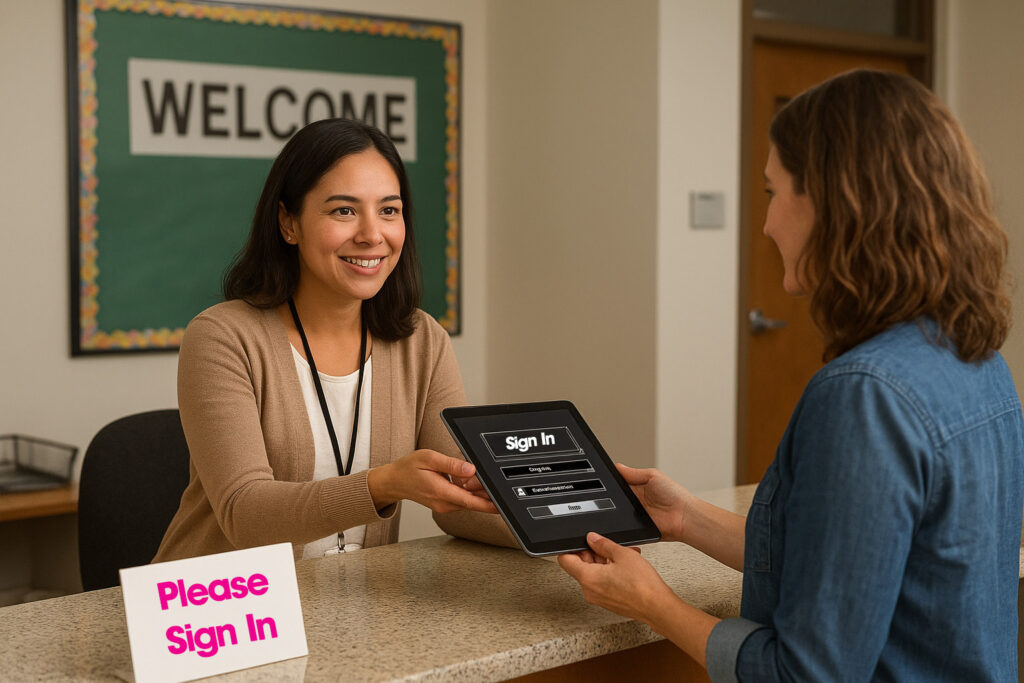
Every school in Texas is legally and morally responsible for knowing who enters the building and verifying that they pose no threat to students. Yet many Houston-area schools still rely on sign-in sheets, manual ID checks at a front desk, and visual identification that provides no systematic verification against threat databases — creating security gaps that can and do result in unauthorized or dangerous individuals reaching students.
Modern school visitor management systems replace these manual processes with systematic, technology-driven verification: driver’s license scanning that automatically checks presented ID against sex offender registries, secure vestibule configurations that control physical access at the building’s primary entry point, and institutional intercom systems that allow front office staff to verify and admit visitors without exposing the building entrance to uncontrolled foot traffic.
This guide walks Houston school administrators, district safety coordinators, and principals through what a properly designed school visitor management system looks like, what it costs, and how Houston-area schools — including those in HISD, Katy ISD, and surrounding districts — are implementing these systems to meet both state safety requirements and evolving security best practices.
📞 Get a Free School Security Assessment
Nexlar Security offers FREE on-site security consultations for Houston-area K-12 campuses. Our licensed team evaluates your visitor entry process and recommends a system that meets Texas safety standards. 👉 Book Your Free Campus Assessment Today
Why Houston Schools Need Modern Visitor Management
Texas law and the Texas School Safety Center establish expectations for school visitor management that go beyond a sign-in sheet at the front desk. Houston-area school districts operate in one of the most diverse, high-traffic urban environments in the country — with large campuses, multiple building entry points, and high daily visitor volumes that make manual verification impractical.
Beyond compliance, the operational reality is direct: a school that cannot verify the identity of every person who enters the building cannot claim to control who has access to its students. Driver’s license-based visitor management with automated sex offender registry checks provides a systematic, documented verification process that manual sign-in cannot replicate.
For Houston public and private schools with significant enrollments and active parent, volunteer, and contractor populations, a visitor management system is the most direct technology investment a school can make to close the gap between the school’s stated security posture and the reality of who enters the building each day.
How School Visitor Management Systems Work
A modern school visitor management system uses a driver’s license or government-issued ID scanner at the front office or secure vestibule entry. When a visitor presents their ID, the system reads the information encoded in the barcode or magnetic stripe and automatically cross-references the visitor’s name and date of birth against one or more registered sex offender databases and, in some deployments, custom watchlists maintained by the school district.
If the verification returns a clear result, the system prints a visitor badge — typically including the visitor’s photo, name, destination, and time of visit — and logs the visit in a searchable database. The entire process takes approximately 30 to 60 seconds.
If the verification returns a match against a sex offender registry or watchlist, the system alerts front office staff — allowing them to deny entry and notify campus security or law enforcement as appropriate — without disclosing the nature of the alert to the visitor.
The visit log maintained by the system provides a complete, searchable record of every visitor who has entered the school — valuable for security investigations, custody dispute situations, and compliance documentation.
Core Components: Vestibules, Scanners, and Intercoms
Secure Vestibule — A controlled entry area between the building’s exterior entrance and the main interior access point. The vestibule creates a buffer zone where visitors can be visually observed and verified by front office staff through a window or video intercom before the interior door is released. The exterior and interior doors of the vestibule cannot both be open simultaneously, preventing unauthorized individuals from following a verified visitor inside.
Driver’s License / ID Scanner — A hardware device that reads the information encoded on the barcode or magnetic stripe of a driver’s license or government ID, populating the visitor management software with accurate identity information rather than relying on manually entered — and potentially inaccurate or falsified — data.
Sex Offender Registry Integration — Automatic, real-time cross-reference of scanned visitor identity information against the Texas Department of Public Safety sex offender registry and, in some systems, national databases maintained by the National Center for Missing and Exploited Children (NCMEC).
Custom Watchlist — A school or district-specific list of individuals who are prohibited from entering the campus — such as non-custodial parents subject to court orders, formerly suspended visitors, or individuals of concern to campus security.
Video Intercom at Vestibule Entry — A two-way video intercom at the exterior vestibule door allows front office staff to see and speak with a visitor before remotely releasing the exterior door — adding a visual identification layer before the visitor even reaches the ID scanner.
Badge Printing — Time-stamped visitor badges with the visitor’s photo and destination communicate visibly that a visitor has been processed and authorized — and make unprocessed visitors immediately identifiable to any staff member who encounters them.
Driver’s License Scanning and Sex Offender Registry Integration
Automated driver’s license scanning with sex offender registry integration is the single most impactful upgrade available to Houston schools still using manual sign-in processes. Here’s why:
Manual sign-in sheets depend on a visitor accurately writing their own name, which is not verified against any database and is trivially falsified. Driver’s license scanning reads the actual encoded identity data — bypassing any possibility of a visitor misrepresenting their name at sign-in.
Sex offender registry checks against manually entered names are unreliable because name misspellings and variations can cause lookups to fail. Barcode-based scanning reads the exact name and date of birth as recorded on the ID, producing consistent, accurate registry matches.
In Texas, registered sex offenders are prohibited by state law from being on school premises without written consent from the school principal. Automated registry integration ensures this legal prohibition is systematically enforced rather than relying on front office staff to recognize offenders by appearance.
Key Benefits for Student and Campus Safety
Systematic, Documented Visitor Verification — Every visitor’s identity is verified and logged against sex offender registries, creating a defensible, documented record of the school’s verification process for every visit.
Deterrence of Unauthorized Entry — The visible presence of ID scanning equipment deters individuals with a reason to avoid identification — providing a deterrent effect beyond the systematic verification itself.
Custody Order Enforcement — For schools managing complex custody situations, the visitor management database can flag specific individuals associated with active custody orders, alerting front office staff when a non-custodial parent attempts to sign in for student pickup.
Faster Visitor Processing — Automated ID scanning and badge printing processes visitors faster than manual sign-in, reducing wait times at the front office during busy arrival and pickup periods.
Searchable Visitor History — The complete, searchable visitor log supports security investigations, law enforcement requests, and compliance documentation.
Common Visitor Management Gaps in Houston Schools
Propped or Unlocked Secondary Doors — A visitor management system at the main entrance is undermined if secondary building entrances are propped open or unlocked during the school day. Physical door hardware control and door position monitoring should accompany visitor management system implementation.
Manual Sign-In as a Backup That Becomes the Default — In high-traffic periods — morning arrival, afternoon pickup — manual sign-in is sometimes used as an overflow process when the visitor management system line backs up. This creates a parallel process with none of the verification benefits. Adequate staffing and hardware at entry points prevent this.
No Badge Check Protocol — A printed visitor badge is only a security measure if staff throughout the building are trained and empowered to challenge visibly badgeless adults. A badge check protocol — with clear staff expectations for challenging unbadged visitors — must accompany the technology implementation.
Katy ISD and Houston-Area School Safety Standards
Katy ISD, one of the largest suburban school districts in the greater Houston area, has been recognized for its systematic approach to school safety — including visitor management protocols that exceed minimum state requirements. Key elements of Katy ISD’s visitor access approach include secure vestibule entry at all campuses, electronic visitor management with driver’s license scanning and sex offender registry integration, and consistent staff enforcement of visitor badge requirements throughout campus buildings.
Houston ISD, Spring ISD, Cypress-Fairbanks ISD, and surrounding Houston-area districts have similarly invested in technology-based visitor management improvements, driven by both state safety requirements and parent community expectations following high-profile school security incidents at Texas campuses.
How to Choose the Right System for Your Houston Campus
Single vs. Multi-Campus Deployment — For Houston school districts deploying across multiple campuses, a district-wide cloud-based visitor management platform with centralized watchlist management and district-level reporting provides significant operational advantages over campus-by-campus deployments with separate databases.
Integration with Existing Access Control — If your campus already has an electronic access control system at the front office and vestibule doors, choose a visitor management system with documented integration capability so that visitor badge issuance can trigger access authorization at controlled doors without a separate manual step.
Registry Depth — Verify which sex offender registries the system checks: Texas DPS registry only, or also national NCMEC and Dru Sjodin databases. Systems that check only the Texas registry may miss offenders registered in other states who have not yet been added to the Texas database.
Emergency Lockdown Integration — Some visitor management systems can be configured to flag active visitors during a lockdown — providing front office staff with an instant list of currently badged visitors during an emergency.
Visitor Management System Comparison Table
| Feature | Manual Sign-In | Basic Digital Log | DL Scanner + Registry Check |
|---|---|---|---|
| Identity Verification | None | None | Automated, documented |
| Sex Offender Registry Check | Manual / None | None | Automated, real-time |
| Visitor Badge Printing | Manual | Manual | Automated with photo |
| Searchable Visit History | No | Limited | Yes, full log |
| Custody Order Flagging | No | No | Yes |
| Audit Trail for Compliance | No | Limited | Yes |
| Deterrence Effect | Low | Low | High |
Cost and Pricing for Houston School Installations
| Configuration | Estimated Cost Range |
|---|---|
| Single-Campus Visitor Management System | $3,000 – $8,000 |
| Multi-Campus District Platform | $15,000 – $50,000+ |
| Vestibule Door Hardware + Intercom | $4,000 – $12,000 |
| Combined Visitor Management + Vestibule | $8,000 – $20,000 |