

HALO vs. Triton Vape Detector: An Honest Comparison
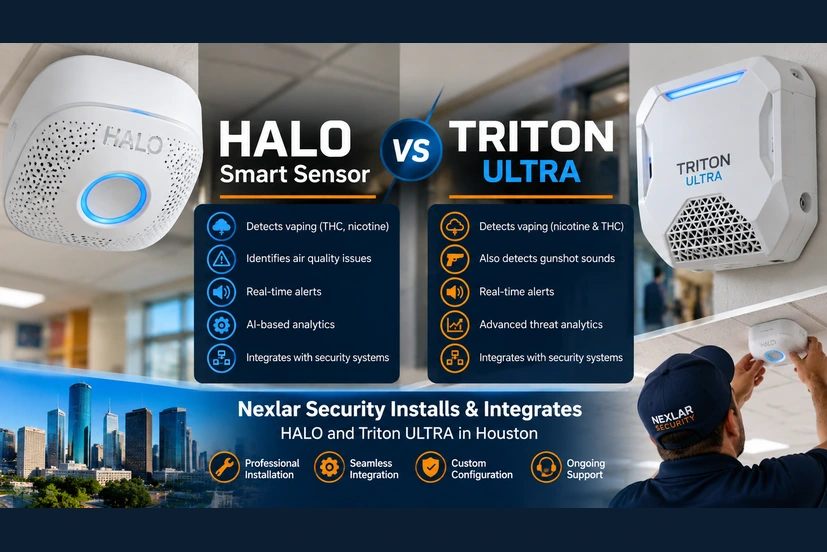
Restrooms and locker rooms are where vaping happens, and they’re also places where cameras aren’t allowed. Camera-free smart sensors were built for those spaces. The HALO Smart Sensor and Triton ULTRA are two of the best-known options. Here’s what each one does, based on the manufacturers’ own published information, and how to choose between them.
Nexlar Security is a Houston security integrator. We design, install and connect vape sensors alongside the cameras, access control and intercom systems you already have.
What they have in common
- – Camera-free and built for privacy areas, with no video and no personally identifiable information (PII)
- – Detect nicotine vaping, smoke and THC, and flag vape-masking attempts
- – Real-time alerts to staff, plus integration with security platforms
- – Extra safety sensing beyond vape detection (sound and aggression, spoken keywords, occupancy)
HALO Smart Sensor at a glance
- – Detection: vape, smoke, THC and vape masking. HALO lists CO2, CO, NO2, VOCs and NH3 among the chemicals it detects.
- – Safety: built-in spoken-keyword alerts (with no audio recording), aggression detection and gunshot detection. HALO states gunshot detection is included on all sensors.
- – Air quality: a live health index and indoor air quality monitoring.
- – Platform: works standalone at the edge. HALO Cloud is optional and adds multi-site management, analytics and reporting.
- – Hardware: IK08 vandal-resistant housing with a tamper alert, plus a programmable LED and speaker.
- – Coverage: HALO says vape sensing typically covers about 144 sq ft at an 8 ft ceiling, and ventilation affects that figure.
Triton ULTRA at a glance
- – Detection: nicotine vape, THC (including synthetic/Delta-8 cartridges, per Triton), cigarette smoke, and masking agents reported separately.
- – Safety: aggression and distress keyword detection, plus mmWave radar occupancy counting and loitering alerts with no camera.
- – Alerts: Triton highlights SMS text alerts and says alerts arrive in about 5 seconds.
- – Integrations: Triton lists Genetec, Milestone, Axis, Hanwha, i-PRO and Verkada.
- – Accuracy: Triton publishes its own test report claiming 98.9% aggregate accuracy. This is manufacturer testing, not an independent study.
| Feature / Capability | HALO Smart Sensor | Triton Sensor |
| Nicotine Vape / Smoke | Yes | Yes |
| THC Detection | Yes | Yes (Organic and synthetic) |
| Vape Masking | Yes | Yes (Reported separately) |
| Keyword / Distress | Yes | Yes |
| Aggression | Yes | Yes |
| Gunshot detection | Yes (included) | Not a headline feature |
| Occupancy | Yes | Yes (mmWave radar, loitering) |
| Air Quality Gases (CO2, CO, NO2, VOCs) | Yes | Not a headline feature |
| Cloud Platform | Optional HALO Cloud | Triton platform |
| VMS Integration | Yes | Genetec, Milestone, Axis, Hanwha, i-PRO, Verkada |
Which should you choose?
- – Choose HALO if you want one device that also covers gunshot detection and detailed air quality (CO2, VOCs), or if you already run HALO Cloud across several buildings.
- – Choose Triton if synthetic-THC detection, radar-based loitering alerts and SMS alerts matter most, or if you run one of the VMS platforms it lists.
- – Either way, results depend on installation: mounting height, airflow, how many sensors each restroom gets, and network and PoE design. Detection is only half the job. The alert has to reach the right person and connect to your cameras at the hallway entrance.
How Nexlar helps in Houston
- – Site survey and sensor placement for each restroom and locker room
- – Low-voltage cabling, PoE and network setup
- – Integration with your cameras/VMS, access control and intercom, so an alert can pull up the nearest hallway camera
- – Ongoing service and support across the Greater Houston area
Frequently Asked Questions
Q: Do HALO and Triton record video or audio?
No. Both are marketed as camera-free. HALO states its keyword detection works without recording audio.
Q: Can they detect THC?
Yes. Both list THC detection. Triton also specifically claims it detects synthetic THC, such as Delta-8 cartridges.
Q: Will deodorant or body spray set them off?
Both vendors say their sensors are designed to reject common aerosols. Triton publishes test results on this. Placement and tuning still matter.
Q: How many sensors does a restroom need?
It depends on size, ceiling height and ventilation. HALO cites about 144 sq ft per sensor for vape detection at an 8 ft ceiling. We confirm the count during a site survey.
Q: Does Nexlar install vape detectors in Houston schools and businesses?
Yes. We install and integrate vape sensors for schools, hotels, healthcare facilities, offices and multifamily properties throughout Houston.
Do You Have A Project
Free quote for your security system or low voltage installation project.
About Us
At Nexlar, security isn’t just a service—it’s our commitment to excellence. As an expert security system company, we are proud to offer a wide range of integrated security system solutions.
Follow Us