

ADA Compliance for Turnstiles: 2026 Facility Guide
If you manage a commercial facility, office building, transit hub, or government property in Texas, you already know that security at entry points is non-negotiable. What many facility managers still overlook, however, is that the way you control access must also meet federal accessibility law. Getting your ada turnstile setup right in 2026 is not just about avoiding legal exposure — it is about building a facility that genuinely serves everyone who walks through your doors.
At Nexlar, we help businesses across Houston, Dallas, San Antonio, Austin, Fort Worth, and San Marcos design and install turnstile access control security systems that are both high-performing and fully compliant. This guide covers everything you need to know.
What the ADA Actually Says About Entry Points
The Americans with Disabilities Act, signed into law in 1990, is a civil rights statute that guarantees equal access to facilities for individuals with physical or mental disabilities. When it comes to ada compliant entry requirements at controlled access points, the law is clear: revolving doors, revolving gates, and turnstiles cannot be the sole means of passage along an accessible route.
Under Section 4.13.2 of the ADA Standards, an accessible gate or door must be provided adjacent to any turnstile or revolving door, designed to facilitate the same use pattern. In practical terms, this means your ada gate requirements include maintaining a minimum clear opening of 32 inches for standard accessible entries. Where openings exceed 24 inches in depth, a 36-inch clear opening is required. These dimensions are not suggestions — they are enforceable federal standards that apply to any facility with 15 or more employees, any place of public accommodation, and all state and local government facilities.
Waist-High Aesthetics — The Most Common Turnstile Setup
Waist-high tripod turnstiles are the most widely deployed option across commercial and institutional facilities. They look clean, manage pedestrian flow efficiently, and integrate smoothly with modern card readers, biometric systems, and mobile credentials. The challenge is that their lane width typically runs around 20 to 22 inches — far too narrow to meet ada compliant turnstile requirements for wheelchair or walker access.
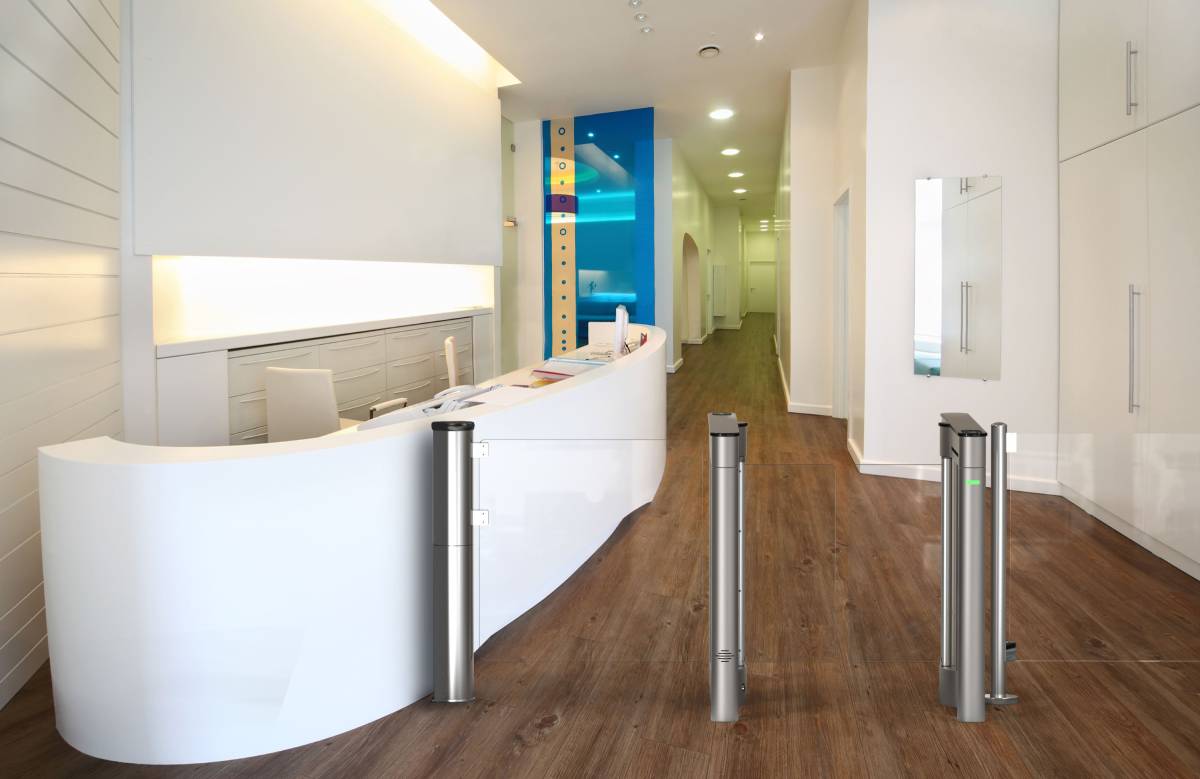
This is why the standard practice when deploying waist-high turnstiles is to pair them with an ADA-compliant swing gate installed directly alongside. The swing gate carries its own access control credential — keycard, fob, or badge reader — so it operates at the same security level as the adjacent turnstiles. There is no compromise in perimeter integrity, and individuals using wheelchairs, canes, walkers, or other mobility aids gain a dignified, independent entry point without being redirected to an inconvenient side entrance.
For facilities that want a streamlined look, matching swing gates that mirror the finish and frame design of the turnstile units are available. This keeps the entry corridor cohesive and professional while checking every box on the ada gate requirements list.
Full-Height Security — When Maximum Control Meets Compliance
Full-height turnstiles are the choice for facilities that need maximum physical deterrence. Correctional facilities, data centers, utility plants, and high-security corporate campuses rely on full-height units because they eliminate the possibility of someone vaulting over or tailgating through a standard waist-high lane. These units stand roughly seven feet tall and create a fully enclosed, one-person-at-a-time passage.
Here too, ada compliant entry standards apply. A full-height ADA gate — sometimes called a full-height swing gate or ADA barrier gate — must be installed as a companion unit in any deployment where the full-height turnstile is the primary controlled access point. These gates meet the same 32-to-36-inch clear opening standard and are designed to be operated by the same access control hardware as the adjacent full-height units. The security level does not drop. The credential requirement does not relax. The gate simply accommodates those who cannot pass through a standard full-height turnstile chassis.
Proper integration of full-height ada turnstile solutions with your broader turnstile access control security systems is something the Nexlar team handles from design through installation and ongoing maintenance.
Best for Employee Entrances — Smart Access That Respects Every Worker
Employee-only entry points carry a specific set of considerations. Unlike public-facing lobby entrances, employee entrances often need to process high volumes of credentialed workers quickly during shift changes while still maintaining tight perimeter control. Many companies assume that because an entrance is not open to the general public, ADA requirements are somehow relaxed. That is incorrect.
Any facility with 15 or more employees is covered under ADA requirements, and service entrances cannot serve as the sole accessible entry unless they are the only entrance to the building. This means employee turnstile lanes at manufacturing plants, warehouses, office buildings, and distribution centers all need an accessible entry option integrated into the same flow.
The best solution we consistently recommend for employee entrances is a lane configuration that alternates standard turnstile lanes with an ADA-compliant lane. This approach prevents the security risk of clustering all the wide, accessible openings in one area while ensuring that no employee with a mobility need is singled out or delayed. When paired with a unified access control platform, every lane — standard and ADA — validates the same credential set.
How Nexlar Designs a Fully Compliant Entry System
When a client brings us into a project, our first step is always a site assessment. We look at the number of entry lanes required, the anticipated daily throughput, the credential technology already in place or preferred, and the physical layout of the entry corridor. From there, we design a turnstile access control security systems configuration that meets traffic demands without creating compliance gaps.
Every ada compliant turnstile installation we deliver is built around the federal clear opening minimums, matched to the existing aesthetic of the facility, and integrated with whatever access control platform the client operates — whether that is a card-based system, biometric readers, mobile credentials, or a combination. We also advise on floor approach clearances and hardware mounting heights for readers and intercoms so that the full entry corridor meets ADA guidelines, not just the gate itself.
Post-installation, we provide maintenance programs that include periodic compliance checks. ADA regulations require that accessible features remain in working order. A gate that has been out of service for weeks without repair can constitute a federal violation. Our maintenance contracts keep that risk off your plate.
Why Choose Nexlar for ADA Turnstile Access Control
At Nexlar, we bring over a decade of hands-on experience installing access control systems for commercial, government, healthcare, educational, and industrial clients across Texas. We are not a hardware vendor that drops equipment and walks away. We are a security technology integrator that designs, installs, and supports end-to-end solutions — which means when you come to us with an ada turnstile compliance challenge, you get a complete answer, not a product catalog.
Our consultants understand both the technical requirements of turnstile access control security systems and the legal framework of ada compliant entry standards. We hold License B14634 and maintain an A-plus BBB rating. Every technician on our team goes through rigorous background checks, and our customer-first approach means you receive the best technology at a price that makes sense for your facility's scale. We have secured more than 1,000 businesses, and we are ready to help you build an entry system that is secure, accessible, and fully compliant heading into 2026.
Frequently Asked Questions About ADA Turnstile Compliance
Q. What are the basic ada compliant turnstile requirements for my facility?
At minimum, your facility must provide at least one accessible entry point that is not a revolving door or standard turnstile. That accessible entry — typically a swing gate — must have a clear opening of at least 32 inches, or 36 inches where the opening depth exceeds 24 inches. It must operate with the same security credential as adjacent turnstile lanes and must be maintained in working order at all times.
Q. Can I use a standard turnstile as part of an ADA compliant entry system?
Yes, but not as the sole means of access. Standard waist-high and full-height turnstiles are acceptable when they are accompanied by a properly sized, credentialed ADA swing gate that provides equivalent access to the controlled area.
Q. What are the ada gate requirements for a swing gate next to a turnstile?
The gate must provide a minimum 32-inch clear opening, must be operable with one hand without tight grasping or twisting, and must be positioned along the same accessible route as the primary entry point. The gate's access control hardware must function at the same security level as the adjacent turnstile lanes.
Q. Does ADA apply to employee-only entrances?
Yes. Any facility covered under the ADA — including those with 15 or more employees — must ensure that employee entrances are accessible. Service or side entrances cannot serve as the sole accessible route unless they are the only physical entrance to the building.
Q. What happens if my accessible gate is broken and out of service?
Under federal ADA guidelines, accessible features must be maintained in working order. Extended periods of non-functional accessible entry can constitute a violation. This is why Nexlar offers maintenance contracts that include regular compliance checks and prompt repair response for all turnstile access control security systems.
Q. How do I know if my existing turnstile setup meets 2026 ADA standards?
The best way is a professional site assessment. Nexlar offers free onsite consultations where our security consultants evaluate your current configuration against current ada compliant entry standards and ada compliant turnstile requirements, then provide a clear remediation plan if needed.
Q. Are ada turnstile gates compatible with biometric and mobile credential systems?
Absolutely. Modern ADA swing gates integrate seamlessly with virtually every major access control platform, including card readers, biometric scanners, mobile credential apps, and intercom systems. Nexlar ensures full integration during installation so that every lane in your facility — standard and accessible — operates on the same unified system.
Follow Us